Table of Contents
- Introduction
- 📋 Key Takeaways
- What You Need Before You Start
- Step 1: Map Where Your Customers Actually Spend Time
- Step 2: Rank Channels by Fit and Opportunity
- Step 3: Test Each Channel With a Small Budget
- Step 4: Measure Results and Decide What to Scale
- Step 5: Scale Winners and Optimize Continuously
- Common Mistakes to Avoid 🚨
- ✅ Quick Action Checklist
- Ready to Improve Your Channel Strategy?
- Frequently Asked Questions
- Additional Resources
- Take the Next Step
TL;DR: Most Kenyan business owners pick marketing channels by guessing or copying competitors, then wonder why money disappears with no results. The right way is simple: know who your customer is, where they actually spend time online, test small, measure everything, and scale only what works. This article walks you through a five-step process to choose channels that deliver real revenue, not just activity.
Introduction
You have a budget for marketing. Maybe it is KES 50,000 a month, maybe KES 500,000.
Either way, you want it to work. But most Kenyan business owners I meet have made the same mistake. They picked their marketing channels without really thinking about it.
They saw Facebook ads working for a competitor in Nairobi, so they tried Facebook. They heard Google is where people search, so they started Google Ads.
They read that TikTok is growing, so they posted there too. None of it moved the needle, and the money just disappeared.
The problem is not that these channels do not work. They do, for the right business.
The problem is that you picked them without knowing if your customers are actually there.
This guide teaches you how to choose marketing channels the right way. It is not based on trends or what your competitor is doing.
It is based on where your actual customers spend their time and which channels will deliver return on investment for your specific business. Use this marketing channels template kenya to track your decisions as you work through this guide.
📋 Key Takeaways
- Your customer’s behaviour, not industry trends, determines which channels work for you.
- Test channels with small budgets first, then scale only the ones that deliver measurable results.
- Track every shilling spent and every result you get, so you know exactly what is working.
- The best channels for a Nairobi e-commerce store are different from the best channels for a Mombasa service business.
- Review your channel performance every month and be ready to shift budget away from channels that stop working.
What You Need Before You Start
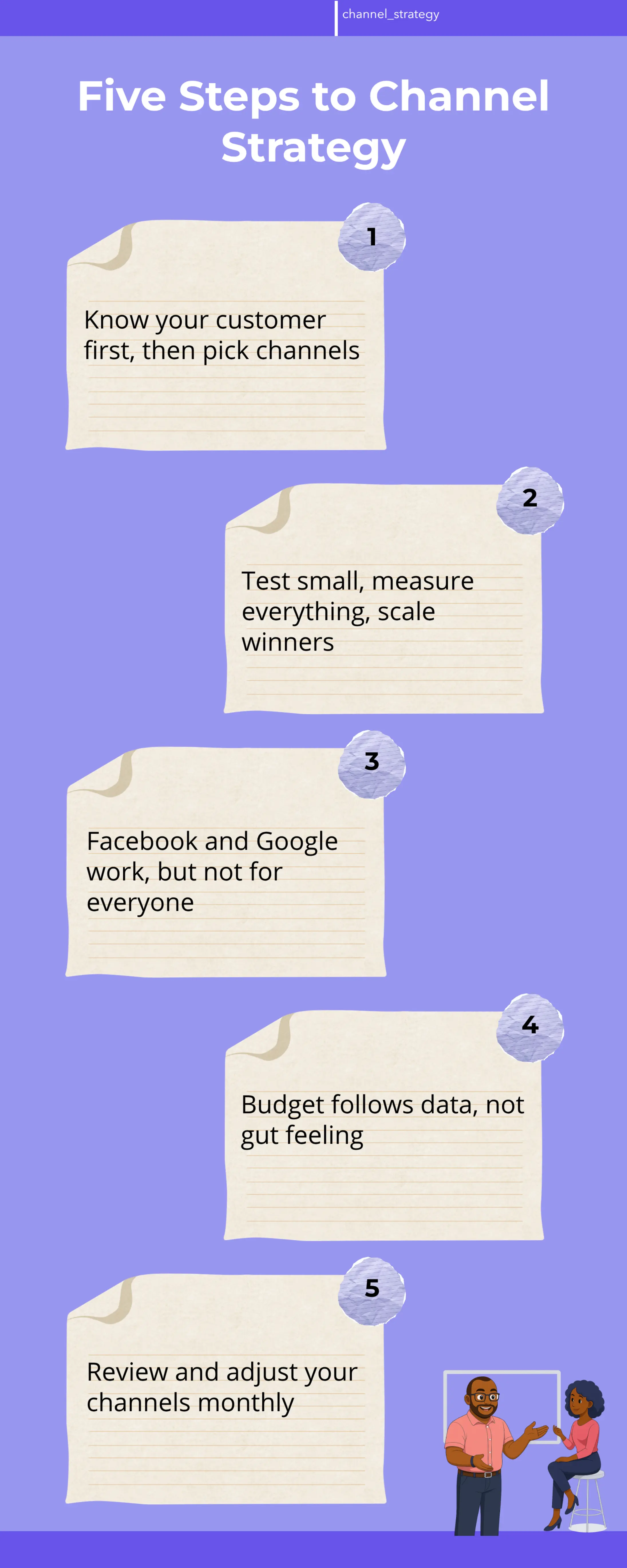
Before you pick a single channel, you need to have done some foundational work. Skip this and you will make expensive mistakes later.
Understand Your Customer
Who is your ideal customer? Not “everyone in Kenya.”
Be specific. What is their age, income level, location, and job?
If you sell high-end furniture in Nairobi, your customer is probably a business owner or professional aged 35-55 with disposable income. If you run a digital marketing training course, your customer might be a young entrepreneur aged 25-35 who spends time on LinkedIn and Instagram.
Write this down. Be as specific as you can.
Know Your Business Model
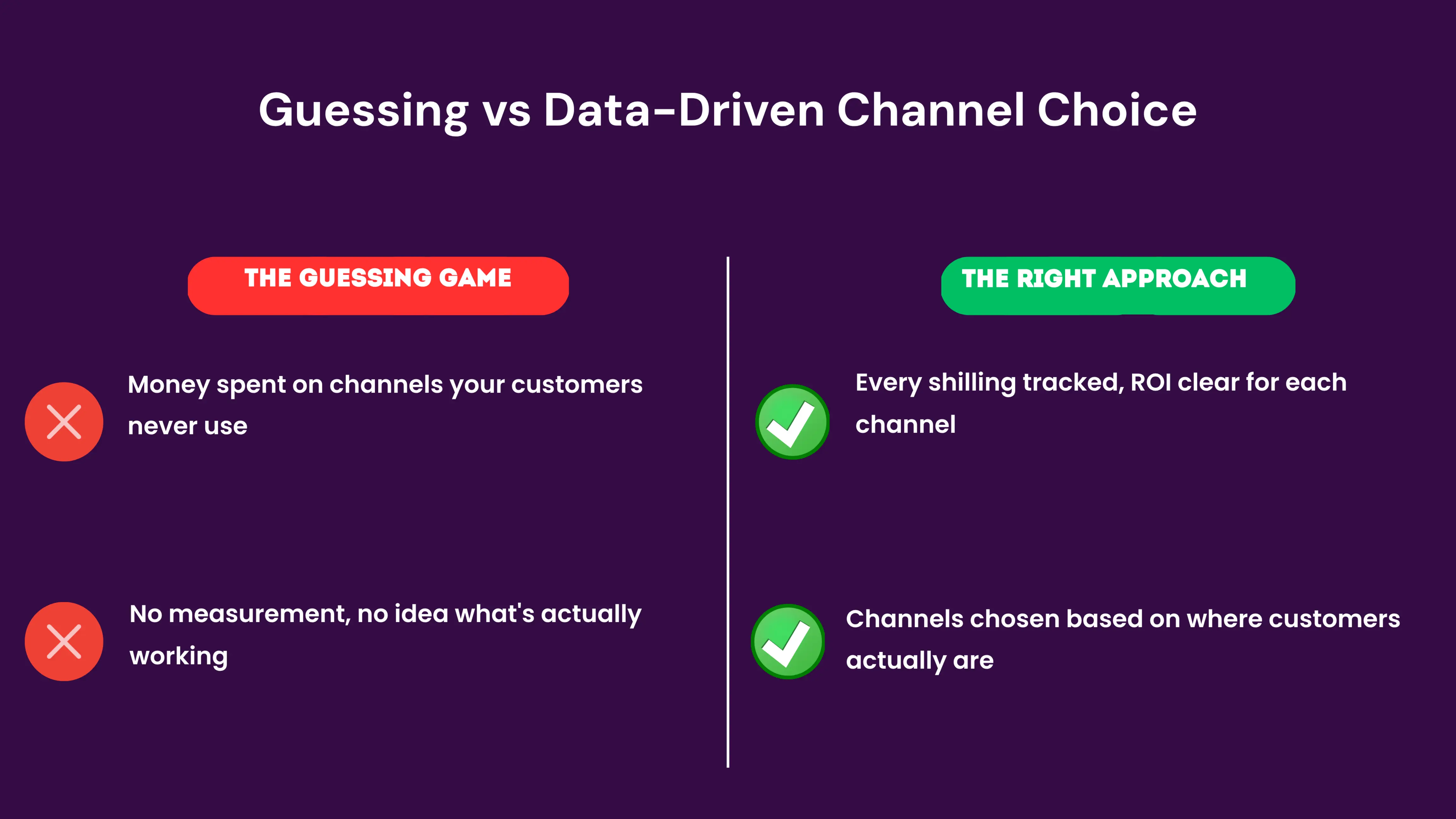
Are you selling a product or a service? Is the sale quick, like a meal delivery, or long, like a real estate transaction?
Do customers buy on impulse or after research? This matters because it tells you which channels will work.
Impulse purchases work well on social media ads. High-consideration purchases, like a business consulting service, work better on search and email automation for kenyan businesses converting leads while you sleep.
Set a Realistic Budget
How much can you actually spend on marketing each month? Be honest.
Most Kenyan SMEs allocate between 5-15% of revenue to marketing, but you might be different. Write down your total monthly budget.
Decide how much of that you will spend on testing new channels versus scaling channels that already work. A good split is 70% on proven channels and 30% on testing.
Once you settle on your top channels, set up social media automation consistency without burnout so you stay consistent without spending all day on it.
Step 1: Map Where Your Customers Actually Spend Time
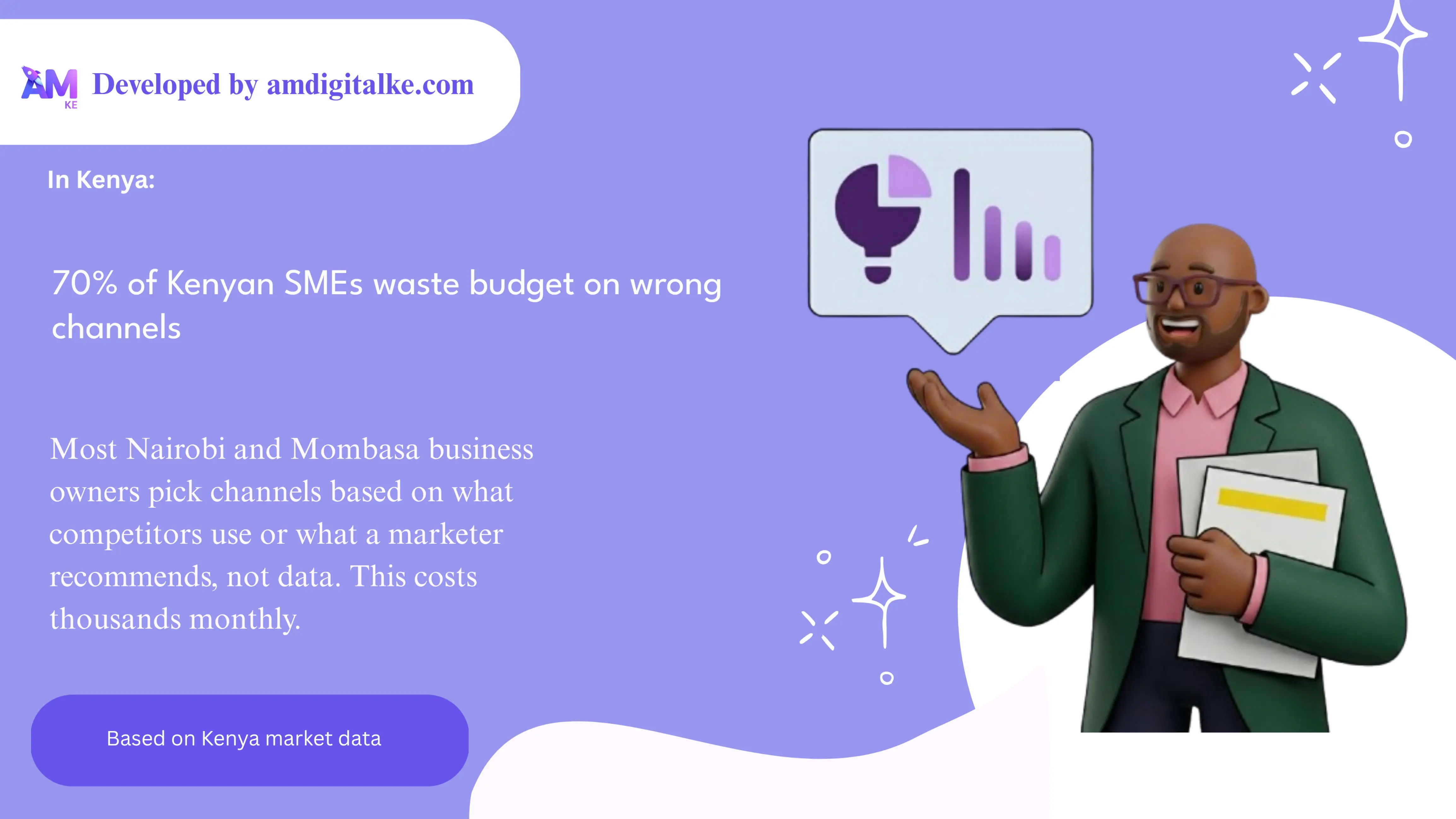
This is the most important step. You must know where your customers are online before you pick a marketing channel.
Do Customer Research
Ask your existing customers where they spend time online. Call them, send them a WhatsApp message, or run a quick Google Form survey.
Ask: “Where do you usually see ads or content online?” and “Which app or website do you visit most often?”
You will get real answers. A Nairobi graphic designer might learn that most clients find them through LinkedIn or Instagram.
A Mombasa tour operator might discover that customers use Facebook and Google Search instead.
Talk to at least 10-20 customers if you can. You need patterns, not just one person’s opinion.
Look at Your Existing Data
If you already have a website, check your Google Analytics. Where are your visitors coming from: search, social media, direct, email, or referral?
If you already have customers, find out where they discovered you. Keep a simple spreadsheet for the next month and record it for each new customer.
This data is gold. It tells you which channels already work for you, even if you are not actively marketing there.
Study Your Competitors
Look at what channels your direct competitors use. Do this to understand what works in your market, not to copy them.
If a competitor is running successful Facebook ads, that tells you Facebook is worth testing. If all the top players in your industry are on LinkedIn, that signal is worth attention.
Check their social media pages, search for their ads on Google, or ask customers where they see competitors advertised. A plumber running a service area business seo ranking without a physical location strategy in Nakuru shows what is possible for local trade businesses.
Step 2: Rank Channels by Fit and Opportunity
Now that you know where your customers are, rank the channels by fit and opportunity. This tells you where to put your money first.
Create a Scoring Matrix
Make a simple table with three columns: Channel, Customer Fit (score 1-10), and Opportunity (score 1-10). Score each channel based on how many customers use it and how much potential it holds for your business.
Here is an example for a Nairobi digital marketing training business:
| Channel | Customer Fit (1-10) | Opportunity (1-10) | Total Score |
|---|---|---|---|
| 9 | 8 | 17 | |
| Google Search | 8 | 9 | 17 |
| 7 | 6 | 13 | |
| 6 | 7 | 13 | |
| TikTok | 3 | 5 | 8 |
| 8 | 9 | 17 |
The channels with the highest total scores are your priorities. In this example, LinkedIn, Google Search, and Email tie for first place, so they get your budget first.
Identify Your Top 3-4 Channels
Do not try to be everywhere. Pick your top 3-4 channels based on your scoring matrix and focus there.
Spreading budget across 10 channels gives each one too little to test properly. Concentrating on 3-4 channels lets you test properly and move fast. A Kisumu retail shop that pairs paid ads with content marketing services kenya businesses trust often sees faster, more consistent results than one that scatters its spend.
Step 3: Test Each Channel With a Small Budget
Now it is time to test. Do not commit your entire budget to a channel yet.
Test with a small amount first.
Set a Testing Budget Per Channel
If your monthly budget is KES 100,000 and you have 4 top channels, allocate KES 5,000-10,000 to each channel for testing. Run the test for at least 2-4 weeks so you get enough data to decide.
The goal of testing is not massive results. It is to understand how the channel works and whether it delivers for your business.
Create Clear Success Metrics for Each Channel
Before you spend a shilling, decide what success looks like for each channel. Do you want website visits, leads, phone calls, or sales?
For Google Search, success might be: “Get 50 website visits for KES 5,000 or less” (cost per visit of KES 100). For Facebook, it might be: “Get 20 qualified leads for KES 5,000 or less” (cost per lead of KES 250).
Write these down. You will use them to decide whether to scale or stop.
Run the Test and Track Everything
Set up tracking for each channel. Use Google Analytics for website traffic, UTM parameters for links, and conversion tracking for leads and sales.
If you are not sure how to set this up, ask your web developer or a digital marketer for help. This is too important to guess on.
Record results every day: how much you spent, how many clicks you got, how many leads or sales came in, and your cost per result.
Step 4: Measure Results and Decide What to Scale
After 2-4 weeks of testing, you will have data. Now you make a decision: scale the winners, kill the losers, or test a different approach.
Calculate Your Cost Per Result
For each channel, divide total spend by total results. If you spent KES 10,000 on Google Search and got 50 website visits, your cost per visit is KES 200.
If you spent KES 10,000 on Facebook and got 5 leads, your cost per lead is KES 2,000. Now you can compare channels fairly.
Compare Against Your Benchmark
Compare your actual cost per result against the target you set. If Google Search costs KES 200 per visit and your target was KES 100, that channel is not ready to scale yet.
But if Facebook delivers leads at KES 2,000 and your target was KES 2,500, that is a winner. Scale it. If you are still unsure which channel type performs better for your industry, this seo vs google ads comparison breaks down the tradeoffs.
Decide Your Next Move
For channels that hit their targets, increase budget by 25-50% next month. For channels that missed badly, stop them or test a different approach.
Try a different audience, creative, or offer. For channels that were close, run another test with small adjustments and see if you can improve the results.
Step 5: Scale Winners and Optimize Continuously
Once you have identified channels that work, it is time to scale. Scaling does not mean doubling your budget overnight.
Increase Budget Gradually
If a channel worked at KES 10,000 a month, try KES 15,000 next month. If that works, go to KES 20,000.
Keep increasing until you hit diminishing returns, when cost per result starts going up. Many Kenyan business owners scale too fast and burn out a channel.
Test New Variations Within Winning Channels
Once a channel works, do not run the same ad forever. Test new headlines, images, offers, and audiences to improve results further.
A Nairobi e-commerce business might find Facebook ads work, then test different product categories to see which gets the best return. A Mombasa service business might test different audience segments on Google Search.
Keep a Monthly Review Habit
Set a calendar reminder for the first Monday of each month. Pull your data, calculate cost per result for each channel, and decide what to do next.
Markets change fast. What works in January might not work in June, so a monthly review keeps you ahead. This habit fits well into broader marketing workflows that scale your kenyan business.
Common Mistakes to Avoid 🚨
I see these mistakes over and over with Kenyan business owners. Learn from them so you do not waste money.
Picking Channels Based on Trends Instead of Data
TikTok is hot right now, so everyone wants to be on TikTok. But if your customers are 45-year-old business owners in Nairobi, TikTok is not where they are.
You will waste money chasing trends instead of customers. Pick channels based on your customer, not what is trending.
Not Tracking Results Properly
You cannot improve what you do not measure. If you are not tracking spend and results, you are flying blind.
Set up tracking from day one. Use Google Analytics, UTM parameters, and a simple spreadsheet, or start with our how to use marketing channels template kenya to keep your numbers organized.
Testing Too Many Channels at Once
If you test 8 channels with KES 100,000, each channel gets KES 12,500 and you get weak data. If you test 3 channels with KES 100,000, each gets KES 33,000 and you get strong data.
Focus beats breadth. Pick 3-4 channels and test them properly.
Giving Up Too Fast
Some channels take time to warm up. Google Search might be slow in week one but strong in week three.
Facebook might have high costs at first but improve as the algorithm learns. Give each channel at least 2-4 weeks of testing before you kill it.
Scaling Without Optimizing
A channel that works at KES 10,000 will not always work the same way at KES 50,000. Sometimes scaling reveals problems.
Scale gradually, test variations, and optimize as you go. Do not throw more money at a channel and hope.
Ignoring Email and Owned Channels
Most Kenyan business owners obsess over paid channels like Facebook and Google. But email and your own website are often your cheapest and most effective channels once you have customers.
Do not ignore owned channels. Build your email list, nurture existing customers, and reduce your dependence on paid ads.
✅ Quick Action Checklist
- ☐ Write down your ideal customer: age, income, location, job, pain points.
- ☐ Ask 10-20 existing customers where they spend time online.
- ☐ Check your Google Analytics to see where your current traffic comes from.
- ☐ Create a scoring matrix for 5-6 channels and identify your top 3-4.
- ☐ Set a testing budget for each top channel (start with KES 5,000-10,000 per channel).
- ☐ Set up tracking: Google Analytics, UTM parameters, and a results spreadsheet.
- ☐ Run a 2-4 week test for each channel and record cost per result.
- ☐ Scale winners by 25-50% and kill or retest losers next month.
Ready to Improve Your Channel Strategy?
Choosing the right marketing channels is a process, not magic. Research, test, measure, then scale.
Most Kenyan business owners skip the first three steps. Then they wonder why their budget disappears. If you want a shortcut, see how to use marketing channels template kenya to speed up the process.
Follow this guide and you will know exactly which channels work for your business. That clarity is worth thousands in saved budget every month.
Frequently Asked Questions
How long should I test a channel before deciding to kill it?
Test for a minimum of 2-4 weeks, with at least KES 5,000-10,000 spent. One week is not enough data.
Channels need time to warm up, especially search and email. If results are still bad after 4 weeks, stop or try a different approach.
Is it okay to use just one marketing channel?
It is not ideal, but it beats spreading too thin. One strong channel beats five weak ones.
Once one channel works and scales, test a second to reduce risk. If that channel stops working, you have a backup.
Should I use the same channels as my competitors?
Not automatically. Your competitors might use channels that do not fit your business.
Use competitor channels as a signal to test, but only if your customer research shows your customers are there too. Data beats copying.
What if I have a very small budget, like KES 10,000 a month?
Pick one channel and test it properly for a full month. Do not split KES 10,000 across five channels.
Once you prove one channel works, scale it, then test a second. Small budgets require focus, not breadth. Tools like whatsapp business automation answering customer questions 24 7 can stretch a small budget further.
How often should I review my channel performance?
Review monthly at minimum. Pull your data on the first Monday of each month.
Calculate cost per result for each channel and decide what to do next. Markets change fast in Kenya, so monthly reviews keep you agile.
Additional Resources
- Smart Automation Services – Once you pick your channels, learn how automation keeps them running without adding to your workload.
- What is Search Engine Marketing – If search came up as a strong option for your business, read this before you commit budget to it.
- Digital Marketing Agency in Kenya – Not sure you have time to manage the channels you just chose? See what handing it over to a local agency looks like.
- Which Chess Piece Is Your Business Quiz – Take this quiz to see how your business position should shape the channel strategy you build.
- SEO Checklist for Kenyan Businesses – Chose SEO as one of your channels? Use this checklist to set it up correctly from the start.
- Top SEO Agency In Kenya Vs AM Digital KE: How To Choose The Right One – Comparing agencies to help run your chosen channels? This breaks down what to look for before you hire.
Take the Next Step
Channel strategy is just the beginning. Once you know which channels work, you need to optimize them for maximum return.
We have created a complete guide to help you track, test, and improve every marketing channel you use. Pair it with lead capture automation never miss a potential customer so no interested buyer slips through.
Download the Channel Optimization Guide for Kenyan Businesses. Start getting measurable results from every shilling you spend on marketing.