Table of Contents
- 📋 Key Takeaways
- What is Search Engine Marketing?
- Why Does Search Engine Marketing Matter for Kenyan Businesses?
- How Search Engine Marketing Works 🔍
- Search Engine Marketing Examples in Kenya 🇰🇪
- Common Mistakes to Avoid ⚠️
- SEM vs. Other Marketing Channels
- ✅ Quick Action Checklist
- Ready to Improve Your Search Engine Marketing?
- Frequently Asked Questions
- Additional Resources
- Take the Next Step
TL;DR: Search engine marketing (SEM) means getting your business in front of customers who are actively searching for what you sell on Google. It has two main parts: paid ads (Google Ads) that show up immediately at the top of search results, and organic results (SEO) that build authority and traffic over time. For Kenyan businesses, SEM is one of the fastest ways to reach customers with buying intent. It only works if you target the right keywords and measure what actually happens after the click, and you can check where your site stands for free before deciding where to invest.
📋 Key Takeaways
- Search engine marketing combines paid search ads and organic SEO to capture customers actively searching for your products or services
- Paid search (Google Ads) gets you results immediately; organic search (SEO) builds sustainable traffic over months but costs less per click long-term
- Kenyans search for local solutions daily, meaning your competitors are already bidding on keywords your customers use
- SEM only works if you target the right keywords and measure conversions, not just clicks or impressions
- Most Kenyan businesses fail at SEM because they spend money without understanding who they’re reaching or what action they want them to take
What is Search Engine Marketing?
Search engine marketing is getting your business in front of people who are actively searching for what you sell. It happens at the exact moment they are searching for it.
That is the entire concept.
There are no brand awareness campaigns here. SEM is about reaching people with intent right now.
The Two Pillars of SEM
SEM has two parts: paid search and organic search.
Most people confuse these. Let’s be clear about each one.
Paid search is Google Ads. You write an ad, choose which keywords trigger it, and set a budget.
When someone in Kenya searches “plumber Nairobi” and you have an ad for your plumbing business, your ad appears at the top of Google in a box labeled “Ad.” If they click it, you pay Google a fee. This usually ranges between 10 shillings and 500 shillings per click depending on how competitive the keyword is.
Organic search is SEO. You publish content on your website and optimize it for keywords people search.
Over time, Google ranks your pages higher in the search results. When someone finds you through organic search, Google doesn’t charge you.
You already paid the cost upfront through content creation and optimization work. Both are search engine marketing.
Both put you in front of searchers. The difference is timing and cost structure.
Why It’s Called “Marketing”
SEM is marketing because it reaches customers where they are, not where you hope they’ll be.
It’s the opposite of traditional advertising. There, you put a billboard on the highway and hope the right person drives past.
In SEM, the customer is already looking. Your job is to show up, be clear about what you offer, and make it easy for them to click or call.
Why Does Search Engine Marketing Matter for Kenyan Businesses?
Kenya’s internet penetration is growing fast. More Kenyans search online daily than ever before.
That means your customers are searching right now, whether you’re showing up or not.
If you run a salon in Westlands, a restaurant in Mombasa, a plumbing service in Kisumu, or an accounting firm in Nairobi, people in your city are searching for you on Google every single day. Your competitor might already be bidding on those keywords.
Customers Are Ready to Buy
When someone searches “best accountant in Nairobi” or “where to buy phone repairs in Mombasa,” they are not browsing.
They have a problem and they want a solution now.
This is different from social media marketing. There, someone might see your post while scrolling and think “maybe I’ll try that later.”
Search is immediate intent. The person searching is a qualified lead.
You Only Pay for Real Attention
With paid search, you don’t pay for impressions or views.
You only pay when someone actually clicks your ad and lands on your website.
This is powerful for Kenyan SMEs with tight budgets. You can spend 5,000 shillings per month and only pay for clicks from real people in your area searching for your service.
There is no waste on people who will never buy from you.
It’s Measurable and Controllable
Unlike traditional marketing, SEM gives you complete visibility into what is working.
You can see exactly how many people clicked your ad and where they came from. You can also see what they did on your website and whether they converted to a customer or inquiry.
Based on AM Digital KE client data across Kenyan accounts, businesses that track SEM properly improve their conversion results within three months just by stopping what doesn’t work.
Local Businesses Compete on Even Ground
In Kenya, a small salon can outbid a large salon for the keyword “hair salon Karen” if the small salon understands SEM better.
You don’t need a huge marketing budget to win on search.
You need to understand which keywords your customers use and which ones convert to sales. You also need to know how to optimize your ads and landing pages for those keywords.
How Search Engine Marketing Works 🔍
Let’s walk through exactly what happens when someone searches and how you show up in those results.
The Search Process
A customer in Nairobi opens Google and types “best pizza Westlands.” Google instantly scans its index of billions of pages to decide which results are most relevant.
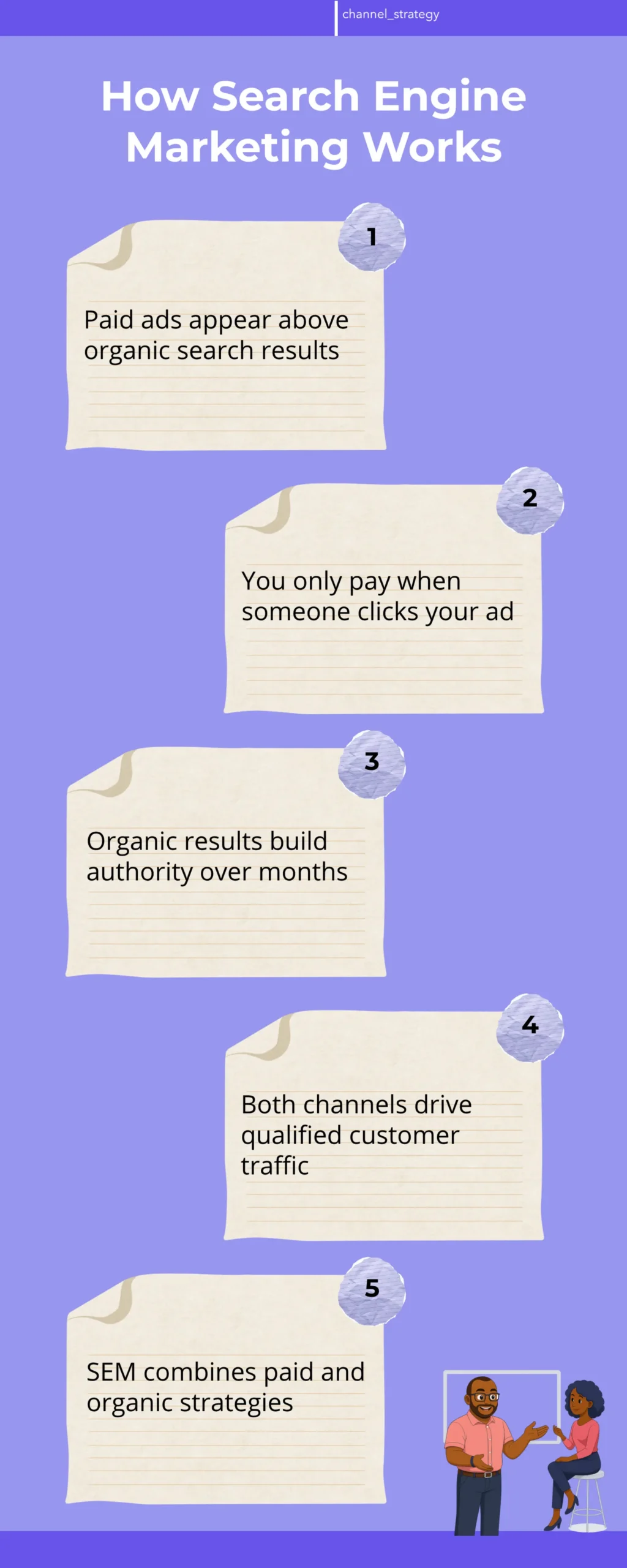
At the very top of the results page, there are usually 2-4 paid ads (Google Ads). These are businesses that have bid on the keyword “best pizza Westlands” and set their ads to show in Nairobi.
Below those, there are 10 organic results. These are websites that Google’s algorithm has ranked as most relevant based on content quality, authority, and relevance.
How Paid Search (Google Ads) Works
You create an ad in Google Ads. The ad has a headline, description, and a link to your website.
You tell Google which keywords should trigger your ad. Examples include “pizza Westlands,” “best pizza in Nairobi,” and “pizza delivery Westlands.”
You set a daily budget. You also set a maximum bid, which is the most you’re willing to pay per click.
When someone searches one of your keywords, Google decides which ads to show based on bid amount and ad quality.
If your ad shows and someone clicks it, they land on your website and you are charged the bid amount. If no one clicks, you pay nothing.
This is called pay-per-click or PPC.
How Organic Search (SEO) Works
You publish content on your website. You write blog posts and optimize your product pages.
You also make sure your website is fast and mobile-friendly. You build authority by getting other websites to link to you.
Google’s algorithm crawls your website, reads your content, and decides if it’s relevant and high-quality.
Over weeks and months, if you do this right, your pages start ranking higher for your target keywords.
Unlike paid search, you don’t pay per click. You pay for the work of creating and optimizing content.
Once you rank, the traffic is free.
The Keyword is the Center of Everything
A keyword is the phrase someone types into Google. “Plumber Nairobi,” “accounting services Kenya,” and “best salon Mombasa” are all keywords.
In SEM, you don’t just pick random keywords. You research which keywords your customers actually search for and which ones have commercial intent, meaning people are searching because they want to buy or hire.
You also need to know which keywords you can realistically rank for or bid on affordably.
Search Engine Marketing Examples in Kenya 🇰🇪
Let’s look at real examples of how SEM works for different types of Kenyan businesses.
A Nairobi Plumbing Service Using Paid Search
A plumber in Nairobi sets up Google Ads and bids on keywords like “emergency plumber Nairobi,” “burst pipe repair,” and “plumber near me.” Their daily budget is 3,000 shillings.
A homeowner in Kilimani has a burst pipe at 8 PM on a Sunday. They search “plumber Nairobi emergency” and the plumber’s ad appears at the top of the results.
The homeowner clicks, calls the number on the website, and books a service. The plumber pays 150 shillings for that click and makes 15,000 shillings on the job.
That is SEM working perfectly. The plumber only paid for a click from someone with immediate buying intent.
A Mombasa Restaurant Building Organic Search Authority
A restaurant in Mombasa publishes blog posts about Swahili cuisine, local ingredients, and dining recommendations.
They optimize their website for keywords like “best restaurant Mombasa,” “Swahili food near me,” and “where to eat in Mombasa.”
After four months of consistent content and optimization, they start ranking in the top three results for “best restaurant Mombasa.” Now, every day, people searching for restaurants in Mombasa find them through organic search without the restaurant paying per click.
The restaurant spent money upfront on content creation. Now they get free traffic for months.
A Nairobi E-Commerce Store Using Both Paid and Organic
An online store selling phone accessories in Nairobi runs Google Ads for high-intent keywords like “buy phone charger online Kenya” and “iPhone screen protector Nairobi.”
They spend 10,000 shillings per day and make 80,000 shillings in sales.
At the same time, they publish content about phone care and comparisons of phone accessories. They also share buying guides.
Over time, their content ranks organically for related keywords, bringing in additional free traffic. The paid search gets immediate revenue, and the organic search builds long-term, sustainable traffic.
Together, they create a reliable customer acquisition machine.
A Kisumu Accounting Firm Using Local SEM
An accounting firm in Kisumu wants to reach small businesses in the region.
They bid on keywords like “accountant Kisumu,” “tax preparation Kisumu,” and “bookkeeping services Kisumu.”
They also publish content about tax filing deadlines for Kenyan businesses and how to register with KRA. They cover common tax mistakes too.
Over time, they rank for these keywords organically and receive inquiries from businesses searching for accounting help in their area. Their SEM strategy combines paid ads for immediate leads with organic content for long-term authority.
Common Mistakes to Avoid ⚠️
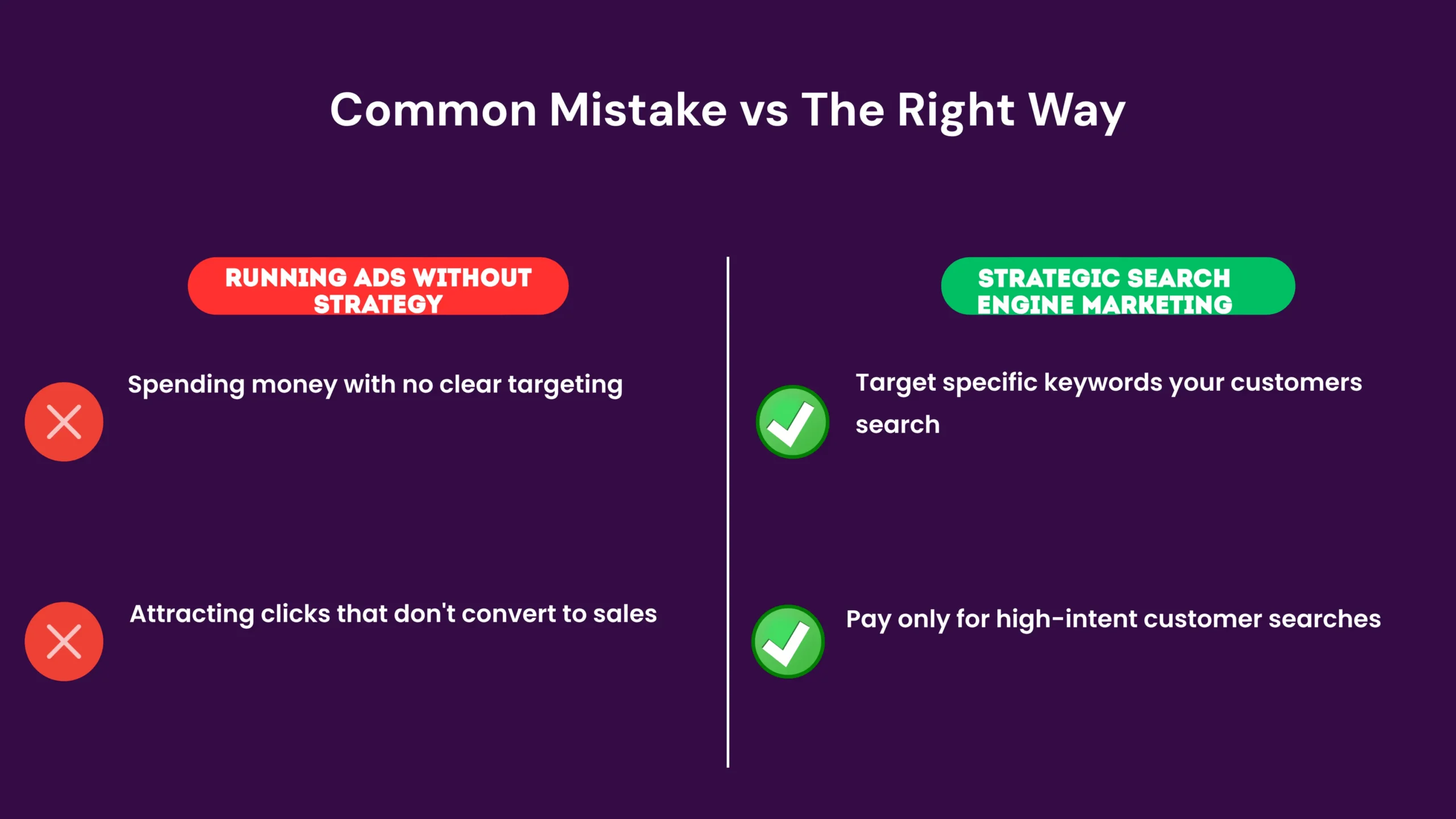
Most Kenyan businesses fail at SEM not because the channel doesn’t work. They make preventable mistakes.
Here are the biggest ones.
Bidding on Keywords Without Knowing If They Convert
A business owner sees that “phone shop Nairobi” gets 500 searches per month and decides to bid on it.
They spend 50,000 shillings on ads and get 200 clicks.
But those 200 clicks only produce 5 sales. The business owner concludes that SEM doesn’t work, when really they were bidding on the wrong keyword.
“Phone shop Nairobi” attracts people looking for phone shops, not people looking to buy a specific phone or repair.
The mistake is not measuring which keywords actually convert to customers before scaling your budget.
Writing Ads That Don’t Match What People Search For
A salon writes an ad that says “Luxury salon experience” but the person searching typed “cheap haircut near me.”
The person clicks the ad, lands on the website, sees expensive prices, and leaves.
You waste money on a click from someone who was never going to buy. The fix is writing ads that match the intent of the search.
Your landing page should also deliver exactly what the search promised.
Targeting Too Broad or Too Narrow
A business targets the keyword “phone” and wastes money showing ads to people searching for everything from phone repair to phone jokes.
Another business targets only “iPhone 15 Pro Max screen protector” and gets almost no searches.
The sweet spot is keywords that are specific enough to show your ad to people who want what you sell. They should still be broad enough to get meaningful search volume.
Not Having a Clear Landing Page
Someone clicks an ad for “web design services Nairobi” and lands on the homepage of a web design agency.
The homepage has information about the company, their mission, and a portfolio.
But there is no clear call to action. There is no form to fill out and no phone number.
The visitor has to search the site to figure out how to contact them. Many visitors leave without taking action.
The fix is sending paid search traffic to a page built specifically for that keyword. It should have a clear next step, such as call, email, form, or purchase.
Ignoring Geographic Targeting
A small business in Kisumu bids on keywords without specifying location.
Their ads show to people searching in Nairobi, Mombasa, and other cities far from Kisumu. They pay for clicks from people who will never visit their physical location.
If you have a physical location or serve a specific area, use geographic targeting. Show your ads only to people in that area.
SEM vs. Other Marketing Channels
It’s useful to understand how SEM fits into the bigger picture of Kenyan digital marketing.
| Channel | Speed to Results | Cost Per Customer | Long-Term Value | Best For |
|---|---|---|---|---|
| Paid Search (Google Ads) | Days | Medium | None (stops when you stop paying) | Immediate revenue, seasonal demand |
| Organic Search (SEO) | Months | Low | High (builds over time) | Sustainable growth, authority |
| Social Media Ads | Days | Medium-High | None | Brand awareness, audience building |
| Email Marketing | Days | Very Low | High (if you own the list) | Repeat customers, retention |
| Content Marketing | Months | Low | High | Authority, thought leadership |
SEM (both paid and organic) is unique because paid search gives you immediate results. Organic search builds long-term value.
Most successful Kenyan businesses use both. If you’re deciding between seo vs google ads, the answer is usually both, allocated based on your timeline and budget.
✅ Quick Action Checklist
- ☐ List 10 keywords your customers search for when looking for your product or service
- ☐ Search each keyword on Google and see who is currently ranking and what ads are showing
- ☐ Set up a Google Ads account and create your first campaign with a small daily budget (1,000-2,000 shillings)
- ☐ Create a landing page specifically for one of your top keywords with a clear call to action
- ☐ Use Google Analytics to track how many people click your ads and how many convert to customers or inquiries
- ☐ Audit your website for basic SEO (mobile-friendly, fast loading, clear navigation)
- ☐ Write one piece of content optimized for one of your target keywords
- ☐ Join Google Search Console and submit your sitemap so Google indexes your pages
Ready to Improve Your Search Engine Marketing?
Search engine marketing is not complicated.
It’s about reaching people who are actively searching for what you sell, at the right time, with the right message.
The challenge is knowing which keywords to target and how much to bid. You also need to know what to say in your ads and how to measure what actually works.
Most Kenyan business owners skip this thinking and lose money as a result.
Start small. Pick one keyword. Run one campaign.
Measure the results. Learn from what works and what doesn’t, then scale.
If you need a structured way to evaluate all your marketing channels, download our marketing channels template kenya and see how to use marketing channels template kenya to prioritize where to invest your budget.
Frequently Asked Questions
What is the difference between SEM and SEO?
SEM is the umbrella term for all search engine marketing, including both paid ads (Google Ads) and organic ranking (SEO). SEO is specifically the practice of optimizing your website to rank higher in organic search results without paying per click. All SEO is SEM, but not all SEM is SEO.
How much does it cost to start with Google Ads in Kenya?
You can start with as little as 500 shillings per day. There is no minimum monthly spend. You set a daily budget and only pay when someone clicks your ad. Most Kenyan SMEs start with 2,000-5,000 shillings per day to test what works before scaling up.
How long does it take to see results from SEO?
Organic search results typically take 3-6 months to appear, depending on how competitive your keywords are and how well you optimize. Paid search results can appear within days. If you need immediate traffic, start with paid search while you build organic authority.
Can I do SEM myself or do I need an agency?
You can do it yourself if you are willing to learn. Google Ads has free training. However, most Kenyan business owners find it faster and more profitable to hire an agency or freelancer who understands SEM, especially if your time is better spent running your business.
What keywords should I target for my Kenyan business?
Target keywords that match your business and have commercial intent, meaning people are searching because they want to buy or hire. They should also be specific to your location or service area. Use Google Keyword Planner (free in Google Ads) to research search volume and competition for keywords in your industry.
Additional Resources
- Experience and Activity Pages – Ranking for Safari and Tour Searches – If you run a tour or safari business, this shows you how to optimize activity pages so they rank when tourists search for specific experiences in Kenya.
- Contractor SEO – Getting Found for ‘Builder Near Me’ Searches – Contractors and builders can use these local SEO tactics to capture high-intent searches from homeowners looking for construction services nearby.
- What is Keyword Research (For the Kenya Market) – Before you spend money on SEM, you need to know which keywords your customers actually search for and which ones are worth targeting.
- SEO FAQs: Your Complete Guide to Search Engine Optimization in Kenya – If you’re new to the organic side of SEM, this FAQ answers the most common questions Kenyan businesses have about ranking on Google.
- How to Leverage Search Engines – A Kenyan Expert’s Guide – This guide walks you through the full process of using search engines strategically to grow your business in Kenya.
- What is a Search Engine – If you’re completely new to search marketing, start here to understand how Google and other search engines actually work.
Take the Next Step
SEM works, but only if you understand how to set it up and measure it properly.
Most Kenyan businesses leave money on the table. They don’t have a system for tracking which keywords convert and which ones waste money.
If you want a clear framework for choosing the right marketing channels for your business, download the Complete Marketing Channels Guide for Kenyan Businesses. It shows you exactly which channels work best for different business types and how to allocate your budget.