
Table of Contents
- What You Need to Know Right Now
- 📋 Key Takeaways
- What Is a Marketing Audit?
- Why Does a Marketing Audit Matter for Kenyan Businesses?
- How a Marketing Audit Works
- Marketing Audit Examples in Kenya
- Common Mistakes to Avoid
- ✅ Quick Action Checklist
- Ready to Improve Your Marketing?
- Frequently Asked Questions
- Additional Resources
- Take the Next Step
TL;DR: A marketing audit is a complete review of all your marketing activities to find what is working, what is failing, and where money is being wasted. It examines your website, SEO, social media, email, and paid ads to give you a clear picture of your marketing health. For Kenyan business owners, a marketing audit is the fastest way to stop guessing and start making decisions based on real data.
What You Need to Know Right Now
Kenyan business owners spend money on marketing every month. You might run Facebook ads, post on Instagram, hire someone to manage your website, or pay for Google Search ads.
Here is the hard truth. Most of you have no idea if that money is actually working.
A marketing audit changes that. It is a systematic, thorough examination of everything you are doing to promote your business.
It answers the questions you should be asking. Are people finding my website? Are they buying? Which marketing channels actually make me money?
📋 Key Takeaways
- A marketing audit is a complete review of your marketing activities to identify what works, what fails, and where money is wasted.
- Most Kenyan SMEs skip audits and repeat the same failing strategies month after month, costing them thousands in wasted spend.
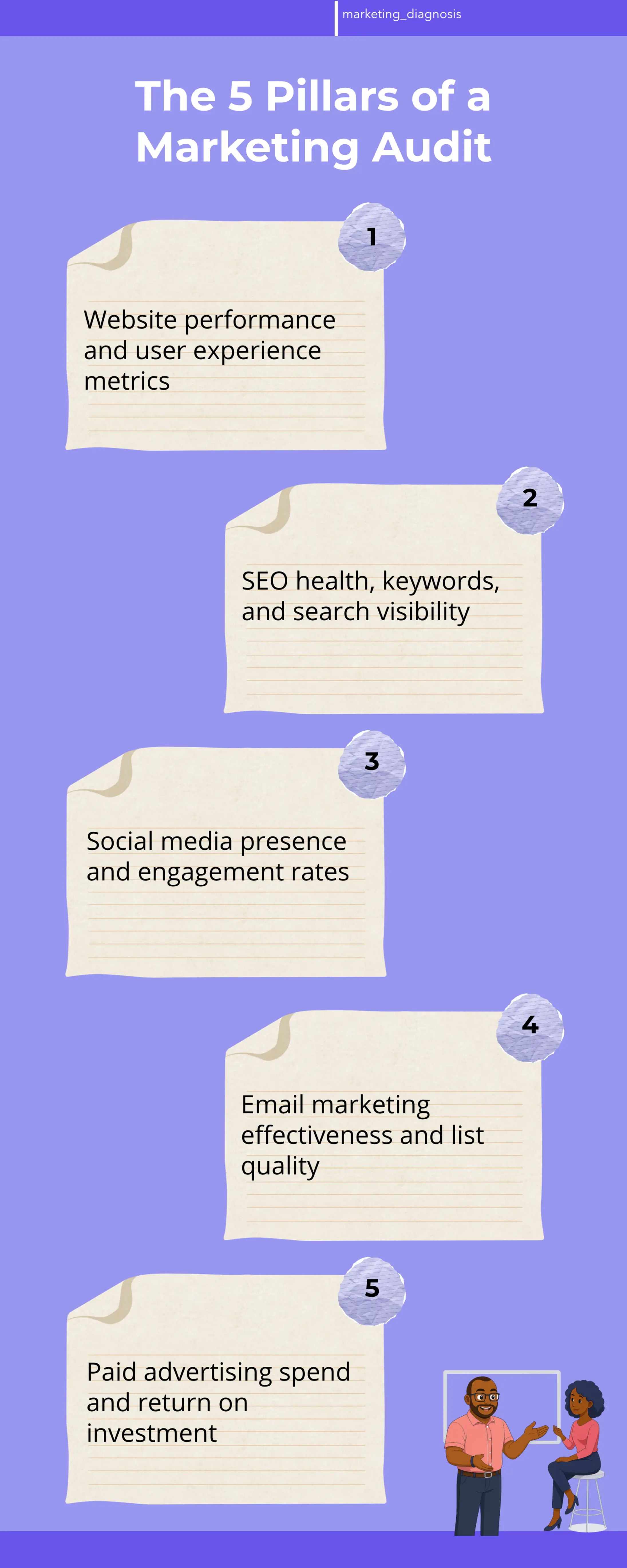
- A proper audit covers your website, SEO, social media, email marketing, and paid advertising in one comprehensive assessment.
- You do not need to hire an expensive agency to start; a basic audit can be done with free tools and clear thinking about your business goals.
- The real value of an audit is not the report—it is the action plan that tells you exactly what to fix first to improve revenue.
What Is a Marketing Audit?
A marketing audit is a complete, honest assessment of your marketing efforts. Think of it like a health checkup for your business’s marketing.
A doctor does not just ask how you feel. They run tests, measure your blood pressure, check your weight, and look at your history. A marketing audit does the same thing for your business.
It examines every channel where you are trying to reach customers. Your website, search engines, social media, email lists, and paid advertising all get checked.
The audit measures performance against your business goals and industry standards. It identifies gaps, inefficiencies, and missed opportunities, some of them marketing secrets hidden in plain sight that you walk past every day.
The Core Purpose of a Marketing Audit
The core purpose is simple. It shows you the truth about your marketing.
Not what you hoped would work. Not what feels like it is working. The actual data.
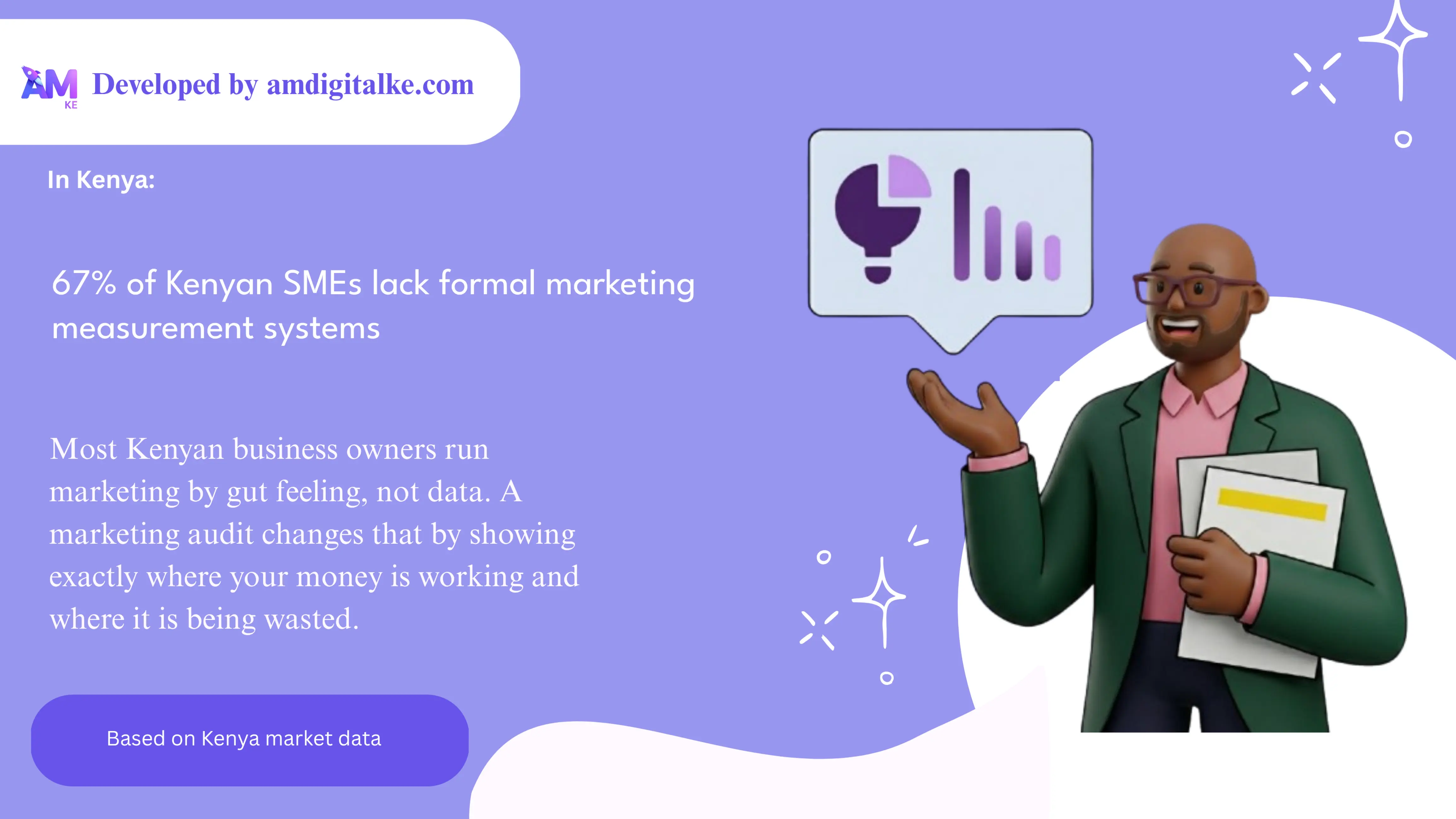
Most Kenyan business owners make marketing decisions based on assumptions. They assume their Facebook ads are bringing customers because they see likes and comments.
They assume their website is fine because it looks good. They assume their email list is working because people open some emails. An audit replaces these assumptions with facts.
What Gets Audited
A marketing audit covers five main areas. Your website gets examined for user experience, page speed, mobile friendliness, and conversion optimization.
Your SEO gets analyzed to see if people can actually find you on Google for the keywords that matter to your business. A proper content audit often reveals which pages are pulling their weight and which ones need work.
Your social media accounts are reviewed for engagement rates, follower growth, and whether posts are actually driving traffic or sales. Your email marketing is assessed for list quality, open rates, and click-through rates.
Your paid advertising is scrutinized to see if you are getting a positive return on every shilling spent.
Why Does a Marketing Audit Matter for Kenyan Businesses?
Here is what we see every day at AM Digital KE. Kenyan business owners spend money on marketing without measuring results.
They hire someone to run Facebook ads and never ask what the cost per customer is. They build a website and never check how many visitors actually convert to sales. They send emails and never measure open rates.
This is not just wasteful. It is dangerous.
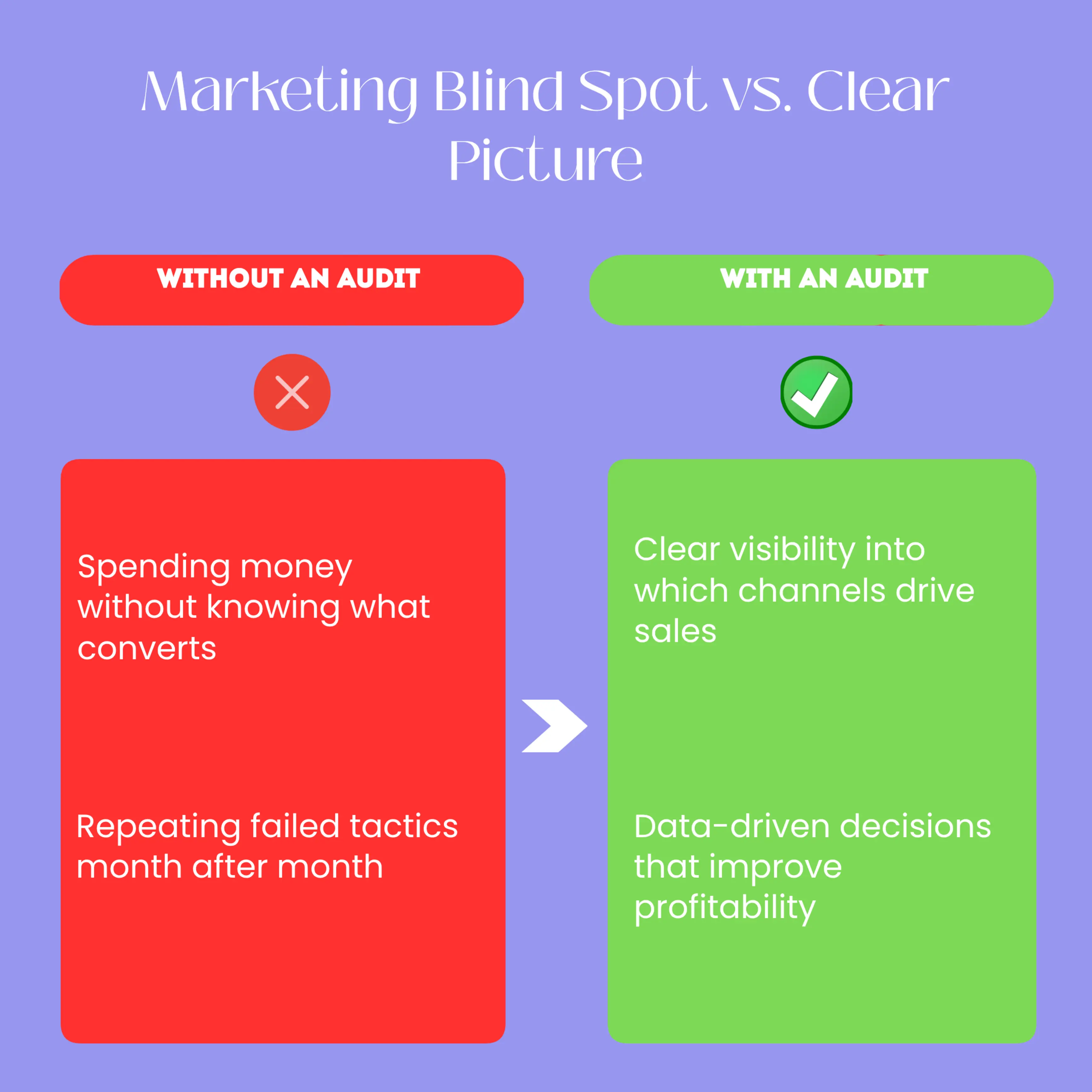
When businesses lack clear marketing measurement, they repeat failing strategies indefinitely, burning cash that could be invested in growth.
Stop Wasting Money on Marketing That Does Not Work
Most Kenyan SMEs have money leaking out of their marketing budget every single month. A salon in Nairobi might be paying for Google ads but getting zero bookings from them.
A Mombasa e-commerce store might have a beautiful Instagram feed but zero sales from Instagram. A Kisumu service business might be sending weekly emails to a list that never opens them. Others miss simpler wins, like setting up WhatsApp Business automation answering customer questions 24 7 instead of losing leads overnight.
Without an audit, you never know where the leak is. With an audit, you find it immediately.
Then you stop the bleeding. You redirect that money to channels that actually work for your business.
Make Decisions Based on Data, Not Gut Feeling
Running a business in Kenya means making decisions fast. You do not have the luxury of a six-month testing period.
You need to know right now: is this working or not? An audit gives you that clarity.
It shows you exactly which marketing activities are driving revenue and which are just creating noise. You can then make smarter decisions about where to spend your next shilling.
Understand Your Customer Journey
A marketing audit maps how customers actually find you and buy from you. Maybe they discover you on Google, visit your website, sign up for your email list, and then buy after three emails.
Or maybe they see your Facebook ad, go to your website, and leave without buying because your website is too slow.
Understanding this journey is critical. It shows you where to optimize for maximum impact.
Identify Your Competitive Advantage
An audit also shows you how you stack up against competitors. If your competitor ranks higher on Google for key search terms, an audit will tell you why and what to fix.
If they have a larger email list, an audit will show you their growth rate. It helps you catch up.
This competitive intelligence is gold. It tells you exactly where to focus your efforts to gain market share in your industry.
How a Marketing Audit Works
A marketing audit follows a clear process. First, you define your business goals and key performance indicators (KPIs).
What does success look like for your business? It could be more website visitors, more sales, more email subscribers, or more phone calls.
Once you know your goal, you measure your current performance against it. You gather data from all your marketing channels.
You analyze that data to identify gaps and opportunities. Finally, you create an action plan that prioritizes what to fix first.
Step 1: Define Your Goals and KPIs
You cannot audit what you have not defined. Before you start, be clear about what you are trying to achieve.
For a Nairobi restaurant, the goal might be 50 new customers per month. For an online course creator, it might be 100 email subscribers per month.
Once you know your goal, identify the KPIs that matter. These are the metrics that tell you if you are on track.
For the restaurant, KPIs might be website visitors, reservation form submissions, and phone calls. For the course creator, KPIs might be email subscribers, webinar attendees, and course sales.
Step 2: Gather Data from All Channels
You need to collect data from every marketing channel your business uses. This includes Google Analytics data from your website, Google Search Console data for SEO performance, and social media insights from Facebook and Instagram.
Add email marketing metrics from your email service provider, and advertising data from Google Ads or Facebook Ads Manager. Strong website copywriting kenya also affects how these numbers perform, so review your page content too.
If you use multiple platforms, consolidate the data into one place. Create a simple spreadsheet or document that shows all your key metrics in one view.
This makes it easy to spot patterns and compare performance across channels.
Step 3: Analyze Performance Against Goals
Now compare your actual performance to your goals. Are you hitting your targets, and if not, by how much are you falling short?
Which channels are performing well? Which are underperforming?
Look for patterns. Maybe your website gets 1,000 visitors per month but only converts 5 of them to customers.
That is a 0.5% conversion rate, which is low. Or maybe your Facebook ads are getting clicks but those clicks are not converting because your landing page is not optimized. If your business ranks lower than rivals despite deeper expertise, read youre the expert but google thinks your competitor is heres why for context. An audit surfaces these patterns.
Step 4: Identify Root Causes
For every underperforming metric, dig into why. If your website conversion rate is low, ask if the site is slow, the call-to-action unclear, or the pricing uncompetitive.
Also ask if the product fits your audience at all. Root cause analysis is where the real insight happens.
Surface-level fixes do not work. You need to understand the underlying reason for poor performance so you can fix it properly.
Step 5: Create Your Action Plan
Finally, create a prioritized action plan. Start with the changes that will have the biggest impact on your revenue.
If your website conversion rate is 0.5% but your email open rate is 45%, fixing your website conversion should be priority one.
Your action plan should be specific and measurable. Not “improve website conversion” but “reduce page load time from 5 seconds to under 2 seconds” or “add customer testimonials to the homepage.”
Specific actions lead to specific results.
Marketing Audit Examples in Kenya
Real Kenyan businesses use marketing audits to improve results every day. These are not hypothetical examples.
These are patterns we see repeatedly in our work with Kenyan SMEs.
Example 1: Nairobi E-Commerce Store Discovers Ad Waste
A Nairobi-based online fashion store was spending KES 50,000 per month on Google Shopping ads. The owner thought the ads were working because they were getting clicks.
But when we did an audit, we discovered something shocking. The ads were generating clicks but almost zero sales.
Why? The landing page was optimized for SEO, not for ad conversions. It had no clear call-to-action, no customer testimonials, and no urgency.
The ads were bringing the right people to the wrong page. We fixed the landing page and reduced ad spend to KES 30,000 per month while increasing sales by 40%.
That is KES 20,000 saved plus more revenue. That is the power of an audit.
Example 2: Mombasa Service Business Finds Their Best Channel
A Mombasa-based cleaning service was running Facebook ads, Instagram posts, and Google Local ads simultaneously. The owner was spreading the budget thin across all three channels.
An audit revealed that Google Local ads were generating 70% of their bookings while Facebook and Instagram combined were generating only 30%.
The business was wasting money on the wrong channels. We recommended shifting 60% of the budget to Google Local and 40% to Facebook.
Within two months, bookings increased by 35% with the same total ad spend. The audit showed them where to concentrate their efforts.
Example 3: Kisumu Consultant Realizes Email Is Their Gold Mine
A Kisumu-based business consultant was posting on LinkedIn three times per week, running Facebook ads, and maintaining a small email list of about 200 subscribers. An audit of email performance showed that 45% of email subscribers had purchased their courses.
That is compared to less than 2% conversion from LinkedIn and Facebook ads combined. The audit revealed that email was their most profitable channel by far.
We recommended shifting focus to growing the email list instead of chasing social media followers. Choosing the right partner matters here too, as shown in artly vs am digital ke.
Within six months, the email list grew to 1,200 subscribers, and revenue from email increased by 250%. The audit changed their entire strategy.
Common Mistakes to Avoid
Kenyan business owners make predictable mistakes when they audit their own marketing. Here are the ones we see most often.
Mistake 1: Only Looking at Vanity Metrics
Vanity metrics feel good but do not drive revenue. Instagram followers, Facebook likes, website visitors, email subscribers. These numbers look impressive in a report. They do not matter if they do not convert to sales.
A common mistake is celebrating 10,000 website visitors per month while ignoring the fact that only 5 became customers. Focus on metrics that actually connect to revenue: conversion rate, customer acquisition cost, customer lifetime value, and return on ad spend.
Mistake 2: Comparing Yourself to the Wrong Benchmark
You are not Google. You are not Safaricom. Do not compare your marketing metrics to global benchmarks or massive corporations. Compare yourself to competitors in your industry and size in Kenya.
If you run a small e-commerce store in Nairobi, compare your email open rate to other Nairobi e-commerce stores, not to Amazon. Compare your website conversion rate to similar businesses in Kenya, not to international benchmarks. Get your comparisons right or your audit will mislead you.
Mistake 3: Ignoring the Customer Journey
A customer does not usually buy on their first visit. They might discover you on Google, visit your website, leave, then see your Facebook ad a week later.
They click it, visit your website again, sign up for your email list, and buy after two more emails. That is a five-touch customer journey.
If you only measure the last touch, the final email, you give all the credit to email. You ignore the role of Google and Facebook, and you make the wrong decision about where to spend money. A proper audit tracks the entire customer journey, not just the last click. This is one reason a seo services in kenya vs social media ads in kenya comparison can mislead you if you only look at final conversions.
Mistake 4: Doing an Audit Once and Never Again
Marketing performance changes constantly. What works this month might not work next month. Seasons change, competitors change, customer behavior changes.
An audit is not a one-time event. Audit your marketing at least quarterly to stay on top of changes.
Many Kenyan businesses do an audit, make changes, and then never measure again. They fall back into old habits. A better approach is to audit quarterly, make small adjustments monthly, and track progress continuously.
✅ Quick Action Checklist
- ☐ List all the marketing channels you currently use (website, Google Ads, Facebook, Instagram, email, etc.)
- ☐ Write down your top three business goals for the next 12 months (e.g., 100 new customers, KES 500,000 in revenue)
- ☐ Gather your last three months of data from Google Analytics, Google Ads, and social media platforms
- ☐ Calculate your current conversion rate (customers divided by total website visitors)
- ☐ Calculate your current customer acquisition cost (total marketing spend divided by new customers)
- ☐ Identify which marketing channel is driving the most revenue right now
- ☐ Identify which marketing channel is wasting the most money with the lowest return
- ☐ Schedule a quarterly audit date on your calendar (same date every three months)
Ready to Improve Your Marketing?
A marketing audit is not optional if you want to grow a profitable business. It is the foundation of smart marketing decisions. Without an audit, you are flying blind. With an audit, you have a clear map of what works and what does not.
The best time to do your first audit is today. Start with the checklist above, gather your data, and be honest about what it shows you. Then create a simple action plan and execute it. If you want expert eyes on your numbers, a free seo analysis kenya is a good place to start.
Frequently Asked Questions
How much does a marketing audit cost?
A basic audit using free tools costs nothing. You can do it yourself with Google Analytics, Google Search Console, and platform insights. A professional audit from an agency in Kenya typically costs between KES 15,000 and KES 50,000 depending on the complexity and depth. For most SMEs, starting with a DIY audit is smart.
How long does a marketing audit take?
A thorough DIY audit takes about 8-12 hours spread over a few days. You need time to gather data, analyze it, and think about what it means. A professional audit typically takes 2-3 weeks from start to finish, including interviews, data gathering, analysis, and report creation.
What if my audit shows everything is failing?
This is actually good news. You now know what to fix. Start with the biggest problem first, usually poor website conversion or wrong audience targeting.
Fix one thing at a time, measure the impact, and move to the next problem. Improvement is a process, not an overnight fix.
How often should I audit my marketing?
Quarterly audits are ideal for most businesses. This gives you enough time to implement changes and measure results, but not so much time that you fall out of alignment with your goals. For fast-growing businesses or those in competitive markets, monthly audits might be necessary.
Can I do a marketing audit myself or should I hire someone?
You can definitely do a basic audit yourself if you are comfortable with data and analytics. A professional audit is valuable if you want deeper competitive analysis, industry benchmarking, or if you do not have the time to do it yourself.
Many Kenyan businesses benefit from a hybrid approach. Do the audit yourself quarterly, and hire a professional for a deep dive annually, especially to check how your content ranks for featured snippets and other search visibility gains.
Additional Resources
- The Three Sales Moments Your Social Media Ads Can’t Capture – Kenyan SEO Expert Explains – If your audit flagged weak ad performance, this explains the buying moments ads miss and why that gap shows up in your numbers.
- Why Isnt My Marketing Working Quiz – Not ready for a full audit yet? Run this quick quiz first to see if you actually need one.
- 5 SEO Mistakes I’Ve Seen In Almost Every Kenyan Business (And How To Fix Them) – Your marketing audit should check for these exact SEO mistakes, this article shows you what to look for.
- What is a Google Penalty – If your audit turns up a sudden traffic drop, rule out a Google penalty before you touch anything else.
- Why Isn’T My Marketing Working? A Kenyan Business Owner’S Honest Diagnosis – A real Kenyan case study showing how a marketing audit uncovers the actual reasons a business isn’t growing.
- How to Recover from a Google Penalty – Once your audit confirms a penalty, use this guide to fix it and get your rankings back.
Take the Next Step
You now know what a marketing audit involves. The next step is seeing exactly where your own marketing stands.
We have created a free Marketing Reality Check tool for Kenyan business owners. It walks you through the key questions from a marketing audit and shows you where to focus first, whether that is your website, your ads, or why your website should be a conference not an expensive brochure.
No signup required. No spam.
Just honest insights about your marketing. Download the Marketing Reality Check for Kenyan Businesses and get started today.
If you are still comparing agencies before you commit to an audit, read savage digital vs am digital ke for a clear breakdown. And if your business handles sensitive information, check our guide on ymyl content writing health information google trusts to see how audits apply to that content too.