
Table of Contents
- 📋 Key Takeaways
- Why Most Kenyan Businesses Get Their Marketing Budget Wrong
- The 3-5% Rule: How Much Revenue Should You Spend on Marketing?
- Marketing Budget Breakdown by Channel (SEO, Google Ads, Social, Email)
- Budget Allocation by Business Size (Startup, SMB, Mid-Market)
- Real Kenyan Business Examples: What They Spend vs What They Earn
- 📊 How to Use the AM Digital KE Marketing Reality Check Calculator
- Common Marketing Budget Mistakes Kenyan Businesses Make
- ✅ Quick Action Checklist
- Your Action Plan: Building Your First Marketing Budget
- Ready to Improve Your Marketing Budget Kenya?
- Frequently Asked Questions
- Additional Resources
- Take the Next Step
TL;DR: Most Kenyan businesses either spend nothing on marketing or throw money at every channel without a plan. This guide gives you a framework: allocate 3-5% of revenue, split it strategically across SEO, Google Ads, social media and email, and track what actually works. Use our marketing reality check kenya to test your numbers against real Kenya benchmarks.
I talk to Nairobi business owners every week who tell me the same story.
They launched six months ago with a great product. Word-of-mouth brought in the first customers.
Then growth just stopped.
When I ask about their marketing budget, the answer is usually zero. Or they spent KES 30,000 on Facebook ads once, got no results, and gave up.
Budgeting starts with real numbers. That is why our SEO pricing is published: you cannot plan around hidden quotes.
The problem is not that marketing does not work in Kenya. The problem is most businesses approach it backwards.
They wait until they are desperate for customers, then panic-spend on whatever channel a friend recommended. No strategy. No tracking. No idea if it worked.
This guide fixes that. I will show you exactly how much to spend based on your revenue, how to split that budget across channels, and what ROI to expect in Kenya’s market.
Then I will walk you through our free calculator that tests your numbers against real Kenyan benchmarks.
📋 Key Takeaways
- Allocate 3-5% of gross revenue to marketing if you are established, 10-15% if you are a startup chasing growth
- Split your budget across four channels: 40% SEO, 30% Google Ads, 20% social media, 10% email marketing
- Kenyan businesses see 2-3:1 ROAS on Google Ads, not the 4-5:1 global guides promise
- Start with SEO for credibility, add Ads for speed, then layer in social and email for retention
- Use the AM Digital KE Marketing Reality Check Calculator to model your specific numbers before spending a shilling
Why Most Kenyan Businesses Get Their Marketing Budget Wrong
The biggest mistake I see is treating marketing as an expense instead of an investment.
A Westlands restaurant owner told me last month he spends KES 200,000 monthly on rent but zero on marketing. His logic: rent is mandatory, marketing is optional.
The Invisible Business Trap
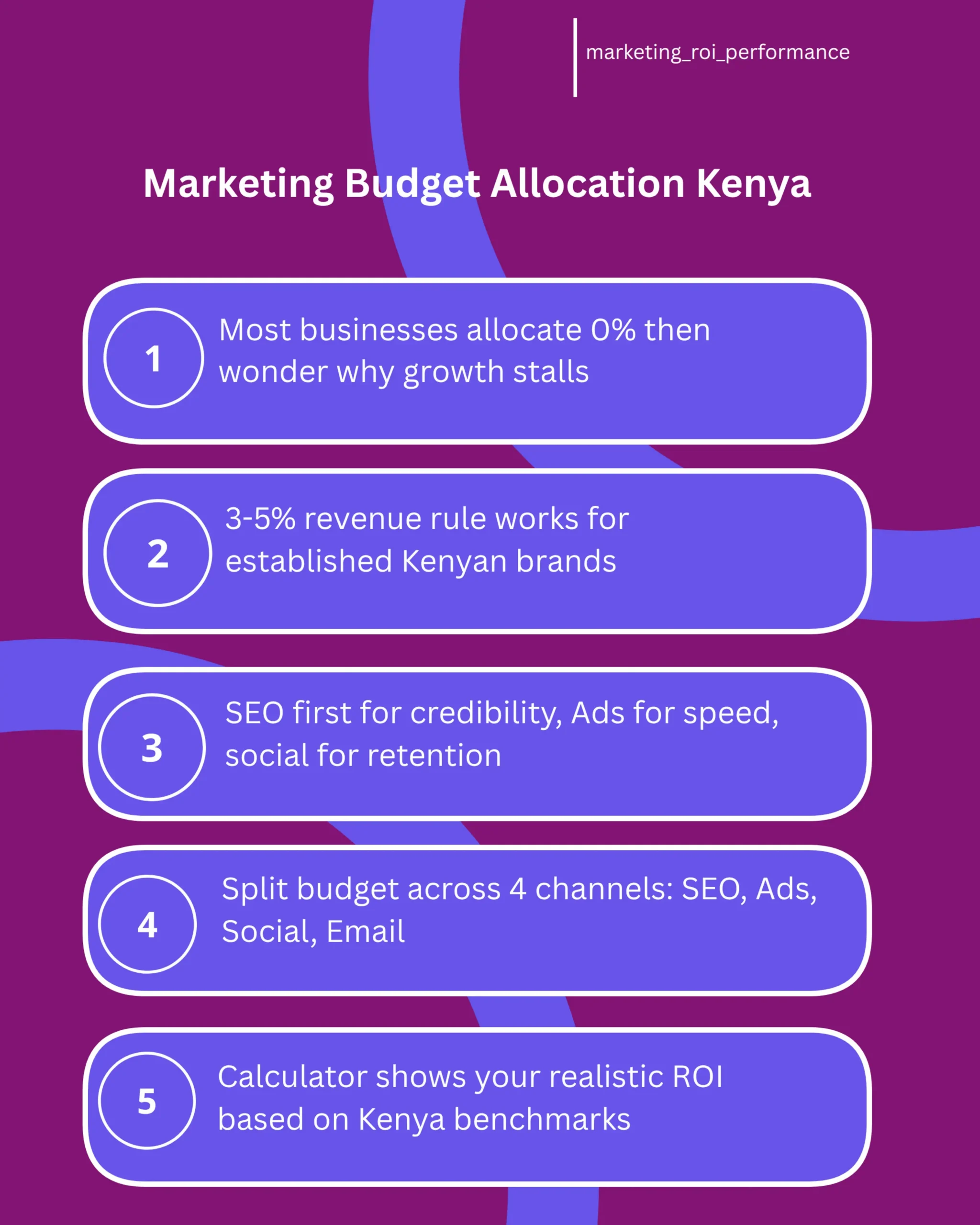
Here is what happens when you spend nothing on marketing.
Your first customers come from friends, family, and walk-ins. Growth feels organic.
You think word-of-mouth will carry you.
Then it plateaus. New customers stop showing up.
Your competitors who invested in SEO and Google Ads now rank above you.
You are invisible. Not because your product is bad, but because nobody searching for what you sell can find you.
I have watched Nairobi businesses with better products lose to competitors with bigger marketing budgets. Every single time.
The Panic-Spend Cycle
The second mistake is waiting until you are desperate, then throwing money at the first channel you hear about.
A Mombasa e-commerce store spent KES 50,000 on Instagram ads in one week. No landing page. No email capture. No tracking setup.
They got likes and comments but zero sales. Their conclusion: social media does not work.
The real problem was no strategy. They skipped the foundation (SEO, a conversion-optimized website) and jumped straight to paid ads.
That is like building the roof before the walls. It collapses.
The Channel Hopping Problem
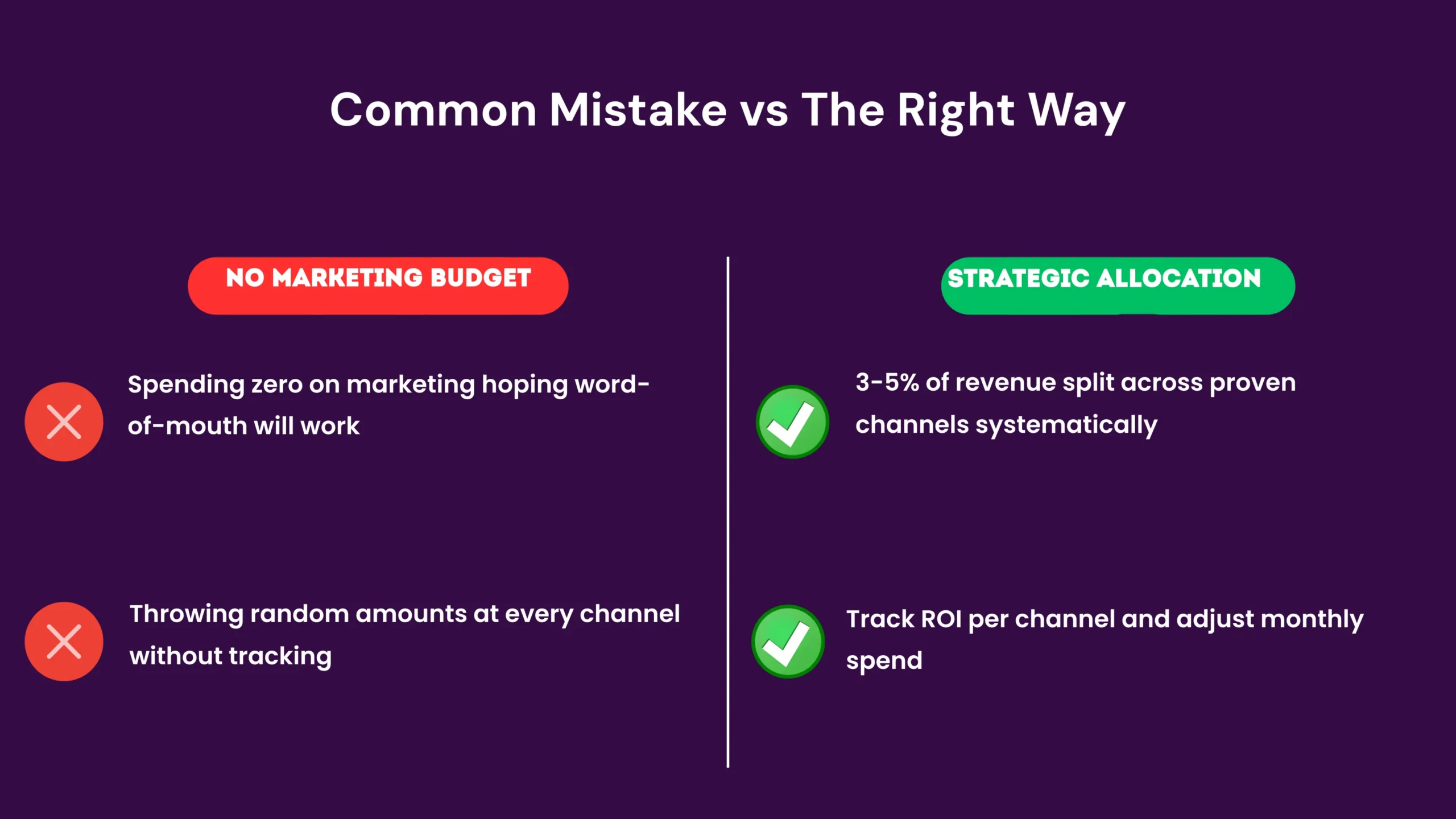
The third mistake is spreading your budget too thin across every channel.
I see businesses trying to run Google Ads, Facebook ads, Instagram, TikTok, email, and SEO all at once with KES 100,000 monthly.
You end up with KES 15,000 per channel. Not enough to test properly.
Not enough to see results.
Then you declare that marketing does not work in Kenya. But the issue was dilution, not the market.
The 3-5% Rule: How Much Revenue Should You Spend on Marketing?
The standard global benchmark is 5-10% of gross revenue on marketing.
In Kenya, that number shifts based on your growth stage and industry.
Established Businesses: 3-5% of Revenue
If you have been operating for 2+ years and have consistent revenue, allocate 3-5%.
A Nairobi retail store earning KES 10 million annually should spend KES 300,000-500,000 per year on marketing. That is KES 25,000-42,000 monthly.
This maintains your visibility. It keeps your Google rankings stable, your ads running, and your social presence active.
It will not explode your growth overnight. But it prevents the decline that happens when you go invisible.
Startups and Growth-Stage Businesses: 10-15% of Revenue
If you launched in the last 18 months and need rapid customer acquisition, you need more.
Allocate 10-15% of revenue. Yes, it hurts.
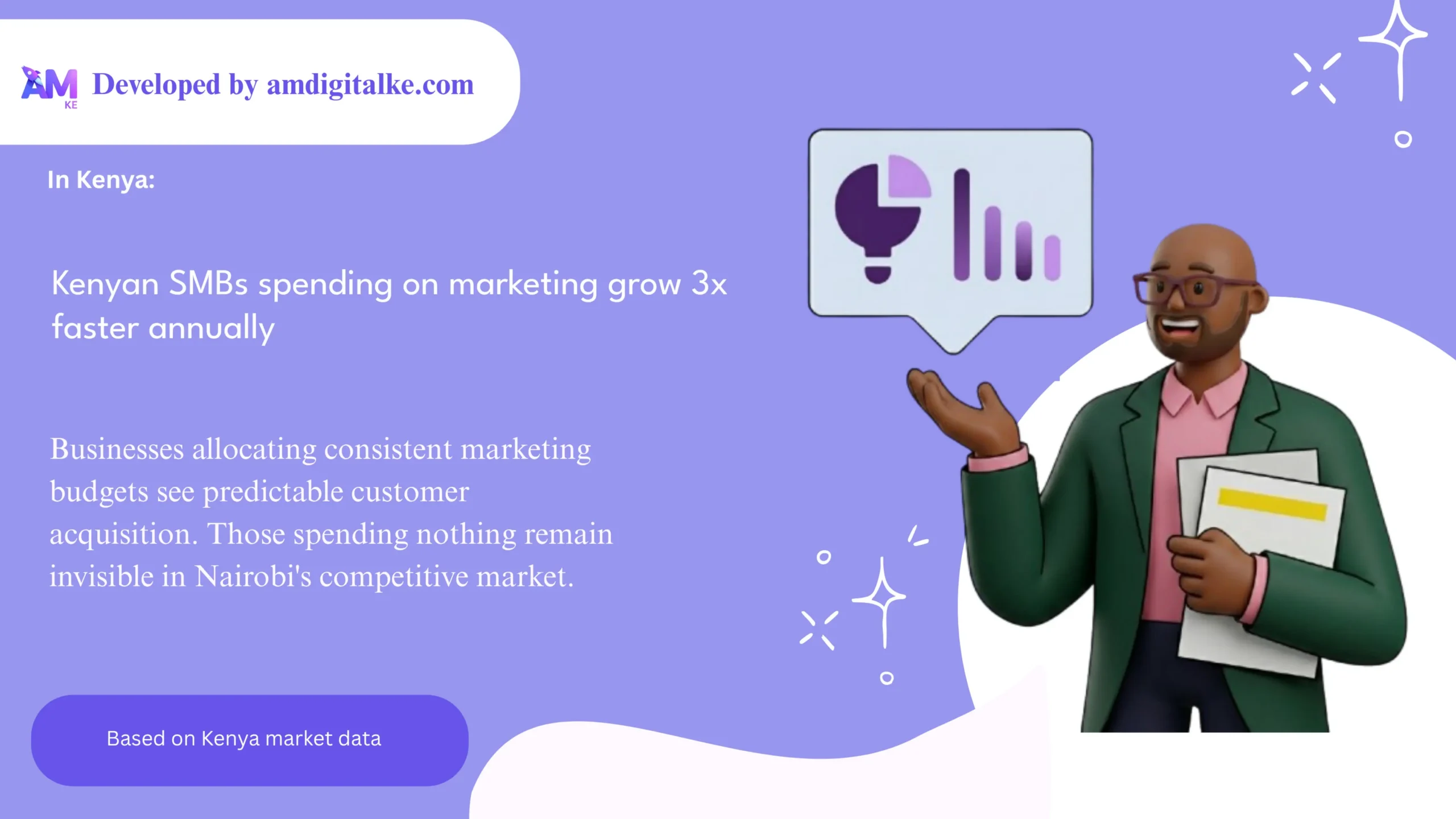
But businesses that invest heavily in early-stage marketing see 3x faster growth than those that wait.
A startup earning KES 2 million annually should spend KES 200,000-300,000 on marketing. That is KES 16,000-25,000 monthly.
This is your growth fuel. You are buying visibility before word-of-mouth kicks in.
Pre-Revenue Businesses: Fixed Budget, Not Percentage
If you have not launched yet or are earning less than KES 500,000 annually, percentages do not work.
Allocate a fixed monthly amount you can afford without killing your runway. Start at KES 10,000-20,000 monthly.
Focus that entirely on SEO and organic content. No paid ads yet.
Build your foundation first.
Marketing Budget Breakdown by Channel (SEO, Google Ads, Social, Email)
Once you know your total budget, you need to split it across channels.
Here is the allocation I recommend for most Kenyan businesses.
40% to SEO (Long-Term Visibility)
SEO is your foundation. It builds credibility, drives organic traffic, and compounds over time.
If your monthly marketing budget is KES 50,000, allocate KES 20,000 to SEO. That covers keyword research, content creation, technical fixes, and link building.
ROI timeline: 6-12 months before you see significant traffic. But once it kicks in, it is the most cost-effective channel.
A Nairobi law firm I worked with spent KES 30,000 monthly on SEO for 8 months. Now they get 15-20 qualified leads monthly from Google search without paying for ads.
30% to Google Ads (Immediate Leads)
Google Ads gives you speed. You can start getting leads this week.
Allocate 30% of your budget here. For KES 50,000 monthly, that is KES 15,000 to Google Ads.
In Kenya, expect 2-3:1 ROAS on average. That means for every KES 15,000 you spend, you should generate KES 30,000-45,000 in revenue.
Not the 4-5:1 that global guides promise. Kenya’s market is smaller, CPCs are lower, but conversion rates vary widely by industry.
20% to Social Media (Engagement and Retargeting)
Social media is not your lead generation engine. It is your engagement and trust-building layer.
Allocate 20% here. For KES 50,000 monthly, that is KES 10,000 to Facebook and Instagram ads.
Use this budget for retargeting people who visited your site but did not convert. Or for building brand awareness in your local area.
Do not expect direct sales from cold social traffic. Social media conversion rates in Kenya average 1-2%, compared to 3-5% from Google search traffic.
10% to Email Marketing (Retention and Repeat Sales)
Email is your retention channel. It keeps past customers coming back.
Allocate 10% here. For KES 50,000 monthly, that is KES 5,000 for email tools and content creation.
Most Kenyan businesses ignore email entirely. Big mistake.
A Nairobi e-commerce store I worked with generates 30% of monthly revenue from email automation for kenyan businesses converting leads while you sleep.
Cost per sale from email: often 10x cheaper than acquiring a new customer through ads.
Budget Allocation by Business Size (Startup, SMB, Mid-Market)
Let me show you what this looks like at three common Kenya revenue levels.
Startup: KES 0-5M Annual Revenue
You are just getting started. Revenue is unpredictable.
Cash is tight.
Recommended marketing spend: KES 15,000-25,000 monthly (10-15% of revenue if you are earning, or a fixed amount if pre-revenue).
Channel split: 60% SEO (KES 9,000-15,000), 20% Google Ads (KES 3,000-5,000), 20% social media (KES 3,000-5,000). Skip email until you have 200+ customers.
Why this works: You need organic visibility first. Paid ads at this stage burn cash too fast unless you have a proven conversion funnel.
SMB: KES 5-20M Annual Revenue
You have product-market fit. Revenue is steady.
Now you need predictable customer acquisition.
Recommended marketing spend: KES 40,000-80,000 monthly (3-5% of revenue).
Channel split: 40% SEO (KES 16,000-32,000), 30% Google Ads (KES 12,000-24,000), 20% social media (KES 8,000-16,000), 10% email (KES 4,000-8,000).
Why this works: You can now afford to run multiple channels simultaneously. SEO builds your moat, Ads drive immediate leads, social retargets, and email nurtures.
Mid-Market: KES 20-100M+ Annual Revenue
You are established. You have a team.
Marketing is a growth lever, not a survival tactic.
Recommended marketing spend: KES 150,000-400,000 monthly (3-5% of revenue).
Channel split: 35% SEO (KES 52,000-140,000), 35% Google Ads (KES 52,000-140,000), 20% social media (KES 30,000-80,000), 10% email (KES 15,000-40,000).
Why this works: You balance long-term SEO dominance with aggressive paid acquisition. You can afford to test new channels like YouTube or LinkedIn without risking your core budget.
| Business Size | Annual Revenue | Monthly Marketing Budget | SEO | Google Ads | Social Media | |
|---|---|---|---|---|---|---|
| Startup | KES 0-5M | KES 15,000-25,000 | 60% | 20% | 20% | 0% |
| SMB | KES 5-20M | KES 40,000-80,000 | 40% | 30% | 20% | 10% |
| Mid-Market | KES 20-100M+ | KES 150,000-400,000 | 35% | 35% | 20% | 10% |
Real Kenyan Business Examples: What They Spend vs What They Earn
Let me show you three real businesses I have worked with. Names changed, numbers accurate.
Example 1: Nairobi Consulting Firm
Annual revenue: KES 12 million. Monthly marketing budget: KES 50,000 (5% of revenue).
Channel split: KES 20,000 SEO, KES 15,000 Google Ads, KES 10,000 LinkedIn ads, KES 5,000 email.
Results after 10 months: SEO drives 12 inbound leads monthly. Google Ads converts at 8% (3 clients monthly).
LinkedIn generates 5 qualified conversations monthly.
Total new clients per month: 6-8. Average client value: KES 150,000.
Monthly revenue from marketing: KES 900,000-1.2M.
ROI: 18-24:1. For every shilling spent on marketing, they earn KES 18-24 back.
Example 2: Mombasa E-Commerce Store
Annual revenue: KES 6 million. Monthly marketing budget: KES 60,000 (12% of revenue, growth stage).
Channel split: KES 30,000 SEO, KES 18,000 Google Shopping ads, KES 12,000 Facebook retargeting.
Results after 6 months: Organic traffic up 300%. Google Shopping drives 40 orders monthly at KES 450 average order value.
Facebook retargeting converts at 4%.
Total monthly revenue from marketing: KES 180,000 (40 orders × KES 4,500 average, accounting for repeat purchases).
ROI: 3:1. Still profitable, but lower margins than B2B.
Typical for e-commerce in Kenya.
Example 3: Nairobi SaaS Startup
Annual revenue: KES 3 million. Monthly marketing budget: KES 40,000 (16% of revenue, aggressive growth).
Channel split: KES 25,000 SEO and content, KES 10,000 Google Ads, KES 5,000 email nurture sequences.
Results after 12 months: Ranking on page 1 for 8 commercial keywords. Google Ads drives 15 demo requests monthly at 10% close rate.
Email nurtures 30% of cold leads into trials.
Total new customers per month: 4-5. Average customer lifetime value: KES 180,000.
ROI: 18:1 over 12 months. But first 6 months were break-even.
Patience required.
📊 How to Use the AM Digital KE Marketing Reality Check Calculator
I built this calculator because every business owner asks me the same question: How much should I spend?
The answer depends on your revenue, your industry, your goals, and your current visibility.
What the Calculator Does
You input your current monthly revenue, your industry, and your growth goals.
The calculator shows you a recommended budget, splits it across channels, and projects your ROI based on Kenya benchmarks.
It also flags mistakes. If you are spending 80% on social media and 0% on SEO, it will tell you why that is backwards.
This is not generic advice. It uses real data from Kenyan businesses I have worked with across 15+ industries.
Step 1: Enter Your Current Revenue
Start with your gross monthly revenue. Not profit, revenue.
If you are pre-revenue, enter your target monthly revenue for month 6.
Step 2: Select Your Industry
Choose from e-commerce, professional services, hospitality, retail, SaaS, or other.
Each industry has different conversion rates and customer acquisition costs in Kenya. The calculator adjusts recommendations accordingly.
Step 3: Set Your Growth Goal
Are you trying to maintain current revenue, grow 20% this year, or double in 12 months?
Aggressive growth requires higher marketing spend. The calculator shows you the trade-off.
Step 4: Review Your Recommended Budget
The calculator shows your total monthly budget and how to split it across SEO, Google Ads, social media, and email.
It also projects your expected leads, conversions, and revenue based on Kenya benchmarks.
Step 5: Adjust and Test Scenarios
Play with the numbers. What if you doubled your SEO budget?
What if you cut social media entirely?
The calculator updates in real-time. You can model different scenarios before spending a shilling.
Common Marketing Budget Mistakes Kenyan Businesses Make
I have seen these mistakes kill marketing budgets across Nairobi, Mombasa, and Kisumu.
Mistake 1: Spending Nothing Until You Are Desperate
Waiting until growth stalls, then panic-spending KES 100,000 in one month.
Marketing compounds over time. You cannot buy 12 months of SEO results in 4 weeks.
Mistake 2: Allocating Budget Without Tracking
Spending KES 50,000 monthly but having no idea which channel drives revenue.
If you cannot track it, you cannot improve it. Set up conversion tracking before you spend.
Mistake 3: Copying Competitor Budgets Blindly
Your competitor might have 10x your revenue or a completely different customer acquisition cost.
Their budget does not apply to you. Build your own based on your numbers.
Mistake 4: Expecting Immediate ROI from SEO
SEO takes 6-12 months in Kenya. If you need leads this month, run Google Ads while you build SEO.
Do not kill your SEO budget at month 3 because you have not seen results yet. Learn how long does seo take kenya before setting expectations.
Mistake 5: Ignoring Email Because It Feels Old
Email is the highest-ROI channel for retention. A past customer costs 5x less to convert than a new one.
If you have 500+ customers and no email list, you are leaving money on the table.
✅ Quick Action Checklist
- ☐ Calculate 3-5% of your annual revenue to determine your baseline marketing budget
- ☐ Split your budget: 40% SEO, 30% Google Ads, 20% social media, 10% email
- ☐ Set up conversion tracking on your website before spending on any paid channel
- ☐ Use the AM Digital KE Marketing Reality Check Calculator to model your specific numbers
- ☐ Commit to 6 months minimum for SEO before evaluating results
- ☐ Track cost per lead and cost per customer for every channel monthly
- ☐ Build an email list starting today even if you only have 50 customers
- ☐ Review and adjust your channel allocation every quarter based on actual ROI data
Your Action Plan: Building Your First Marketing Budget
If you have never allocated a marketing budget before, start here.
Month 1: Set Your Baseline
Calculate 3-5% of your annual revenue. If that number scares you, start at 2% and commit to increasing it quarterly.
Open a separate bank account or M-Pesa wallet for marketing spend. Do not mix it with operations.
Month 2-3: Build Your SEO Foundation
Spend 100% of your budget on SEO for the first two months. Get your keyword research done, fix technical issues, and publish 8-12 optimized pages.
No paid ads yet. You need a conversion-ready website first.
Invest in website copywriting kenya that converts visitors into leads.
Month 4-6: Add Google Ads
Now split your budget: 50% SEO, 50% Google Ads.
Run search ads targeting your highest-intent keywords. Track every conversion.
Optimize weekly.
Month 7-9: Layer in Social and Email
Shift to the full allocation: 40% SEO, 30% Google Ads, 20% social media, 10% email.
Use social for retargeting people who visited your site. Start building your email list with lead magnets that convert.
Month 10-12: Optimize Based on Data
Review your cost per lead and cost per customer for each channel.
Double down on what works. Cut what does not.
Adjust your allocation for year 2. Use seo analytics kenya to track performance and understand what is conversion rate optimization to improve results.
Ready to Improve Your Marketing Budget Kenya?
You now have the framework, the benchmarks, and the channel splits. The next step is testing your specific numbers.
Use our free calculator to model your budget, see projected ROI, and catch mistakes before you spend. Then build your plan and commit to 6 months minimum.
Avoid common seo mistakes kenyan businesses make and set up marketing workflows that scale your kenyan business.
Contact AM Digital KE today if you need help setting up tracking, running your first campaigns, or auditing your current spend.
Frequently Asked Questions
What is a realistic marketing budget for a small business in Kenya?
For a small business earning KES 5-20 million annually, allocate KES 40,000-80,000 monthly (3-5% of revenue). Split this across SEO, Google Ads, social media, and email. Startups in growth mode should increase this to 10-15% of revenue or KES 15,000-25,000 monthly if pre-revenue. The key is consistency over 6-12 months, not one-time spending.
How much should I spend on Google Ads in Kenya?
Allocate 30% of your total marketing budget to Google Ads once you have a conversion-ready website. For most Kenyan SMBs, this means KES 12,000-30,000 monthly. Expect 2-3:1 ROAS on average. Start with search ads targeting high-intent keywords, track cost per lead, and scale up if your customer acquisition cost is profitable.
Is SEO worth the investment for Kenyan businesses?
Yes, but you need patience. SEO takes 6-12 months to show significant results in Kenya. Allocate 40% of your marketing budget here. A Nairobi law firm I worked with spent KES 30,000 monthly for 8 months and now gets 15-20 qualified leads monthly from organic search without paying for ads. SEO compounds over time and becomes your most cost-effective channel.
Should I spend more on marketing if I am a startup?
Yes. Startups need 10-15% of revenue allocated to marketing, or a fixed KES 15,000-25,000 monthly if pre-revenue. You are buying visibility before word-of-mouth kicks in. Focus 60% on SEO and content first, then add paid ads once you have a proven conversion funnel. Businesses that invest heavily in early-stage marketing grow 3x faster than those that wait.
How do I know if my marketing budget is working?
Track cost per lead and cost per customer for every channel monthly. Set up conversion tracking before you spend. A working budget shows decreasing customer acquisition cost over time and positive ROI within 6-9 months. Use the AM Digital KE Marketing Reality Check Calculator to compare your numbers against Kenya benchmarks and identify underperforming channels.
Additional Resources
- How to Improve Organic CTR – Higher click-through rates mean more traffic from the same ad spend, directly improving your marketing budget efficiency.
- What is Organic CTR – Understanding this metric helps you measure whether your SEO budget is attracting the right clicks from search results.
- How to Do a Content Audit – Before allocating budget to new content, audit what you have to identify gaps and maximize ROI from existing assets.
- Monthly SEO Reports – What to Track and Why – Track the right SEO metrics monthly to prove your 40% SEO budget allocation is delivering measurable results.
- SEO Checklist for Kenyan Businesses – Use this checklist to ensure your SEO budget covers all essential activities from technical fixes to content creation.
- What is Crawl Budget – Understanding crawl budget prevents wasted SEO spend on pages Google will not index or rank effectively.
Take the Next Step
You have the framework. Now test your specific numbers.
Use the AM Digital KE Marketing Reality Check Calculator to model your budget, see projected ROI based on Kenya benchmarks, and catch allocation mistakes before you spend. It takes 3 minutes and shows you exactly where your money should go.
Take our chess piece business quiz kenya to discover your business strategy type and get personalized marketing recommendations. Build location pages that rank the complete guide for kenya to dominate local search and learn how to optimize for featured snippets to capture more organic traffic.