Table of Contents
TL;DR: Course page SEO helps Kenyan students find your online courses. Optimise each page with local keywords, clear benefits, and trusted credentials to rank higher.
Last Updated: March 2026
Key Takeaways
- Use Kenyan location keywords
- Target student outcome phrases
- Write clear title tags
- Add credible credentials
- Answer common student questions
Your e-learning platform has brilliant courses.
World-class instructors. Competitive pricing. But when Kenyan students search “digital marketing course Nairobi” or “online coding bootcamp Kenya,” they’re finding your competitors instead.
The problem isn’t your courses.
It’s how Google sees your course pages. Let’s fix that.
Why Course Page SEO Matters for Kenyan E-Learning
Here’s the reality: most Kenyan students research courses online before enrolling.
If your course pages don’t rank, you’re invisible during the most critical decision-making moment.
Unlike product pages that sell once, course pages need to convince students to invest time and money in education.
Your SEO needs to address deeper questions about outcomes, credibility, and value.
Most Kenyan e-learning platforms make the same mistake.
They optimise their homepage and blog but treat individual course pages as afterthoughts.
Each course page is a potential ranking opportunity for high-intent keywords like “learn Python online Kenya” or “certificate course in project management Nairobi.”
Understanding what SEO really means starts with recognising every page as a ranking asset.
The Course Page Optimisation Framework
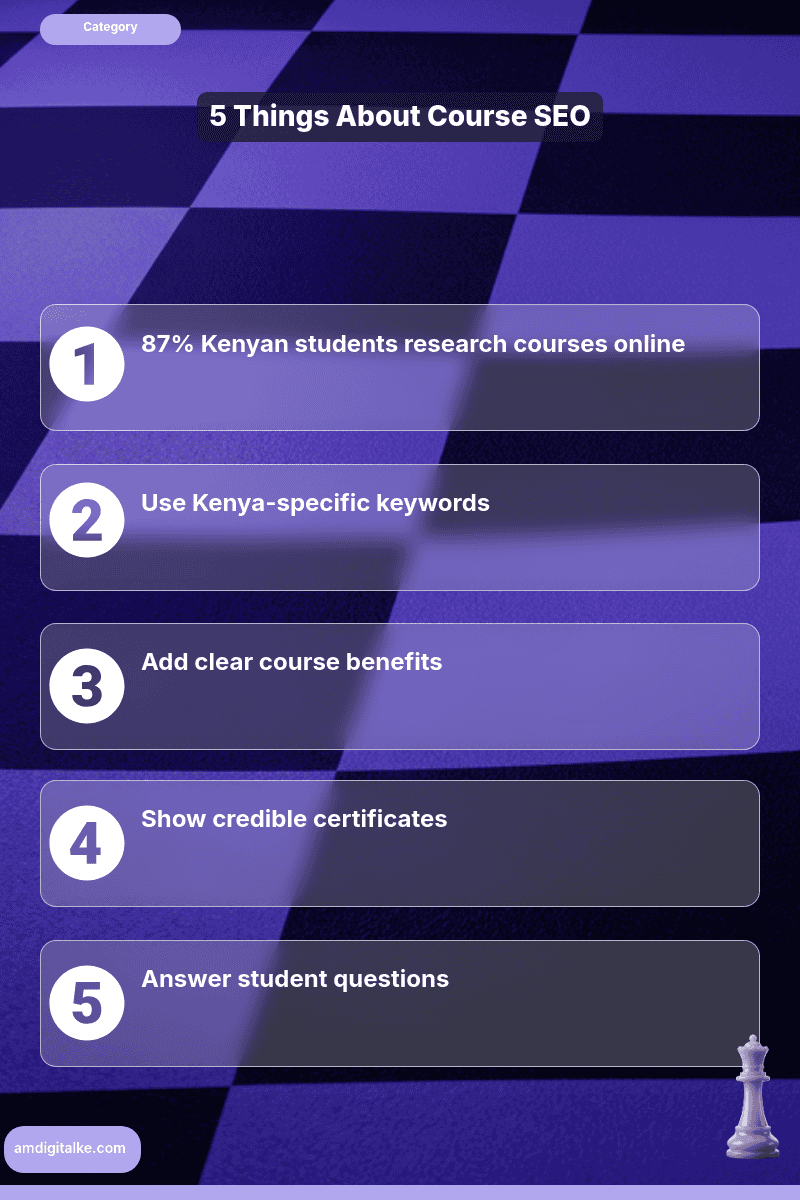
1. Strategic Keyword Targeting for Each Course
Don’t target “online courses” generically.
Each course page needs its own keyword strategy based on what Kenyan students actually search.
Program keywords: “digital marketing course,” “data science bootcamp,” “graphic design training”
Location modifiers: Add “Kenya,” “Nairobi,” “online Kenya” naturally
Outcome keywords: “certificate course,” “professional diploma,” “career training”
Student intent: “learn [skill],” “how to become [profession],” “[skill] for beginners”
Example: Instead of optimising for just “web development course,” target “web development certificate course Kenya” or “learn web development online Nairobi.”
Implementing proper keyword research helps you identify these exact student search patterns.
2. Title Tags That Convert Searchers to Students
Your course title tag is your first impression in Google search results.
Use this proven formula:
[Course Name] – [Key Benefit] | [Credential] | [Platform Name]
Examples:
“Digital Marketing Masterclass – Get Certified in 12 Weeks | Professional Diploma | LearnHub Kenya”
“Python for Data Science – Land Your First Tech Job | Industry-Recognised Certificate | CodeAcademy KE”
Keep it under 60 characters.
Include your primary keyword, and emphasise the outcome or credential. Kenyan students want to know what they’re working toward.
3. Rich Course Descriptions with Search Intent
Your course description needs to answer the questions Kenyan students ask Google.
Understanding what search intent really means is critical.
What will I learn? List specific skills and modules with keywords naturally embedded.
Instead of “Module 1: Introduction,” write “Module 1: Social Media Marketing Fundamentals – Master Facebook Ads, Instagram Marketing, and Twitter for Business.”
Who is this for? Be explicit: “Perfect for Nairobi-based entrepreneurs, marketing professionals, or career changers looking to break into digital marketing.”
What outcomes can I expect? Include specific, measurable results: “Graduate with 5 portfolio projects, industry-recognised certification, and job-ready skills used by top Kenyan companies like Safaricom and Equity Bank.”
Structure your description with H2 and H3 subheadings that target keyword variations:
H2: “What You’ll Learn in This Digital Marketing Course”
H3: “Social Media Marketing for Kenyan Businesses”
H3: “Google Ads and SEO Strategies”
4. Schema Markup for Course Pages
Schema markup is code that tells Google exactly what your page offers.
For course pages, it’s non-negotiable. Understanding what schema markup means helps you implement this properly.
Implement the Course schema to display:
- Star ratings and reviews in search results
- Course duration and format (online, self-paced, instructor-led)
- Pricing in Kenyan Shillings
- Provider information
When Google understands your course structure, you can appear in rich snippets showing course details directly in search results.
This gives you significantly more visibility than competitors without schema.
5. Student Reviews and Social Proof SEO
Reviews are ranking signals.
Pages with authentic student testimonials rank higher because they signal quality to Google. But beyond SEO, reviews answer the #1 question Kenyan students have: “Is this course worth it?”
Encourage students to leave detailed reviews mentioning:
- Specific skills they learned
- How the course helped their career (with job titles and companies when possible)
- Why would they recommend it to other Kenyans
Display reviews prominently on course pages with star ratings, student names (with permission), and their locations in Kenya.
“This course helped me land a marketing role at a Nairobi fintech startup” carries more weight than generic praise.
6. Internal Linking Between Related Courses
Each course page should link to 2-3 related courses to help both students and Google understand your course catalogue structure.
Understanding what internal linking means for site architecture is essential.
“Students who took Digital Marketing also enrolled in: Content Writing Masterclass, SEO Fundamentals, and Social Media Strategy”
“Advance your skills: After completing Python Basics, try Data Analysis with Python or Web Development with Django”
This creates a content cluster around topics, showing Google you have comprehensive expertise in that subject area.
Need help with technical implementation?
Check out our SEO FAQs page for detailed answers to common e-learning optimisation questions.
7. Mobile-First Course Page Design
Most Kenyan students research courses on mobile devices.
Usually on Safaricom or Airtel networks with varying speeds. Your course pages must load fast and display perfectly on small screens.
Understanding what technical SEO means ensures your pages perform well on mobile.
Optimise for mobile by:
- Using a responsive design that adapts to any screen size
- Breaking course descriptions into scannable sections with bold subheadings
- Placing CTA buttons (“Enrol Now,” “Download Syllabus”) where thumbs naturally reach
- Compressing images and videos (especially course previews)
- Testing on actual Kenyan mobile networks, not just fast WiFi
A slow course page on mobile doesn’t just hurt SEO.
It costs you enrollments.
A Nairobi-based coding bootcamp optimised its 15 course pages using this framework.
They added detailed course descriptions with keyword-rich module breakdowns, implemented the Course schema, and encouraged student reviews with specific outcomes mentioned.
Before optimisation:
❌ Ranking page 3-5 for “[course name] Kenya” keywords
❌ 450 monthly organic visitors to course pages
❌ 12 course enrollments from search per month
After 5 months:
✅ 9 courses ranking in the top 3 for primary keywords
✅ 3,200+ monthly organic visitors to course pages
✅ 89 course enrollments from search per month
The strategy: They treated each course page as a landing page worthy of optimisation, not an afterthought.
They focused on answering student questions directly in course descriptions, showcasing real graduate outcomes, and making pages mobile-first for Kenyan learners researching on their phones.
Your Course Page SEO Checklist
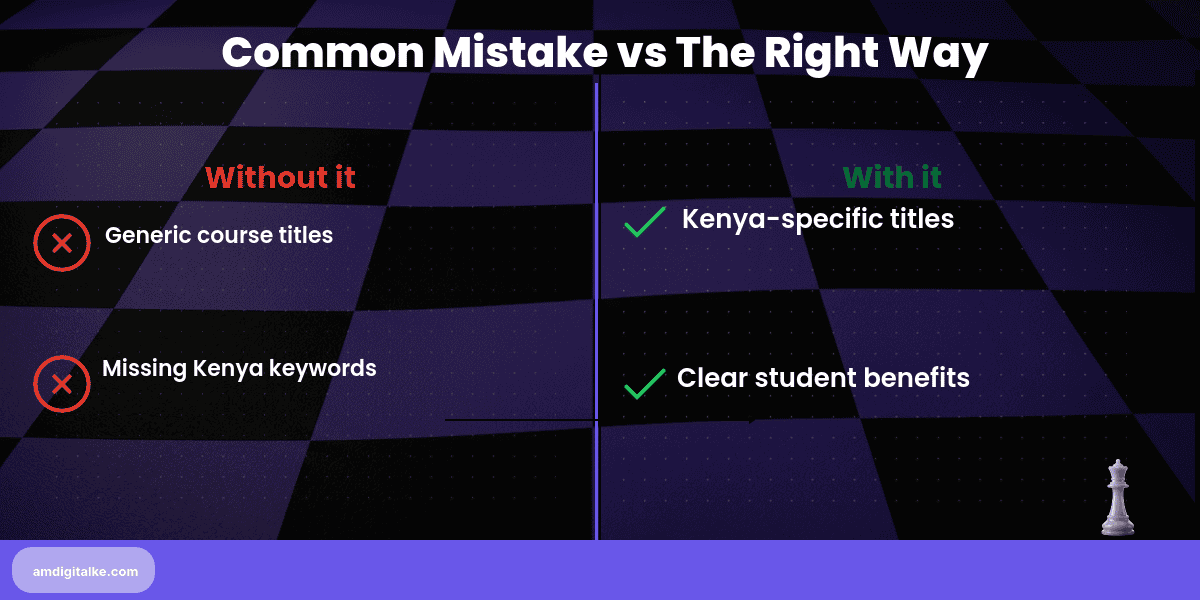
Before launching your optimisation, download this complete SEO Checklist to ensure you’re covering all essential elements.
☐ Keyword research: Identify 3-5 keywords per course page based on student search intent
☐ Optimise title tags: Use formula [Course] – [Benefit] | [Credential] | [Platform] (under 60 chars)
☐ Write detailed descriptions: Include specific modules, outcomes, and “who this is for” sections (500+ words)
☐ Add schema markup: Implement Course schema for rich snippets with ratings, pricing, and duration
☐ Collect student reviews: Display authentic testimonials with specific outcomes and locations
☐ Internal linking: Link 2-3 related courses and learning paths from each course page
☐ Mobile optimisation: Test course pages on Safaricom/Airtel networks for speed and usability
Course page optimisation isn’t just about rankings.
It’s about helping Kenyan students find the right learning path when they’re actively searching.
At AM Digital KE, we help e-learning platforms build education SEO strategies that connect courses with students ready to enrol.
Want your courses to appear when students search for skills training?
Visit our Education SEO Services in Kenya and see how we optimise course pages to rank for high-intent searches and convert researchers into enrolled students.
Wondering why competitors enrol students you could teach?
Get a free SEO analysis review where we’ll analyse your course page optimisation, assess your schema implementation, and identify student search patterns filling competitor classrooms instead of yours.
Related Content
Curious to learn more about education SEO? Check out the posts below:
- What is On-Page SEO? – Explained By A Kenyan SEO Specialist — On-page SEO is the foundation of course page optimisation, covering title tags, meta descriptions, and content structure.
- How to Rank on SERPs for Your Kenyan Business — See the complete process of taking course pages from unranked to top positions in competitive education searches.
- What is a Meta Description (Through a Kenyan Lens) — Learn how to write meta descriptions that convert course researchers into enrolled students when they see your listing.
- Why Search Intent Beats Search Volume: The Strategic SEO Move — Understanding student search intent helps you create course descriptions that match what learners actually need.
These articles will help you build a comprehensive e-learning SEO strategy that fills classrooms.
Have more SEO questions? Our SEO FAQs Kenya page answers the most common ones.
Frequently Asked Questions
What is course page SEO?
Course page SEO helps your online course rank on Google when Kenyan students search for courses like ‘digital marketing training Nairobi’.
Why does Kenya need special SEO?
Kenyan students search uniquely, using local phrases like ‘online Kenya’ and ‘Nairobi certificate courses.’ Tailor SEO to these patterns.
Can SEO help enrolments?
Yes. Good SEO puts your course top for Kenyan students ready to enrol in courses like coding or business management.