Table of Contents
- Why Law Firms in Kenya Need SEO (And Why It’s Different)
- 📋 Key Takeaways
- What You Need Before You Start
- Step 1: Research and Target the Right Keywords
- Step 2: Optimize Your Google My Business Profile
- Step 3: Create Content That Answers Your Clients’ Legal Questions
- Step 4: Build Backlinks From Kenyan Legal and Business Sites
- Step 5: Fix Technical SEO Problems on Your Website
- Common Mistakes to Avoid 🚫
- Table: SEO Tasks by Timeline
- ✅ Quick Action Checklist
- Ready to Improve Your Law Firm’s Google Rankings?
- Frequently Asked Questions
- Additional Resources
- Take the Next Step
TL;DR: Law firms in Kenya lose clients because their websites don’t show up on Google when people search for legal help. SEO for law firms works differently than other businesses because clients search for specific legal problems, not just law firm names. This guide shows you exactly how to get found locally, build trust through content, and turn Google searches into paying clients.
Why Law Firms in Kenya Need SEO (And Why It’s Different)
A law firm in Nairobi with 15 years of experience and a stellar reputation still loses cases to younger competitors with better Google rankings.
Your potential clients are not searching for “law firm near me” on Google. They are searching “how to handle a land dispute in Kenya” or “divorce lawyer in Westlands” or “company registration requirements for startups.”
This is the core difference between law firm SEO and other business SEO. Your clients search for specific legal problems first, then choose a lawyer.
When someone types “property lawyer Nairobi” into Google, they are ready to hire. They have a problem that needs solving right now.
If your firm doesn’t appear in the top three results, they will call someone else. The good news is that SEO in Kenya is not complicated.
It is systematic. You need to understand how your clients search, what Google rewards, and how to build a website that converts searches into consultations.
📋 Key Takeaways
- ☑ Kenyan law firm clients search for specific legal problems, not law firm names. Target these problem-based keywords first
- ☑ Google My Business is your fastest win for local rankings in Nairobi, Mombasa, and other cities
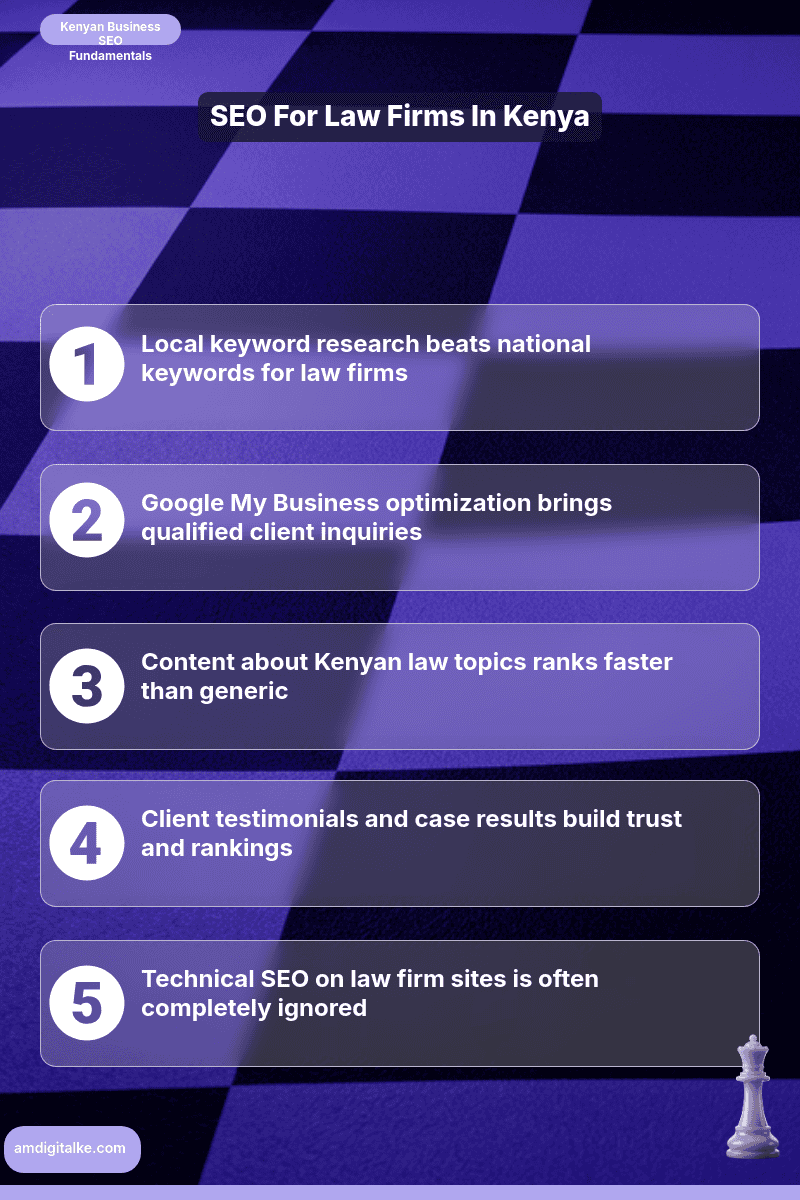
- ☑ Content about Kenyan law topics (succession law, employment law, land disputes) ranks faster than generic legal content
- ☑ Client testimonials and case results build both search rankings and trust simultaneously
- ☑ Most law firm websites fail on technical SEO basics: site speed, mobile optimization, and proper heading structure
What You Need Before You Start
Before you write one word of content or change one thing on your website, you need three things in place. Without these, your SEO effort will waste time and money.
A Working Website That Loads Fast
Your law firm website must load in under three seconds on mobile phones. In Kenya, most people search on phones using 4G or 3G connections, not fiber at home.
If your website takes seven seconds to load, Google ranks it lower. More importantly, clients leave before it loads and call a competitor instead.
Test your website speed right now using Google PageSpeed Insights. If it scores below 50 on mobile, fix this first before doing anything else.
Google My Business Profile That Is Fully Completed
Google My Business is a free tool that shows your law firm on Google Maps and in local search results. Most Kenyan law firms either do not have one or have one with incomplete information.
Your profile must include your full address, phone number, office hours, practice areas, and at least 10 photos of your office. When someone in Nairobi searches “employment lawyer,” Google shows the three closest law firms with complete profiles first.
A Clear Understanding of Your Client’s Search Journey
You must know exactly how your ideal client searches for legal help. This is not a guess.
You must research it.
If you handle divorce cases, your clients search “divorce lawyer Nairobi” or “how much does divorce cost in Kenya” or “what happens to property in a divorce Kenya.” They do not search “family law services provider.”
Write down the 20 searches that your ideal clients actually type into Google. This list becomes your SEO foundation.
Step 1: Research and Target the Right Keywords
Keyword research for law firms means finding the exact words and phrases that potential clients type into Google when they need legal help. This is not about ego or fancy terms.
It is about matching how real people search. The same approach works for SEO for SACCOs Kenya and other professional services.
Understand the Three Types of Legal Searches
Your clients search in three ways, and each type needs different content. First, they search for information: “what is a deed of transfer in Kenya” or “how long does a court case take.”
Second, they search for local services: “employment lawyer Nairobi” or “tax consultant Mombasa.” Third, they search for problem solutions: “I was fired illegally what can I do” or “how to challenge a will in Kenya.”
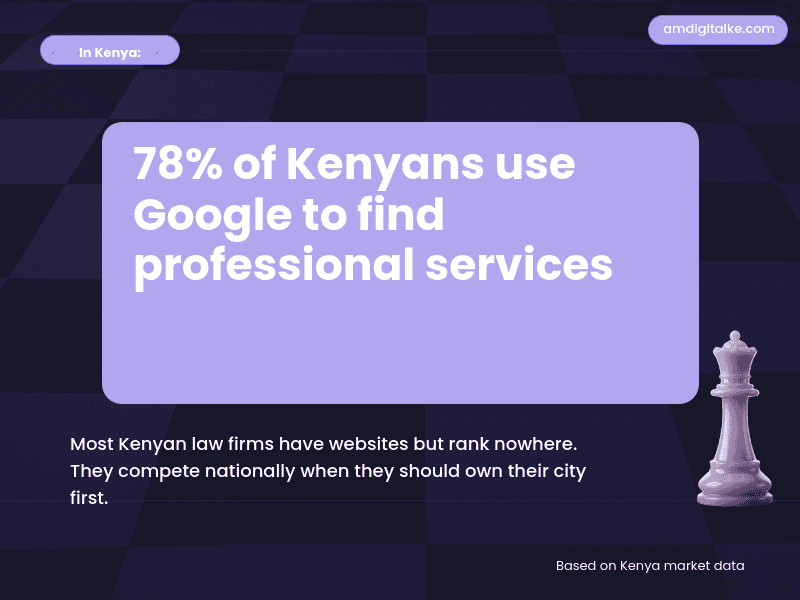
Most law firms only target the second type (local services). This is a mistake because the first type (information) brings you more traffic, and the third type (problem solutions) brings you more qualified leads.
Use Free Tools to Find What Clients Actually Search
You do not need expensive software. Use Google Keyword Planner (free, inside Google Ads) to see how many people search for specific phrases each month.
Type in “divorce lawyer Kenya” and Google tells you the search volume. Also use Google’s autocomplete feature.
Type “employment law” into Google search and look at the dropdown suggestions. Those are real searches people make every day.
Screenshot these and add them to your keyword list. Most importantly, ask your existing clients how they found you and what they searched for.
Call five clients and ask “when you needed a lawyer, what words did you type into Google?” Write down their exact answers.
Build Your Keyword Target List
Create a spreadsheet with three columns: keyword, search volume, and difficulty. Focus on keywords with real search volume in Kenya that are specific to your practice area.
A law firm in Nairobi should target “commercial lawyer Nairobi” instead of “lawyer” because “lawyer” is too broad and too competitive. You will never rank for it, but “commercial lawyer Nairobi” is achievable in six to twelve months.
Step 2: Optimize Your Google My Business Profile
Google My Business is the single fastest way to get law firm clients from local searches. A complete, optimized profile can bring you inquiries within two weeks, even if your website is not finished yet.
This approach mirrors local SEO services Kenya strategies that work across industries.
Claim and Complete Your Profile
Go to google.com/business and search for your law firm name. If a profile exists, click “Manage this business” and verify ownership by phone or email.
If no profile exists, create one. Fill in every field completely.
Your address must be your actual office location in Nairobi, Mombasa, or wherever you practice. Add your phone number, website, and office hours.
This information must be exactly correct because Google uses it to show you in local searches.
Add Practice Areas and Service Categories
In the “Services” section, list every area of law you handle: family law, corporate law, real estate, employment law, intellectual property, whatever applies. For each service, add a description of what you do.
Use the exact keywords you researched earlier. If your keyword list includes “conveyancing lawyer Nairobi,” make sure you add “conveyancing” as a service with a description that uses that phrase naturally.
Upload Photos and Get Client Reviews
Upload at least 15 photos: your office entrance, reception area, meeting rooms, and you working with clients (if you have permission). Google prioritizes profiles with lots of photos.
Ask five of your best recent clients to leave a Google review. Send them a simple message: “We appreciated working with you on your case.
If you have a moment, would you leave us a review on Google? Here is the link.” Include the direct link to your Google review page.
Each review with keywords (like “great employment lawyer” or “helped me with my land dispute”) helps Google understand what you do and improves your local ranking.
Step 3: Create Content That Answers Your Clients’ Legal Questions
Content is the engine that drives law firm SEO. When you create helpful articles that answer real legal questions, Google ranks you higher and potential clients find you before they call competitors.
Strong website copywriting Kenya makes the difference between content that converts and content that gets ignored.
Write About Kenyan Legal Topics, Not Generic Legal Content
The biggest mistake Kenyan law firms make is copying content from American or British law websites. This content does not rank in Kenya because it does not answer Kenyan legal questions.
Write about Kenyan succession law, not generic inheritance law. Write about how to register a company under the Kenyan Companies Act, not general business incorporation.
Write about land disputes under Kenyan property law, not American real estate disputes. When you write about Kenya-specific legal topics, Google sees you as a local authority.
You rank faster and attract clients who actually need Kenyan legal advice.
Create a Content Calendar for Your Practice Areas
Choose your top five practice areas. For each one, write down ten questions that your clients ask you.
These become your content topics. If you handle employment law, your client questions might be: “Can my employer fire me without notice in Kenya?” “What is the minimum wage in Kenya?” “Can I sue for wrongful dismissal?” “What are my rights as a contract employee?”
Write one article for each question. Publish one article every two weeks.
After three months, you will have six articles ranking on Google. After one year, you will have 26 articles bringing you steady client inquiries.
Write Articles That Convert Readers Into Clients
Every article must have a clear structure: problem, explanation, Kenya-specific examples, and a call to action. At the end of each article, add a paragraph that says something like “If you are facing a similar situation, contact us for a free consultation.”
Use short paragraphs and simple language. Your readers are stressed people with legal problems, not lawyers reading law journals.
Explain complex ideas in plain English with examples from Nairobi life. Include a table or comparison in each article.
For example, an article about employment contracts could include a table comparing permanent contracts, fixed-term contracts, and casual labor agreements under Kenyan law. You can also target featured snippets by formatting answers clearly.
Step 4: Build Backlinks From Kenyan Legal and Business Sites
A backlink is when another website links to your website. Google sees backlinks as votes of confidence.
If other trusted websites link to you, Google trusts you more and ranks you higher.
Get Mentioned in Kenyan Business Publications
Write a short article or expert opinion for Kenyan business websites like Business Daily, The Standard, or industry-specific publications. Include a link back to your website in your author bio.
You do not need to write long pieces. A 300-word expert commentary on a recent court ruling or change in Kenyan law gets published quickly and brings you a backlink from a trusted source.
Partner With Complementary Services
Identify businesses that serve the same clients you do but do not compete with you. An accountant works with the same business owners you do.
A real estate agent works with the same clients who need conveyancing lawyers. Reach out and propose a link exchange or partnership.
“We will link to your website from our resources page, and you link to us from yours.” This is a simple, natural way to build backlinks.
List Your Law Firm in Kenyan Directories
Submit your law firm to Kenyan business directories, legal directories, and professional listings. Each listing is a backlink and also improves your local visibility.
Look for directories like Nairobi business directories, Kenya professional services listings, and industry-specific directories for your practice area. The same tactics that power ecommerce SEO services Kenya apply here: quality directories matter more than quantity.
Step 5: Fix Technical SEO Problems on Your Website
Technical SEO means fixing the behind-the-scenes problems that prevent Google from ranking your website. Most law firm websites have technical problems that kill their rankings, and the owners do not even know.
Make Your Website Mobile-Friendly
Based on AM Digital KE client data across Kenyan accounts, most internet users access websites on phones. If your website does not work well on mobile, Google ranks it lower and you lose clients.
Test your website on an actual phone (not just a computer). Tap the buttons. Do they work?
Read the text. Is it too small? Scroll down. Does the page load smoothly?
If anything feels broken or slow, fix it immediately.
Fix Your Site Structure and Navigation
Your website must be organized logically so that both Google and clients can find information easily. Create clear categories: Practice Areas, About Us, Client Testimonials, Blog, Contact.
Under Practice Areas, list each area of law you handle as a separate page. Under each practice area page, link to related blog articles.
This structure helps Google understand what your website is about and helps clients find what they need. Learn more about practice area pages that rank SEO for Kenyan law firms.
Add Proper Heading Tags to Every Page
Use heading tags (H1, H2, H3) to organize your content. Every page should have one H1 tag (the main title), then H2 tags for major sections, then H3 tags for subsections.
If your page is about “Divorce Lawyers in Nairobi,” your H1 should be that phrase. Your H2 tags might be “What to Expect,” “How Much Does It Cost,” “How Long Does It Take.”
This structure helps Google understand your page and improves rankings.
Common Mistakes to Avoid 🚫
Most Kenyan law firms make the same SEO mistakes over and over. Knowing what not to do is just as important as knowing what to do.
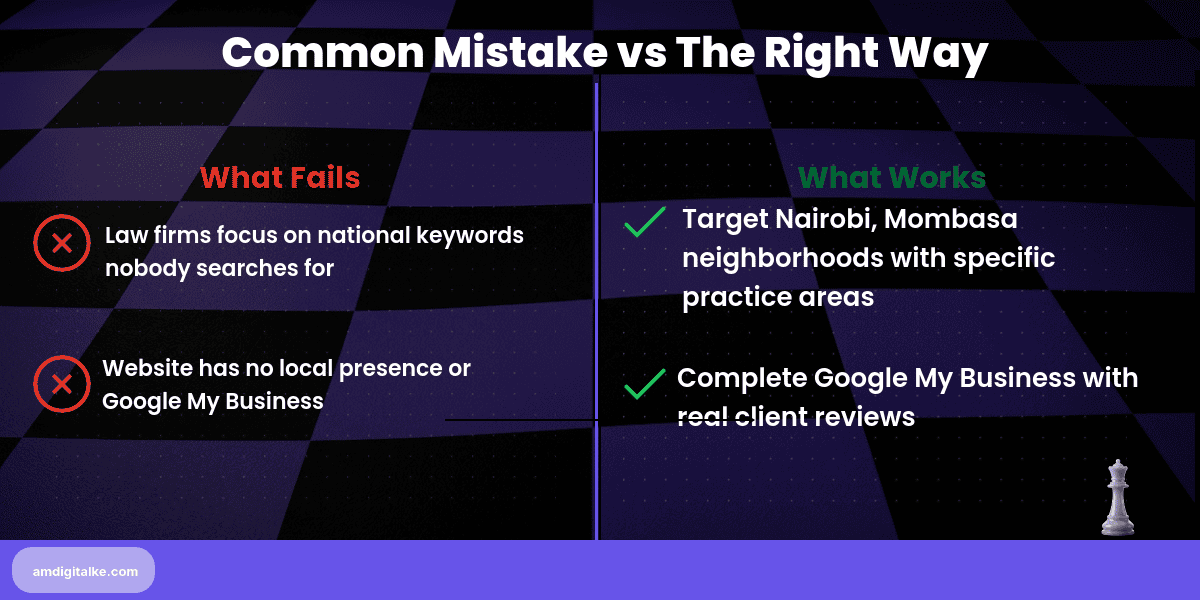
Mistake 1: Targeting National Keywords Instead of Local Keywords
A law firm in Mombasa targets “best lawyer Kenya” instead of “family lawyer Mombasa.” This is backwards.
You will never rank for “best lawyer Kenya” because it is too competitive, and even if you did, you would get clients from all over Kenya who cannot visit your office. Always target local keywords first: your city name plus your practice area.
“Property lawyer Nairobi” is ten times better than “property lawyer Kenya.” If you want broader reach later, consider national SEO services Kenya after dominating your local market.
Mistake 2: Writing Generic Content That Could Apply to Any Country
Your blog article about “how to start a business” that applies equally to Nigeria, South Africa, or Kenya is worthless for SEO. Google sees it as generic and ranks it low.
Write “How to Register a Business Under the Kenyan Companies Act” instead. Mention specific Kenyan requirements, costs, timelines, and government agencies.
This content ranks higher and attracts clients who actually need Kenyan legal advice.
Mistake 3: Ignoring Google My Business Because Your Website Is Not Perfect Yet
Many law firms delay setting up Google My Business because their website is still under construction. This is a costly mistake.
Google My Business brings clients immediately, even without a website. Set up your Google My Business profile today, even if your website needs work.
A complete Google My Business profile brings you inquiries while you finish your website.
Mistake 4: Never Asking Clients to Leave Reviews
Law firms are often too polite to ask for reviews. They think clients will volunteer to leave reviews on Google without being asked.
This almost never happens. You must ask directly.
After a case is resolved successfully, send a message: “Thank you for letting us help with your case. We would appreciate a review on Google. Here is the link.”
You will get reviews, and each one improves your ranking.
Mistake 5: Publishing Content Randomly Without a Strategy
A law firm publishes one blog post, then nothing for three months, then two posts, then nothing again. Google sees this as random activity and does not reward it with rankings.
Publish consistently: one article every two weeks, or one article every week. Google rewards consistency.
After 12 months of regular publishing, you will have 26 to 52 articles ranking and bringing you steady inquiries.
Table: SEO Tasks by Timeline
| Timeline | Task | Expected Result |
|---|---|---|
| Week 1-2 | Complete Google My Business profile with photos and reviews | Appear in local search results and Google Maps |
| Week 3-4 | Research keywords and create content calendar | Clear roadmap for 12 months of content |
| Month 2-3 | Publish first 4-6 blog articles on Kenya-specific topics | First articles begin ranking on Google |
| Month 4-6 | Build backlinks from Kenyan business sites and directories | Improved domain authority and local rankings |
| Month 6-12 | Continue publishing content, optimize based on results | 20+ articles ranking, steady client inquiries from Google |
✅ Quick Action Checklist
- ☐ Test your website speed on mobile using Google PageSpeed Insights
- ☐ Claim and complete your Google My Business profile with all information and photos
- ☐ Ask five recent clients to leave Google reviews
- ☐ Research and list 20 keywords your ideal clients actually search for
- ☐ Create a content calendar with one article topic for each keyword
- ☐ Write and publish your first blog article on a Kenya-specific legal topic
- ☐ Submit your law firm to three Kenyan business directories
- ☐ Fix heading tags (H1, H2, H3) on your main practice area pages
Ready to Improve Your Law Firm’s Google Rankings?
SEO for law firms in Kenya is not complicated, but it does require consistency and strategy. Start with Google My Business this week, publish your first article next week, and ask for reviews the week after.
Most Kenyan law firms do not do SEO at all, which means you have a real opportunity to dominate your local market. The law firms that rank on Google today will have more clients and higher revenue tomorrow.
Consider adding an AI chatbot for Kenya to your website to capture leads 24/7. Pair your SEO efforts with which social platforms matter for Kenyan businesses to maximize your digital presence.
Frequently Asked Questions
How long does it take for law firm SEO to work in Kenya?
Google My Business can bring results in two to four weeks. Blog articles typically start ranking in two to three months.
Full SEO results (where you rank for multiple keywords and get steady inquiries) take six to twelve months of consistent effort. Speed depends on competition in your area and how often you publish.
Do I need to hire an SEO agency or can I do this myself?
You can do basic SEO yourself: set up Google My Business, write blog articles, and ask for reviews. However, keyword research, technical fixes, and backlink building are easier with professional help.
Many Kenyan law firms do basic SEO themselves and hire help for the complex parts. Compare options like Savage Digital vs AM Digital KE or Artly vs AM Digital KE to find the right partner.
What if my law firm is in a small town, not Nairobi?
SEO works even better in smaller towns because there is less competition. A lawyer in Kisumu has an easier time ranking for “family lawyer Kisumu” than a lawyer in Nairobi has ranking for “family lawyer Nairobi.”
Follow the same steps but use your town name in your keywords.
Should I pay for Google Ads while I work on SEO?
Google Ads (paid search) and SEO (organic search) work together. Many law firms run both: Google Ads bring immediate clients while SEO builds long-term rankings.
You can start with just SEO and add Google Ads later if you want faster results.
What if I do not have time to write blog articles?
Hire a writer who understands Kenyan law to write articles for you. You review and approve them before publishing.
This costs money but saves time. Many Kenyan law firms hire freelance writers to handle content while they focus on client work.
Additional Resources
- SEO Checklist for Kenyan Businesses – Use this checklist to audit your law firm website against the same technical and content standards that help businesses across Kenya rank on Google.
- Legal SEO Services – See how professional legal SEO services structure campaigns specifically for Kenyan law firms, including practice area optimization and local citation building.
- Logistics & Supply Chain SEO Services – Learn how logistics companies use similar local SEO tactics to capture B2B clients searching for specialized services in Kenya.
- Education & eLearning SEO Services – Discover how educational institutions optimize for informational searches, a strategy law firms can adapt for legal education content.
- NGO & Nonprofit SEO Services – See how nonprofits build trust and authority through content, techniques that apply directly to law firm reputation building.
- Construction & Home Improvement SEO Services – Explore how construction firms target project-based searches, similar to how law firms should target case-type searches.
Take the Next Step
SEO is a long-term investment in your law firm’s growth, but the returns are real. Every article you publish is a potential client inquiry that comes to you automatically through Google.
Download the AM Digital KE Law Firm SEO Checklist to get a detailed month-by-month roadmap for your first year of SEO work.