Table of Contents
- Key Takeaways
- Why Most Kenyan Businesses Track the Wrong Metrics
- The 8 Metrics Every Kenyan Business Must Track
- Your Website Metrics Tracking Plan
- Related Content
- Frequently Asked Questions
- Why is bounce rate important for Kenyan websites?
- How do I track conversions for my Kenya business?
- What’s a good conversion rate for Kenyan websites?
- How do Kenya’s mobile users affect website metrics?
TL;DR: Track metrics that grow your Kenyan business, not vanity numbers. Focus on organic traffic, conversions, and local relevance.
Last Updated: March 2026
Key Takeaways
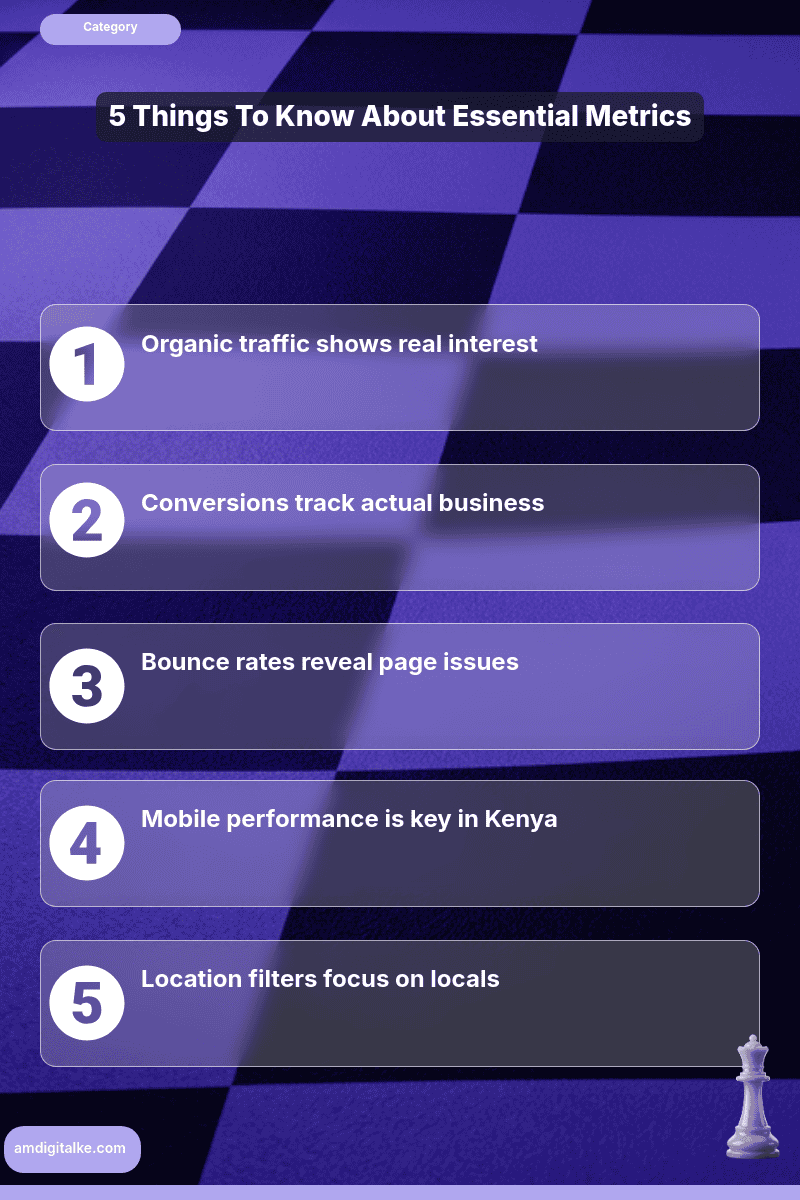
- Organic traffic from target keywords matters most
- Conversion rates show real business impact
- High bounce rates signal page issues
- Mobile performance is critical in Kenya
- Location filters help focus on local customers
Your website gets traffic. You see numbers in Google Analytics.
But here’s the question that matters: Are you tracking the metrics that actually grow your Kenyan business, or just vanity numbers that look good in reports?
Most Nairobi business owners check their website stats and feel confused by the data overload. Others feel falsely confident because “traffic is up,” when what matters is whether that traffic converts, a point we make for hotels chasing direct bookings in our hotel ranking tactics breakdown.
Neither helps you make better decisions.
Why Most Kenyan Businesses Track the Wrong Metrics
Total website visits sound impressive. Your developer shows you a graph with 5,000 monthly visitors.
You feel good.
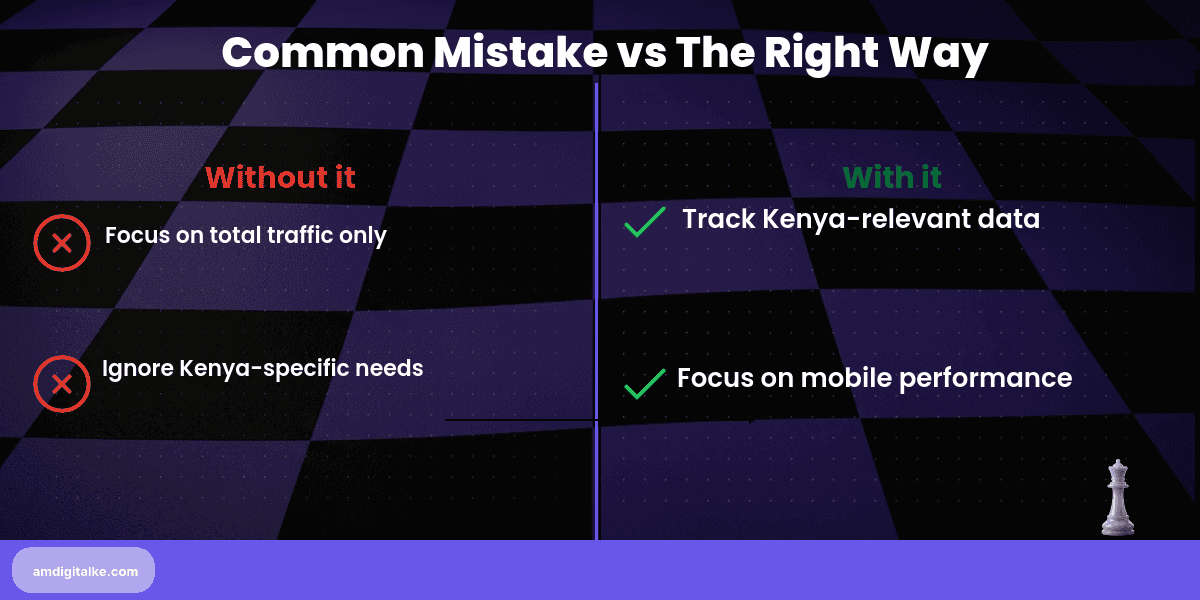
But if those visitors are bouncing after 3 seconds, coming from irrelevant searches, or never converting into customers, that traffic is worthless.
The problem isn’t that you lack data. Understanding what Google Analytics means gives you dozens of metrics.
The problem is knowing which metrics actually predict business growth. This is especially true for Kenyan businesses competing in local markets with unique challenges like mobile-first users and slower connection speeds.
The 8 Metrics Every Kenyan Business Must Track
1. Organic Traffic from Target Keywords
What It Measures: Visitors finding you through Google searches for your actual services.
Why It Matters: Someone searching “personal injury lawyer Nairobi” is far more valuable than someone who landed on your site by accident. Track traffic from your target keywords separately to understand what Google Search Console means.
Kenya Context: Filter by location. Traffic from Nairobi matters more for your Westlands law firm than traffic from New York.
2. Conversion Rate by Traffic Source
What It Measures: Percentage of visitors who complete your desired action (form submission, phone call, purchase).
Why It Matters: A clinic with 500 visitors and 50 appointment bookings (10% conversion rate) is doing better than one with 2,000 visitors and 40 bookings (2% conversion rate). Quality beats quantity.
How to Track: Set up goals in Google Analytics for form submissions, phone clicks, and checkout completions.
3. Bounce Rate for Key Pages
What It Measures: Percentage of visitors who leave without clicking anything.
Why It Matters: High bounce rates above 70% on service pages mean visitors aren’t finding what they expected. This kills your rankings over time because Google sees users rejecting your content.
Kenya Alert: Mobile bounce rates are typically higher due to slower loading. If your bounce rate is above 80% on mobile, your site is too slow for Kenyan networks.
For more guidance on tracking setup, check out my SEO FAQs page, where I explain bounce rate benchmarks for different industries.
4. Average Page Load Time
What It Measures: How fast your pages load for real users.
Why It Matters: 53% of mobile users abandon sites that take longer than 3 seconds to load. In Kenya, where many users are on 3G or inconsistent 4G, every extra second costs you customers.
Target for Kenya: Under 3 seconds on 3G connections. Test using Google PageSpeed Insights with throttling enabled.
Understanding what Page Speed means helps you diagnose and fix loading issues.
5. Mobile vs. Desktop Performance Gap
What It Measures: Difference in conversion rates between mobile and desktop users.
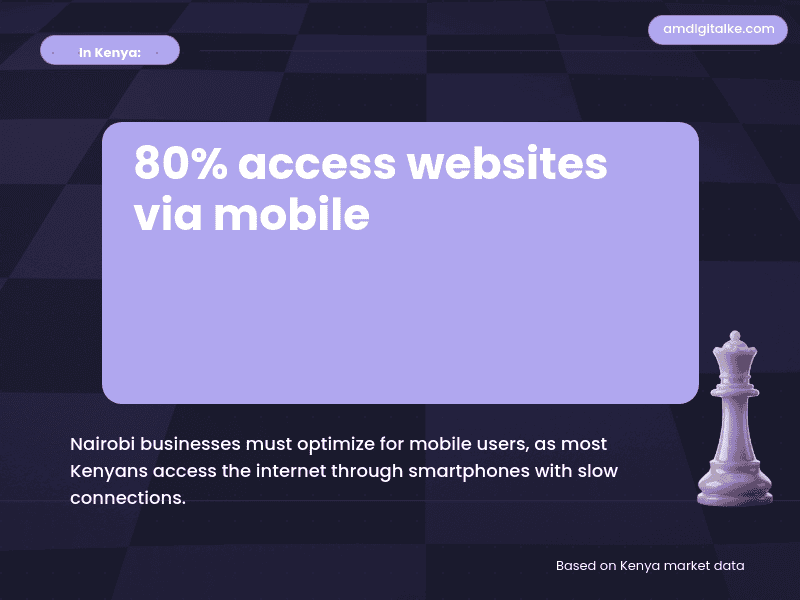
Why It Matters: If desktop converts at 8% but mobile at 2%, you’re losing money. Over 75% of Kenyan web traffic is mobile, so your site must work flawlessly on phones.
Check This: Compare bounce rates, time on page, and conversions between devices in Google Analytics.
6. Local Search Visibility (Google Business Profile Insights)
What It Measures: How often your business appears in local search results and map searches.
Why It Matters: For businesses with physical locations, appearing in “near me” searches is more valuable than ranking #1 for generic terms. A Kilimani restaurant needs Karen residents searching “restaurant near me,” not people in Mombasa.
Track Weekly: Total searches (direct + discovery), phone calls, direction requests, and website clicks from your optimising your Google Business Profile.
7. Keyword Rankings for Money Terms
What It Measures: Your position in Google for keywords that drive customers.
Why It Matters: Ranking #12 for “real estate agent Nairobi” gets you zero traffic. Ranking #3 gets you customers.
Track your position for your top 10 money keywords weekly.
Kenya Focus: Track rankings with “Kenya” or “Nairobi” modifiers. That’s where the commercial intent lives for improving your Local SEO performance.
8. Cost Per Acquisition from Organic Search
What It Measures: Total SEO investment divided by customers acquired through organic search.
Why It Matters: This tells you if understanding what SEO really means is actually profitable. If you’re spending KES 50,000/month on SEO and getting 5 clients worth KES 20,000 each, your ROI is positive.
If you’re getting 2 clients worth KES 15,000, it’s not.
Calculate Monthly: (SEO costs) ÷ (customers from organic search) = cost per acquisition
A Westlands financial advisory firm was celebrating 3,000 monthly website visits. But when we dug into their metrics, we found:
- 85% bounce rate (visitors leaving immediately)
- 6-second average load time on mobile (killing conversions)
- Only 12% of traffic from Kenya (the rest was irrelevant international traffic)
- 0.5% conversion rate (15 inquiries from 3,000 visits)
After focusing on the metrics that mattered, improving mobile speed, targeting Kenya-specific keywords, and optimising for conversions, their results after 4 months:
- 47% bounce rate (visitors actually engaging)
- 2.8-second load time on Safaricom 4G
- 89% of traffic from Kenya (relevant audience)
- 4.2% conversion rate (126 qualified inquiries from 3,000 visits)
Same traffic volume. 8x more customers.
That’s the power of tracking what matters.
Your Website Metrics Tracking Plan
Week 1: Set Up Proper Tracking
→ Install Google Analytics 4 and Google Search Console (20 minutes)
→ Set up conversion goals for form submissions and phone clicks (15 minutes)
→ Connect your Google Business Profile to track local search data (10 minutes)
Week 2-4: Establish Your Baseline
→ Document current metrics for all 8 areas listed above
→ Identify your biggest weakness (high bounce rate? Slow mobile speed? Low conversion?)
→ Choose ONE metric to improve first. Don’t try to fix everything at once.
Month 2-3: Optimise & Measure
→ Implement improvements targeting your weakest metric
→ Check weekly to see if changes are working
→ Adjust strategy based on what the data tells you
Before you start implementing changes, download this complete SEO Checklist to ensure you’re tracking all critical metrics properly.
Pro Tip: Create a simple monthly dashboard with just these 8 metrics. If you’re checking 30 different stats, you’re tracking too much.
Focus creates results.
Tracking website metrics isn’t about collecting data. It’s about understanding what drives growth.
At AM Digital KE, we help businesses move beyond vanity metrics. We track, analyse, and improve the numbers that actually drive customer growth and revenue.
Tracking traffic but not sure if it’s growing your business? Check out our Analytics Services in Kenya and learn which metrics actually predict revenue growth for Kenyan businesses.
Learn which vanity numbers to ignore.
Drowning in data but starving for insights? Schedule an SEO audit where we’ll review your current tracking setup.
We’ll identify which numbers drive your specific business model. We’ll create a simple dashboard focused on growth metrics that matter.
Related Content
Curious to learn more about analytics and measurement? Check out the posts below
- How to Make Decisions with Google Analytics — This guide shows you how to turn raw metrics into actionable business decisions that drive revenue.
- What is CTR — Understanding click-through rates helps you interpret your Search Console data and identify underperforming pages.
- How to Optimise Page Speed — Page speed is one of the 8 critical metrics. Learn how to improve it for Kenyan mobile users.
- National SEO Services — See how we help Kenyan businesses track and improve these 8 metrics systematically for sustainable growth.
These articles will help you build a complete measurement framework that drives decisions.
Have more SEO questions? Our SEO FAQs Kenya page answers the most common ones.
Frequently Asked Questions
Why is bounce rate important for Kenyan websites?
High bounce rates mean visitors leave fast, signaling content or page issues. Nairobi users on mobile often leave slow-loading pages.
How do I track conversions for my Kenya business?
Set up goals in Google Analytics for actions like M-Pesa payments, Nairobi clinic bookings, or Nairobi hotel reservations.
What’s a good conversion rate for Kenyan websites?
Based on AM Digital KE client data across Kenyan accounts, Nairobi businesses average 3-5% for e-commerce and 5-10% for service-based sites.
How do Kenya’s mobile users affect website metrics?
Most Kenyan users access websites via mobile, so optimize for fast loading and mobile-friendly design to improve metrics.