Table of Contents
In short: Start SEO by picking a few searches your buyers really type, fixing your basic pages and publishing helpful articles steadily. SEO isn't social media posting. You may see movement early, but proper results start around month 3.
Key takeaways
- Ads stop bringing visits when the budget stops, while a page that ranks keeps bringing visits without a new bill.
- Long-tail searches bring fewer visits at first, but the visitors are highly targeted.
- You can do the basics yourself; the steady weekly publishing is what takes the time.
- Before paying an agency, ask what's included, whether you approve changes, whether there's a lock-in and how they report.
- Compare what each SEO quote includes, not just the monthly price.
You’ve got a new website, a small budget and a lot of people telling you that you need SEO. For a startup, the start depends on one choice: a few searches your buyers really type, not every search you could chase.
Get that choice right and each later step has a clear target. By the end of this page, you’ll know what to do first, what you can handle yourself and what to check before you pay anyone.
Is SEO worth it for a young business?
Why ads alone cost a startup more
Running a startup in Kenya is expensive, and every shilling has a job to do. Ads feel like the quick answer, but you pay for every click, and the visits stop the day the budget stops.
SEO works another way. It reaches people who are already searching for what you sell, and a page that ranks keeps bringing those people in without a new bill for each visit.
Say you run a new office cleaning company in Nairobi. Someone who types “office cleaning services Westlands” into Google already has an office to clean and a reason to call.
That person is closer to hiring you than someone scrolling past an ad. I’ll stay with this cleaning company through the steps below, because it makes each one easier to picture.
Can SEO bring in sales and leads?
It can, because the people it brings are close to buying. I can’t promise how many enquiries any one business will get, since that depends on your market, your site and how fast you reply.
What I can tell you is where the leads come from. A search with buying intent, meaning the words show the person wants to buy or hire soon, tends to bring visitors who call, message or ask for a quote.
Start with long-tail searches
The searches I point startups to first are long-tail searches: longer, more specific phrases like “deep cleaning for offices in Kilimani” rather than “cleaning”.
They bring fewer visits at first, while your harder, broader articles take time to rank. But the visitors are highly targeted, so a small number of them is more likely to become a real enquiry.
Why many Kenyan businesses still skip SEO
Many of the founders I speak to think SEO means posting on Instagram, TikTok or Facebook. It’s an understandable mix-up, because many Kenyan businesses are visible on social media, and both often get called “digital marketing”.
Social posts reach people who are scrolling. SEO is about the people who stop and search, and it lives on your own website, which you control, rather than on a platform’s feed.
That gap can work in your favour. While competitors put their effort into social media, the search results for your service may have room for a newcomer, and I explain the difference further in what SEO is in Kenya.
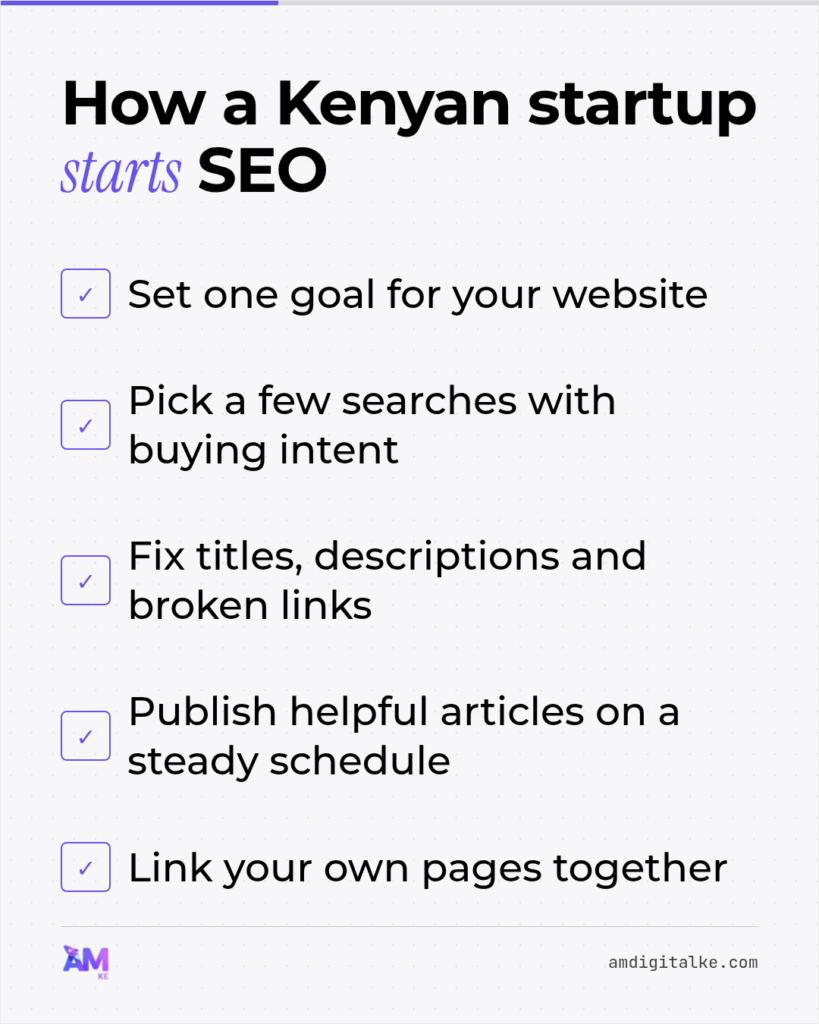
How to start SEO as a beginner: the steps
Work through these steps in order. Each one makes the next easier, and jumping ahead is where a lot of wasted effort comes from.
Step 1: Set one goal for your website
Write down the one thing you want people to do after they find you: request a quote, send a WhatsApp message, book a visit or buy online.
What you should see: one sentence every page can point to. For the cleaning company, that’s “get offices in Westlands and Kilimani to request a quote”.
What goes wrong most often: aiming for “more traffic” with no goal behind it. Visits that lead nowhere cost you time and tell you nothing about what’s working.
Step 2: Pick a few searches with buying intent
Choose three to five searches your buyers really type, where the words show they’re ready to hire or buy. Start with the words customers use when they call or message you.
Then type those phrases into Google and look at the suggestions it offers as you type, and at the pages that already rank. If the top results are businesses selling the same service, you’ve found a buying search.
What you should see: a short list like “office cleaning Westlands”, “post-construction cleaning Nairobi” and “office cleaning quote”. My guide on how to do keyword research walks through finding and checking them.
What goes wrong most often: picking the biggest searches because more people type them. A word like “cleaning” draws job seekers and people wanting home tips, which is why search intent beats search volume on a small budget.
Step 3: Fix your basic pages
Give each key page (home, services, about, contact) its own title and description, the two lines Google shows in its results. Put the search that page is for in its title.
Next, fix broken links, the ones that lead to an error page, and add titles to any pages missing them. Google Search Console, a free tool from Google, lists many of these problems for you.
What you should see: every key page with a title that says what you do and where, like “Office Cleaning in Westlands | Your Company Name”.
What goes wrong most often: the same title on every page, often just the business name. Google then can’t tell your pages apart, and none of them stands out for its search.
Step 4: Set up your Google Business Profile
If you serve customers in a set area, claim your free Google Business Profile, the listing that shows on Google Maps and in local results. Fill in your category, service area, hours, phone number and photos.
What you should see after verification: your business on Maps when you search its name. Appearing for local service searches is not guaranteed.
What goes wrong most often: a half-filled profile with the wrong category, or a phone number that doesn’t match your website. If you sell only online across Kenya, skip this step for now and give the time to Step 5.
Step 5: Write helpful articles that answer real questions
Write one article for each real question a buyer asks before hiring you. For the cleaning company, that could be “how often should an office be deep cleaned” or “what’s included in post-construction cleaning”.
Publish on a schedule you can keep, even if it’s one article a week. Steady publishing is what builds results over the months.
What you should see: each article ending with a clear way to reach your goal, such as a quote form or a WhatsApp button.
What goes wrong most often: writing about your company instead of the buyer’s question, or publishing a burst of articles and then stopping. Unedited AI drafts are another trap, because they tend to repeat what every other page says.
Step 6: Link your own pages together
Inside each article, link to the service page it relates to, and link related articles to each other. These links between your own pages help Google understand your site and help readers reach the page where they can buy.
What you should see: no page standing alone, and every article leading to a service page.
What goes wrong most often: links on words like “click here”, which tell Google and the reader nothing about the page they open.
How long before SEO starts working?
You may see movement early, but proper results start around month 3. In the first weeks, that movement usually looks like your pages appearing in Search Console for a few searches.
I understand that three months feels long when money is tight. But a page that ranks keeps bringing visits without a new bill, and every article you add builds on the ones before it.

SEO checklist for a startup
Work through this list in your first few weeks. Each line is one task you can tick off.
- Choose one goal for your website, such as quote requests or WhatsApp messages.
- Write down three to five searches your buyers really type.
- Add a clear title and description to each key page.
- Fix broken links and pages with missing titles.
- Claim and complete your Google Business Profile, if you serve a local area.
- Plan your first articles, one for each real question buyers ask.
- Link each article to its service page and to related articles.
- Set up tracking with Google Search Console and Google Analytics.
What to track from day one
Search Console shows which searches your pages appear for and how often people click. Google Analytics shows what visitors do once they arrive, including whether they reach your quote form or WhatsApp button.
Set both up before you change anything, so you can see what each fix does. When you’re ready for more, the complete SEO checklist for Kenyan businesses goes much deeper.
Can I do SEO myself, or should I hire someone?
What you can do yourself
You can do the basics in-house. Everything in the checklist above is work a founder or one team member can learn and do.
What takes the time is the steady part: researching searches, writing and editing articles every week, improving old pages and checking what’s working. Many founders I speak to start strong, then slow down once sales and hiring fill their week.
A fair way to decide is to do the setup yourself, then watch whether you can keep publishing. If you can’t, that steady work is the part worth paying for.
Is SEO dead now with AI?
No. People still search Google to find services, compare options and decide who to call, and AI answers draw on pages that explain things well.
What has changed is the standard. Thin pages stuffed with keywords hold up badly, while clear pages that answer a real question are the kind worth building.
Can ChatGPT do SEO?
ChatGPT and similar AI tools can help with parts of the work. They can suggest article ideas, draft outlines and help you write titles and descriptions faster.
They need your business details and access to the right tools to check facts or find website problems, and their findings still need checking. A person should choose the searches, edit every draft and decide what goes live.
What to ask an agency before you pay
I’ve tested 15 Kenyan SEO agencies and spoken to their past clients. These are the four questions I’d ask any of them before paying, us included.
- What exactly is included? Ask for the number of articles, pages improved and fixes each month, in writing.
- Do I approve what goes live? Nothing should appear on your site without you seeing it first.
- Is there a lock-in? Find out how long you’re tied in and what happens if you stop.
- How do you report? Ask for a report you can read without SEO terms explained, and a person you can question about it.
An agency that answers all four clearly is far easier to trust with your website.
How much does SEO cost in Kenya?
Prices vary a lot between providers, and the monthly figure alone tells you little. Compare what’s included: how many articles, who edits them, which fixes, how often you hear from them and whether you can leave.
What a fair price looks like
A fair price is one where you can see the work behind it. Two quotes at the same price can buy very different amounts of work.
Line up each quote against the four questions above. The cheaper quote can cost you more if it buys work that never ranks, because you’ve paid for months with nothing to show.
What Managed SEO includes
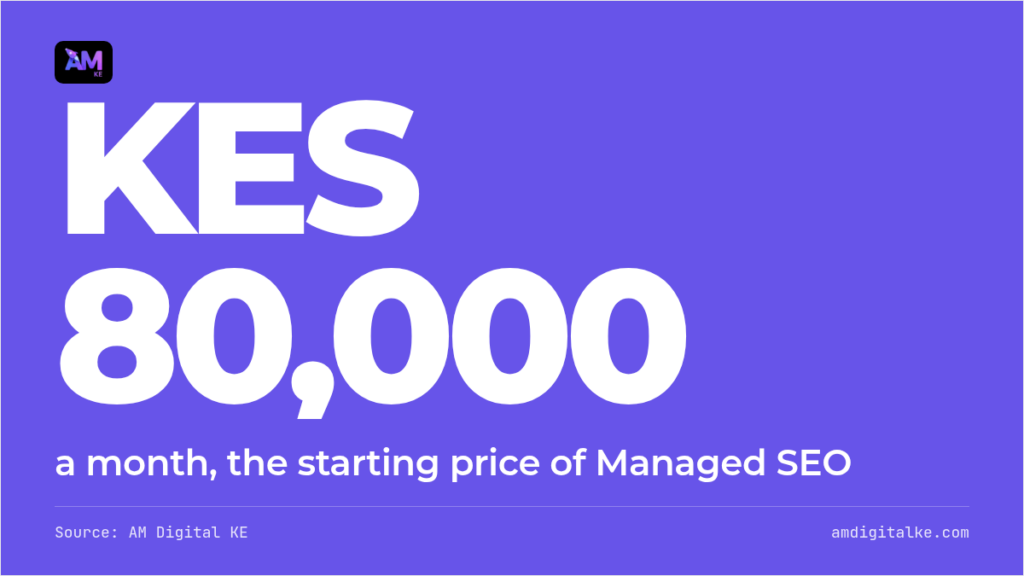
AM Digital KE sells one plan, Managed SEO, starting from KES 80,000 a month. There’s no menu of packages to choose between.
For that, you get:
- A strategy built for your business, run through our systems and carried out with you.
- Up to 30 articles a month, each read and edited by a person before you see it.
- 4 of your existing pages improved every month.
- Fixes to your current pages, such as broken links, redirects and missing titles.
- Links between your own pages, added every week.
- Social posts made from your articles.
- The SEO Brain, which you can ask anything, any day of the month.
- A plain-language report every month and a monthly call with me.
Nothing goes live on your site until you approve it, and there’s no lock-in contract. The social posts come from your articles, so this isn’t social media management.
That’s a real commitment for a startup. The upside is that it covers the steady weekly publishing and fixing that founders find hardest to keep up alongside everything else.
Your next step: a free SEO analysis
Before you spend anything, run our free instant SEO analysis of your site and city. It’s instant and needs no call, and a call afterwards is up to you.
You’ll go into your first three months knowing where your site stands, rather than guessing.
Additional resources
- SEO FAQs: Your Complete Guide to Search Engine Optimization in Kenya: Are you curious about SEO in Kenya, how it can help your business, and don’t know where to start?
- What is Content Marketing: I define all the common SEO terms for the Kenyan business community.
- Local SEO Services: Local SEO services for Kenyan businesses: Google Business Profile, citations, reviews, and local content.
- What is Technical SEO: I explain what technical SEO is in a simple but detailed way.
- What is On-Page SEO: Are you looking to improve your digital marketing?
- How to Build a Content Strategy: I teach you content marketing using Nairobi examples so you actually understand it.