Table of Contents
- 📋 Key Takeaways
- Why a One-Time Checklist Fails (And Why Monthly Discipline Wins)
- The 3 Phases of SEO: Setup, Optimization, Maintenance
- 📊 Your Monthly SEO Checklist: Week 1–4 Breakdown
- How to Automate Your Monthly Checklist (Tools for Kenyan Agencies)
- Real Example: How a Nairobi E-Commerce Store Uses This Monthly
- ✅ Common Mistakes to Avoid
- Your First Month: Quick Start Guide
- ✅ Quick Action Checklist
- Ready to Improve Your SEO with Monthly Discipline?
- Frequently Asked Questions
- Additional Resources
- Take the Next Step
TL;DR: Most Kenyan businesses complete an SEO checklist once, then wonder why their rankings disappear after three months. SEO is a monthly discipline, not a one-time project. This guide shows you how to use your checklist every month with a week-by-week system that takes four hours monthly and delivers sustained ranking growth.
You did SEO once. Your competitor does it every month.
That is why they own page one in Nairobi while you are still on page three.
I see this pattern constantly at AM Digital KE. A business owner downloads an SEO checklist, works through it diligently over two weeks, sees their rankings climb, then moves on to other priorities.
Three months later, they are back where they started. Their Google Business Profile has not been updated since February.
Their blog has not published new content in twelve weeks. Their rankings dropped 40% and they have no idea why.
The problem is not the checklist. The problem is treating SEO in Kenya like a project with a finish line instead of a system with a monthly rhythm.
This article teaches you how to use your SEO checklist as a recurring system. You will learn the week-by-week breakdown I use with Nairobi clients who maintain top-three rankings month after month.
📋 Key Takeaways
- SEO requires monthly maintenance, not one-time setup, to sustain rankings in competitive Kenyan markets
- A four-week checklist rhythm (content, technical, links, analytics) prevents ranking drops before they happen
- Monthly discipline takes four hours per month when you automate alerts and dashboards properly
- Kenyan businesses that abandon SEO after six months miss the compounding growth that starts in month four
- Week-by-week structure makes SEO manageable for business owners without full-time marketing staff
Why a One-Time Checklist Fails (And Why Monthly Discipline Wins)
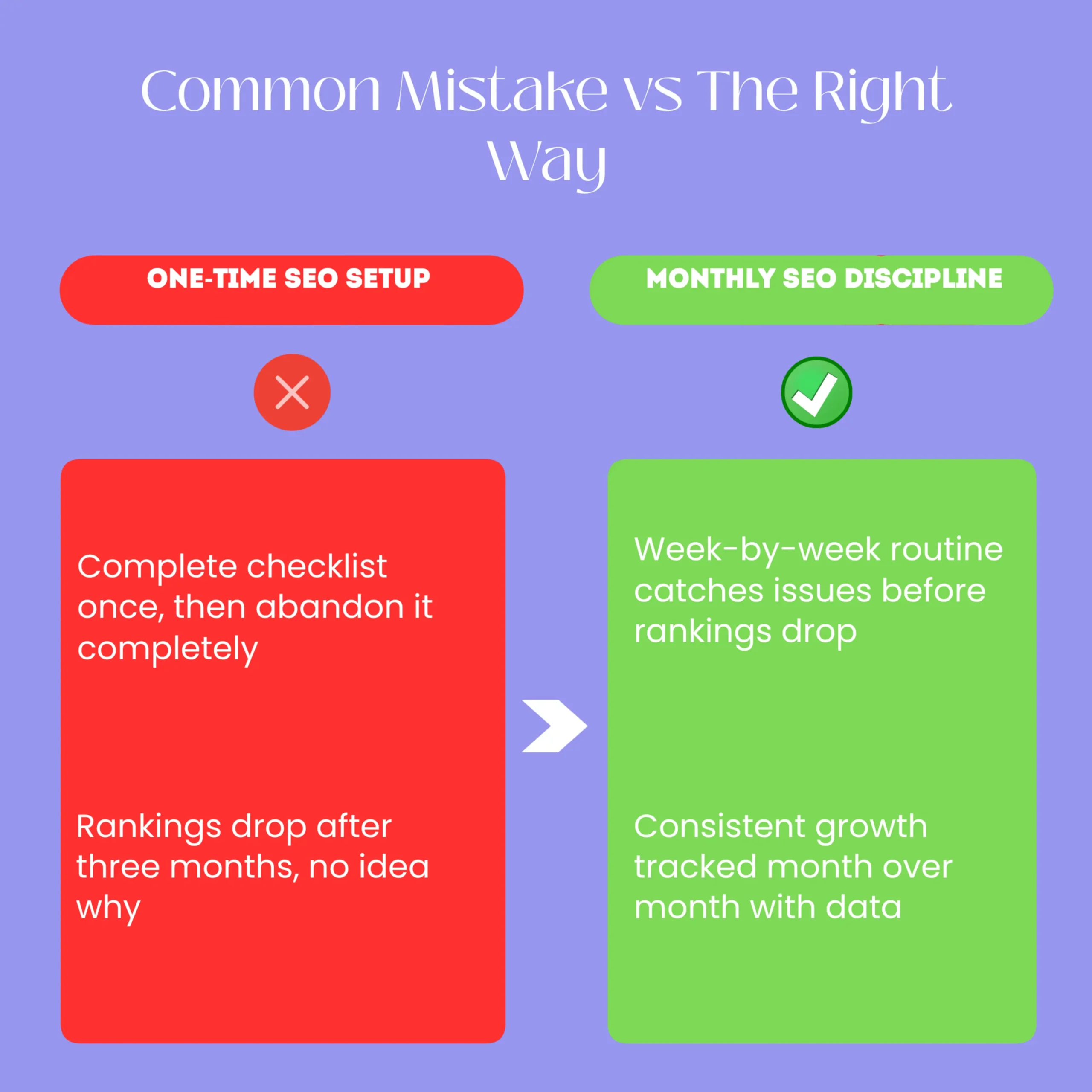
Let me show you what happens when you treat SEO as a one-time task.
You complete your SEO checklist Kenya in January. You optimize your title tags, fix your site speed, update your Google Business Profile, build five backlinks.
The Three-Month Cliff
By February, your rankings improve. You move from page two to page one for three of your target keywords.
You see organic traffic increase by 35% compared to December. Everything looks great.
Then March arrives. Your rankings hold steady.
You assume SEO is done. You shift focus to other parts of your business.
April comes and your rankings start slipping. By May, you are back on page two.
What happened? Your competitors kept going while you stopped.
What Breaks When You Stop
SEO is not a static achievement. Google’s algorithm updates monthly.
Your competitors publish new content every week. Backlinks decay as websites go offline or remove links.
Your Google Business Profile becomes outdated when you do not add new posts or photos. Technical issues emerge as your website grows.
I worked with a Nairobi e-commerce store selling home appliances. They ranked number two for “buy washing machines Nairobi” after completing their initial SEO setup.
They stopped updating their site for four months. Their ranking dropped to number eight.
When we audited their site, we found their Google Business Profile had not been updated in 16 weeks. Their product pages showed old pricing.
Three competitor websites had published comparison guides targeting the same keyword. Those competitors earned 12 new backlinks while my client earned zero.
The Compounding Effect of Monthly Work
Monthly SEO work compounds like savings in a SACCO. The first month feels slow.
The second month shows modest gains. By month four, you see exponential growth because every previous month’s work is still working for you.
That same Nairobi e-commerce store implemented a monthly checklist routine. They spent four hours per month on SEO tasks.
Month one: ranking climbed from eight to six. Month two: six to four.
Month three: four to two. Month four: they held position two consistently and added three new top-ten rankings for related keywords.
Their organic traffic grew from 1,200 visitors per month to 4,800 visitors in six months. Revenue from organic search increased by KES 180,000 monthly.
The difference was not more work. It was consistent work every single month.
The 3 Phases of SEO: Setup, Optimization, Maintenance
Before we dive into your monthly checklist, you need to understand the three phases of SEO. Most Kenyan businesses complete phase one, skip phase two, and never reach phase three.
Phase One: Setup (Month 1)

This is the initial checklist work. You fix technical errors, optimize your Google Business Profile, add proper title tags and meta descriptions, set up Google Search Console and Google Analytics.
This phase takes 10 to 20 hours depending on your website size. You should only do this once.
If you have not completed phase one yet, download my complete checklist and work through it systematically. Do not move to phase two until setup is complete.
Phase Two: Optimization (Months 2-3)
This is where you build momentum. You publish new content targeting specific keywords.
You earn your first backlinks from Kenyan business directories and local partnerships. You optimize existing pages based on Search Console data.
Phase two requires 8 to 12 hours per month. You are actively improving your site, not just maintaining it.
Most businesses stop here. They complete optimization, see rankings improve, then assume the work is done.
Phase Three: Maintenance (Month 4 Onward)
This is the monthly discipline that separates page one businesses from everyone else. You are not doing massive overhauls.
You are catching small issues before they become ranking drops. You are publishing consistent content.
You are monitoring your backlink profile and updating your Google Business Profile. Phase three takes four hours per month when you follow a systematic checklist.
This is where compounding happens. Every month builds on the previous month’s work.
📊 Your Monthly SEO Checklist: Week 1–4 Breakdown
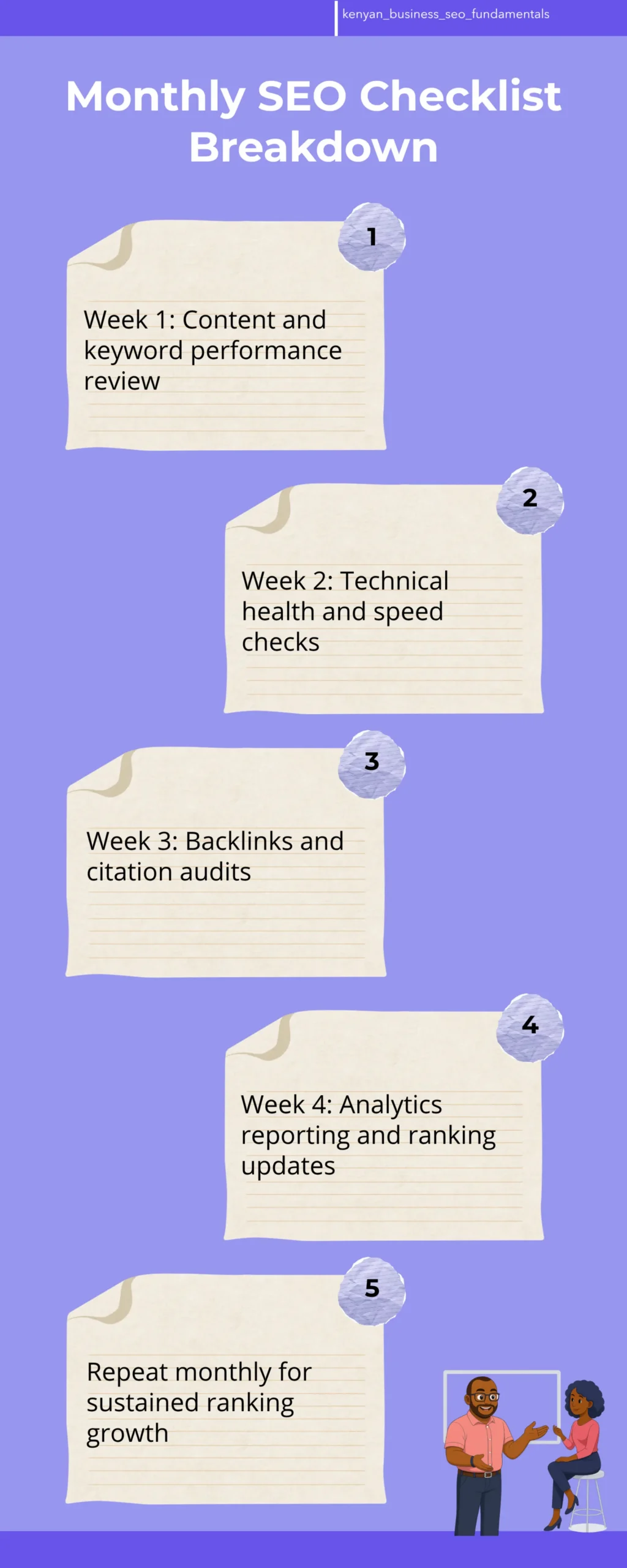
Here is the exact four-week system I use with Nairobi clients. Each week focuses on one category of SEO tasks.
This prevents overwhelm and ensures nothing gets skipped. Total time commitment: four hours per month, or one hour per week.
| Week | Focus Area | Time Required | Key Tasks |
|---|---|---|---|
| Week 1 | Content & Keywords | 60 minutes | Review GSC performance, identify content gaps, plan new content |
| Week 2 | Technical & Performance | 60 minutes | Check site speed, fix crawl errors, verify indexing status |
| Week 3 | Links & Authority | 60 minutes | Audit backlinks, update citations, identify link opportunities |
| Week 4 | Analytics & Reporting | 60 minutes | Review GA4 data, track ranking changes, document wins |
Week 1: Content & Keywords (What to Check)
Start your month by reviewing what content is working and what needs attention. Open Google Search Console and filter by the last 28 days.
Look at your top ten pages by clicks. Which pages dropped in impressions or clicks compared to the previous month?
Those pages need attention. Either the content is outdated or a competitor published something better.
Next, look at queries where you rank between positions four and ten. These are your quick-win opportunities.
You are already on page one but not getting clicks. A simple content refresh can push you to positions one through three where click-through rates increase by 300%.
Identify one content gap to fill this month. What keyword does your target customer search for that you do not have content covering?
Plan one blog post or service page to publish this month. Write it down in your checklist.
Finally, update your Google Business Profile. Add one new post about a recent project, customer win, or business update.
Upload two new photos of your office, team, or work. This takes ten minutes and signals to Google that your business is active.
Week 2: Technical & Performance (Speed, Crawl Errors, Indexing)
Week two focuses on keeping your website healthy. Technical issues kill rankings faster than anything else.
Start with Google Search Console. Check the Coverage report for any new errors or warnings.
If pages are not indexed, investigate why. Common issues in Kenya: slow hosting, broken internal links, or pages blocked by robots.txt.
Next, test your site speed using Google PageSpeed Insights. Your mobile score should be above 70.
If it drops below 70, investigate what changed. Did you add new images without compressing them?
Did a plugin slow down your site? Fix speed issues immediately because Google prioritizes fast sites in mobile search.
Check for broken links using a free tool like Broken Link Checker. Fix any 404 errors you find.
Broken links frustrate users and waste your crawl budget. Finally, verify that your XML sitemap is up to date and submitted to Google Search Console.
If you published new content in week one, make sure it appears in your sitemap. This entire process takes one hour when you follow a checklist systematically.
Week 3: Links & Authority (Backlinks, Internal Links, Citations)
Week three is about building and protecting your authority. Start by auditing your backlink profile in Google Search Console.
Look at the Links report. Have you earned any new backlinks this month?
If not, you need to be more proactive. Identify one local partnership opportunity this month.
Reach out to a complementary Nairobi business and propose a content collaboration. For example, if you run an accounting firm, partner with a business lawyer to co-author a guide on starting a business in Kenya.
Each of you links to the other’s website. That is one high-quality local backlink.
Next, check your Google Business Profile citations. Are your business name, address, and phone number consistent across all directories?
Inconsistent citations confuse Google and hurt your local rankings. Update any outdated listings you find.
Finally, improve your internal linking. Find one high-authority page on your site (a page with backlinks and traffic).
Add one internal link from that page to a newer page you want to rank. Internal links pass authority and help Google understand your site structure.
Week 4: Analytics & Reporting (GSC, GA4, Rankings)
The final week of your month is for measuring results and planning next month. Open Google Analytics 4 and review the last 30 days.
How many organic sessions did you get? How does that compare to last month?
Look at your top landing pages. Which pages drove the most conversions or leads?
Double down on those topics next month. Which pages had high bounce rates?
Those pages need content improvements or better calls to action. Track your keyword rankings.
I recommend using a simple rank tracker or manually checking your top five keywords in an incognito browser. Document any ranking changes.
If you dropped for a keyword, investigate why. Did a competitor publish new content?
Did you lose a backlink? If you improved, document what you did so you can repeat it.
Finally, write down three wins from this month. Did you earn a new backlink?
Did a blog post start ranking? Did organic traffic increase?
Documenting wins keeps you motivated and proves ROI when you review your SEO investment. This weekly rhythm makes SEO manageable.
You are never overwhelmed because you only focus on one category per week. You never skip important tasks because they are scheduled into your calendar.
How to Automate Your Monthly Checklist (Tools for Kenyan Agencies)
Manual checklist work takes time. Smart automation reduces your four-hour monthly commitment to two hours without sacrificing quality.
Set Up Google Search Console Email Alerts
Google Search Console can email you when critical issues occur. Enable alerts for coverage errors, manual actions, and security issues.
You will know immediately if pages drop out of the index or if Google penalizes your site. This eliminates the need to manually check for errors every week.
Create a Google Analytics 4 Monthly Dashboard
Build a custom GA4 dashboard that shows your key metrics in one view. Include organic sessions, top landing pages, conversion rate, and bounce rate.
Save this dashboard and open it during week four of your monthly routine. You get all your analytics data in two minutes instead of digging through reports.
Use Free Rank Tracking Tools
Manual rank checking wastes time. Use a free tool like Google Search Console’s Performance report to track your average position for target keywords.
Filter by specific queries and compare 28-day periods. You see ranking trends without manually searching Google.
Schedule Google Business Profile Posts in Advance
Many Kenyan businesses forget to update their Google Business Profile monthly. Use the scheduling feature to write four posts at once and schedule them weekly.
This takes 20 minutes once per month instead of remembering to post every week. Automation does not replace strategic thinking.
You still need to analyze data and make decisions. But automation eliminates repetitive tasks so you spend your time on high-value work.
Real Example: How a Nairobi E-Commerce Store Uses This Monthly
Let me show you exactly how one of my Nairobi clients uses this monthly checklist. They sell electronics online and compete in a crowded market.
Month One: Initial Results
We implemented the four-week checklist in January. Week one, we identified that their product pages had thin content.
We planned to expand five product descriptions with buying guides. Week two, we discovered their mobile site speed was 45.
We compressed images and removed an unused plugin. Speed improved to 78.
Week three, we reached out to two Kenyan tech blogs for backlink opportunities. We offered to write guest posts reviewing their products.
Week four, we documented baseline metrics: 1,800 organic sessions, average position 12 for their main keyword, zero backlinks from tech sites. By end of January, rankings had not moved much.
This is normal. Month one is about building the foundation.
Month Two: Momentum Builds
February followed the same four-week rhythm. Week one, we published expanded product descriptions and one buying guide.
Week two, site speed remained stable at 78. No new technical issues.
Week three, we earned one backlink from a Kenyan tech blog. Week four, organic sessions increased to 2,100.
Average position for their main keyword improved to position nine. Small progress, but progress nonetheless.
Month Three: Rankings Jump
March is when compounding kicked in. Week one, we noticed their buying guide from February was ranking position six for a long-tail keyword.
We optimized it further by adding comparison tables. Week two, no technical issues.
Week three, we earned two more backlinks from local business directories. Week four, organic sessions hit 3,200.
Their main keyword jumped to position four. Three other product pages entered the top ten for related keywords.
Month Four: Sustained Growth
By April, the system was running smoothly. They spent one hour per week maintaining their SEO.
Rankings held steady in positions three through five for their main keywords. Organic sessions stabilized around 4,500 per month.
More importantly, they were no longer stressed about SEO. The monthly checklist became routine, like paying bills or updating inventory.
They knew exactly what to do each week. The result: sustained rankings, predictable traffic, and organic conversion rates around 2.8% that generated KES 220,000 in monthly revenue from search.
✅ Common Mistakes to Avoid
I see the same mistakes repeatedly when Kenyan businesses try to implement monthly SEO checklists. Avoid these and you will save months of wasted effort.
Mistake One: Skipping Weeks When You Get Busy
The biggest mistake is inconsistency. You follow the checklist for two months, then skip a month because work gets busy.
That one skipped month breaks your momentum. Rankings slip and you spend the next month recovering instead of progressing.
Treat your monthly SEO like paying KRA taxes. It is not optional.
Block one hour per week in your calendar and protect that time. If you cannot do it yourself, delegate it to a team member or hire an agency.
Mistake Two: Focusing Only on New Content
Many businesses think SEO means publishing new blog posts every week. Content is important, but technical health and backlinks matter just as much.
If your site is slow or has crawl errors, new content will not rank. Follow all four weeks of the checklist, not just week one.
Mistake Three: Not Documenting Results
If you do not measure results, you will quit after three months because you will not see progress. Week four of your checklist is critical.
Document your wins, track your metrics, and celebrate small improvements. SEO is a long game.
You need visible proof that your effort is working. Finally, do not try to do everything at once.
The four-week structure exists for a reason. Focus on one category per week and you will never feel overwhelmed.
Your First Month: Quick Start Guide
If you are starting your monthly SEO routine today, here is exactly what to do in your first 30 days. This quick start guide gets you into the rhythm immediately.
Week One: Set Up Your Tracking
Before you can maintain SEO monthly, you need baseline data. Verify your website in Google Search Console if you have not already.
Set up Google Analytics 4. These tools are free and essential.
Check your current rankings for your top five keywords. Write them down.
Note your current organic traffic in Google Analytics. This is your starting point.
Week Two: Fix Critical Issues
Run a site speed test. If your mobile score is below 60, fix it immediately.
Compress images, remove unused plugins, or upgrade your hosting if necessary. Check Google Search Console for coverage errors.
Fix any critical indexing issues. Make sure your most important pages are indexed.
Week Three: Claim Your Google Business Profile
If you have not claimed your Google Business Profile, do it now. Add complete business information, upload photos, and publish your first post.
This takes 30 minutes and immediately improves your local visibility. If you already have a profile, update it with fresh content and photos.
Week Four: Document Your Baseline
Review your first month’s data. How many organic sessions did you get?
What are your current rankings? How many backlinks do you have?
Write this down. Next month, you will compare against these numbers to measure progress.
After your first month, you are ready to follow the full four-week checklist. You have tracking in place, critical issues fixed, and baseline data documented.
✅ Quick Action Checklist
- ☐ Download the complete SEO checklist and save it where you can access it monthly
- ☐ Block one hour per week in your calendar for the next three months (non-negotiable time)
- ☐ Set up Google Search Console email alerts so you catch technical issues immediately
- ☐ Create a simple spreadsheet to track monthly metrics: organic sessions, rankings, backlinks, conversions
- ☐ Schedule your first week one session this week: review Google Search Console performance data
- ☐ Identify one content gap to fill this month based on keyword research or customer questions
- ☐ Set a reminder to update your Google Business Profile with one post and two photos this week
- ☐ Commit to following the four-week rhythm for at least three months before evaluating results
Ready to Improve Your SEO with Monthly Discipline?
SEO is not a one-time project. It is a monthly system that compounds over time.
The businesses that win in Nairobi search results are not doing more work. They are doing consistent work every single month using a systematic checklist.
If you want sustained rankings and predictable organic traffic, treat SEO like a monthly discipline. Follow the four-week rhythm, automate what you can, and document your results.
Contact AM Digital KE today if you need help implementing this system for your Kenyan business.
Frequently Asked Questions
How long does the monthly SEO checklist take?
The complete monthly checklist takes four hours when you follow the week-by-week structure. That breaks down to one hour per week. Week one focuses on content and keywords, week two on technical issues, week three on links and authority, and week four on analytics and reporting. With automation tools like Google Search Console alerts and scheduled Google Business Profile posts, you can reduce this to two to three hours monthly.
Can I skip a month if my rankings are stable?
No. Skipping months breaks your momentum and allows competitors to overtake you. SEO requires consistent monthly maintenance because Google’s algorithm updates frequently, competitors publish new content, and technical issues emerge over time. Even if your rankings look stable, you need to maintain your Google Business Profile, monitor backlinks, and check for technical errors. The businesses that skip months are the ones that lose rankings suddenly and do not understand why.
What happens if I only focus on content and ignore technical SEO?
Your content will not rank if your website has technical problems. Slow site speed, crawl errors, and indexing issues prevent Google from properly accessing and ranking your pages. You need all four weeks of the checklist: content, technical, links, and analytics. Focusing only on content is like planting seeds in bad soil. The foundation must be healthy for anything to grow.
How do I know if my monthly SEO work is actually working?
Track three metrics every month: organic sessions in Google Analytics, average ranking position for your top five keywords in Google Search Console, and number of backlinks in your Search Console Links report. Document these numbers during week four of your monthly checklist. Compare month over month. You should see gradual improvement starting in month two or three. If you see no change after three months of consistent work, your strategy needs adjustment.
Should I hire an agency or do monthly SEO myself?
It depends on your time and expertise. If you can commit four hours per month and follow a systematic checklist, you can handle basic monthly SEO maintenance yourself. However, if you lack time or technical knowledge, hiring a Kenyan SEO agency makes sense. An experienced agency completes the work faster, catches issues you might miss, and implements advanced strategies beyond basic maintenance. The key is consistency, whether you do it yourself or delegate it.
Additional Resources
- How to Set Up Google Business Profile – A Kenyan Expert’s Guide – Week one of your monthly checklist requires updating your Google Business Profile; this guide shows you the complete setup if you haven’t claimed yours yet.
- I Describe Different Types of SEO in Kenya – Pick the Right One for Your Business – Before you commit to a monthly checklist, understand whether you need
local, national, or e-commerce SEO so you focus on the right tasks each month. - The Best Free SEO Tools for Kenyan Businesses – Automate your monthly checklist with free tools that track rankings, monitor site speed, and alert you to technical issues without paying for expensive software.
- How to Set Up Google Business Profile A Kenyan Expert’s Guide – Week one of your checklist includes posting to your Google Business Profile; this guide walks you through optimizing every section for maximum local visibility.
- What is Legal SEO in Kenya – If you run a law firm, your monthly checklist needs industry-specific tasks like citation management and legal directory submissions covered in this guide.
- How to Do SEO for Law Firms in Kenya – Law firms need specialized monthly SEO routines that include reputation management and legal content strategies beyond the general checklist.
Take the Next Step
This article showed you how to use your SEO checklist as a monthly system. Now you need the actual checklist to follow.
I have created a complete step-by-step checklist specifically for Kenyan businesses. It includes every task mentioned in this article organized by priority, plus automation tips and tracking templates.
Download the Complete SEO Checklist for Kenyan Businesses and start your first month today.