Table of Contents
- Introduction
- 📋 Key Takeaways
- What Is Logistics SEO?
- Why Does Logistics SEO Matter for Kenyan Businesses?
- How Logistics SEO Works
- Logistics SEO Examples in Kenya
- Common Mistakes to Avoid
- Logistics SEO vs. Other Marketing Channels: A Quick Comparison
- ✅ Quick Action Checklist
- Ready to Improve Your Logistics SEO in Kenya?
- See What Is Working, Any Day You Ask
- Frequently Asked Questions
- Take the Next Step
TL;DR: Logistics SEO in Kenya is the practice of optimizing your freight company’s website and online presence so that shippers and businesses searching for cargo services, delivery, or transport find you first on Google. It combines local search optimization, keyword strategy, Google Business Profile management, and customer reviews to turn online searches into phone calls and bookings. Without it, your competitors capture the leads that should be yours.
Introduction
You run a logistics company in Kenya. Your trucks move goods between Nairobi and Mombasa, or across the country.
You have the capacity and reputation to handle the work. But here’s the problem: when a shipper needs to move cargo, they don’t call you.
They Google “logistics services near me” or “cargo transport Kenya.” They find your competitor instead.
That’s where logistics SEO comes in. It’s the difference between being invisible online and being the first company a shipper calls when they need to move goods.
This article explains what logistics SEO is and why it matters for your business. It also covers how it works in practice and the mistakes that hold most Kenyan logistics companies back. Before we go deeper, it helps to understand the basics of seo in kenya and how it applies to freight and transport businesses.
📋 Key Takeaways
- ☐ Logistics SEO is the process of optimizing your company’s website and online presence so shippers find you when they search for cargo, transport, or delivery services on Google.
- ☐ Most Kenyan shippers search online before hiring logistics providers, meaning your visibility directly impacts your revenue.
- ☐ Local search optimization and Google Business Profile management are your fastest wins for getting found by nearby clients.
- ☐ Customer reviews and ratings on Google, Trustpilot, and industry platforms build credibility with shippers who have never heard of you.
- ☐ Mobile optimization is essential because shippers search for logistics services on their phones while managing shipments on the road.
What Is Logistics SEO?
Logistics SEO is the practice of optimizing your freight company’s digital presence so shippers find you first on Google. It is not about advertising, it is about earning visibility through search engine optimization.
Think of Google as the phone book for modern business in Kenya. When someone needs to move goods from Kisumu to Nairobi, they no longer ask around.
They search for “cargo transport Kisumu to Nairobi” or “logistics company near me.” If your company shows up in that search result, you get the call.
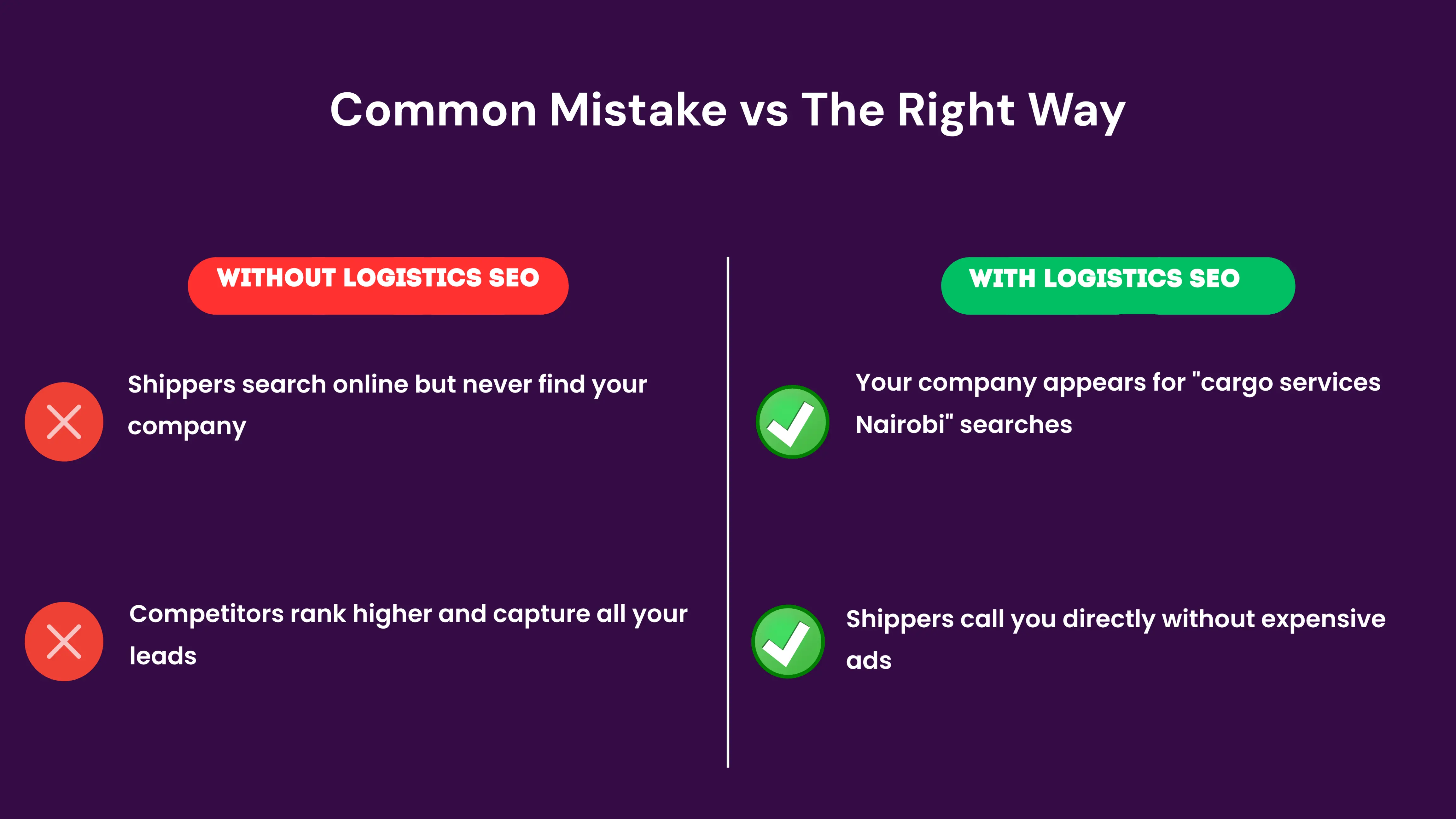
If you don’t, your competitor does.
The Core Goal of Logistics SEO
The core goal is simple. Get your company in front of shippers at the exact moment they need your service.
Not when they’re thinking about it someday, but right now, when they have cargo to move and they’re searching for a solution. Logistics SEO does this by aligning your website content, your online listings, and your digital reputation with the words shippers actually use.
A shipper doesn’t search for “premium freight solutions.” They search for “cargo services Nairobi” or “transport company with tracking.”
How Logistics SEO Differs from General SEO
General SEO works for any business. Logistics SEO is tailored to how shippers search and the specific information they need.
A shipper doesn’t care about your company history or your mission statement. They care about your routes, your rates, your capacity, and whether you can deliver on time. This is where logistics seo services kenya providers focus their strategy.
Logistics SEO prioritizes what shippers actually search for. This includes service areas, cargo types you handle, pricing transparency, delivery timelines, and real customer reviews from other shippers.
Your website needs to answer these questions faster and more clearly than your competitors’ sites do.
Why Does Logistics SEO Matter for Kenyan Businesses?
Logistics is a competitive market in Kenya. Every town of size has multiple transport companies. Many of them offer similar services at similar prices.
The difference between a logistics company that thrives and one that barely survives is visibility. The companies that shippers find first get the calls.
The ones that don’t get found lose leads to competitors every single day. This is exactly where seo in kenya becomes a business decision, not just a marketing task.
Shippers Search Online Before They Call
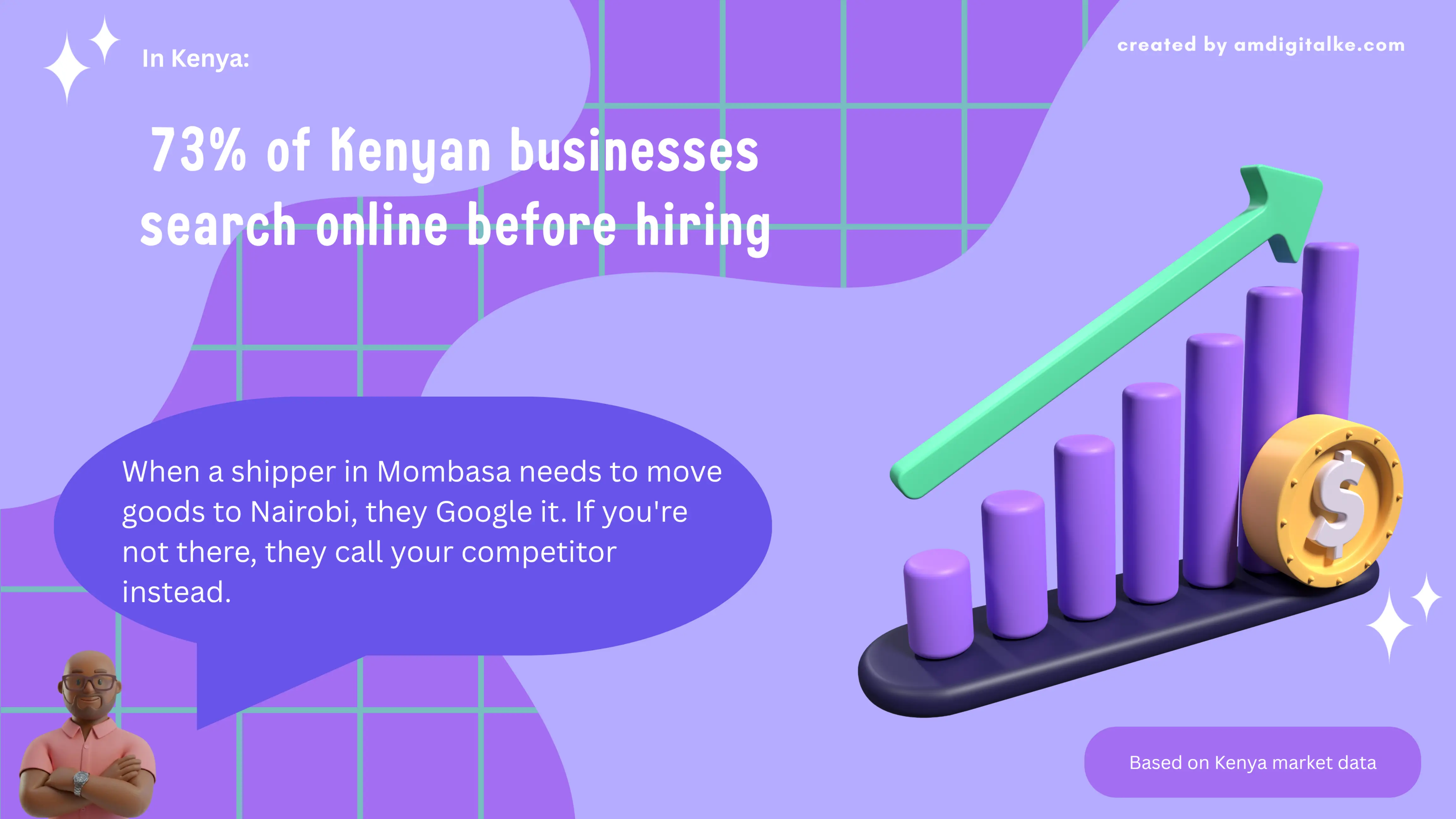
73% of Kenyan businesses search online before hiring any service provider. That includes logistics and transport services.
When a shipper in Mombasa needs to move goods to Nairobi next week, they don’t call five companies at random. They search Google, check reviews, and call the company that looks most trustworthy.
If your company isn’t in that search result, you never get the chance to pitch your services.
SEO Traffic Is Cheaper Than Paid Advertising
Google Ads for logistics keywords can cost between 200 KES and 800 KES per click, depending on the keyword and your location. Every time someone clicks your ad, you pay, with no guarantee they become a customer.
SEO traffic, once earned, costs you nothing per click. A shipper searching for “cargo transport Nairobi” and clicking your organic result doesn’t cost you a shilling.
You’ve already paid for SEO optimization upfront. Now every search result is free lead generation.
Local Search Dominates for Logistics Services
Shippers almost always search for logistics services in their area. They search for “cargo services near me” or “transport company Nairobi” or “logistics Mombasa,” not “best logistics company in Africa.”
This is good news for you. Local SEO is faster and cheaper to win than national or international SEO.
You don’t have to compete with every logistics company in Kenya. You only have to compete with the five or ten companies in your city or region, which is a winnable game. Understanding national seo vs local seo which does your kenyan business need helps you focus your effort correctly.
Reviews and Reputation Drive Conversions
A shipper who finds your company on Google checks your reviews before they call. Five-star reviews from other shippers build instant trust.
No reviews, or negative ones, and they call your competitor instead.
Logistics SEO includes managing your online reputation. That means getting reviews from satisfied customers, responding to feedback, and building credibility with prospects who have never heard of you.
This matters even more in Kenya, where word-of-mouth and reputation still carry enormous weight in business decisions.
How Logistics SEO Works
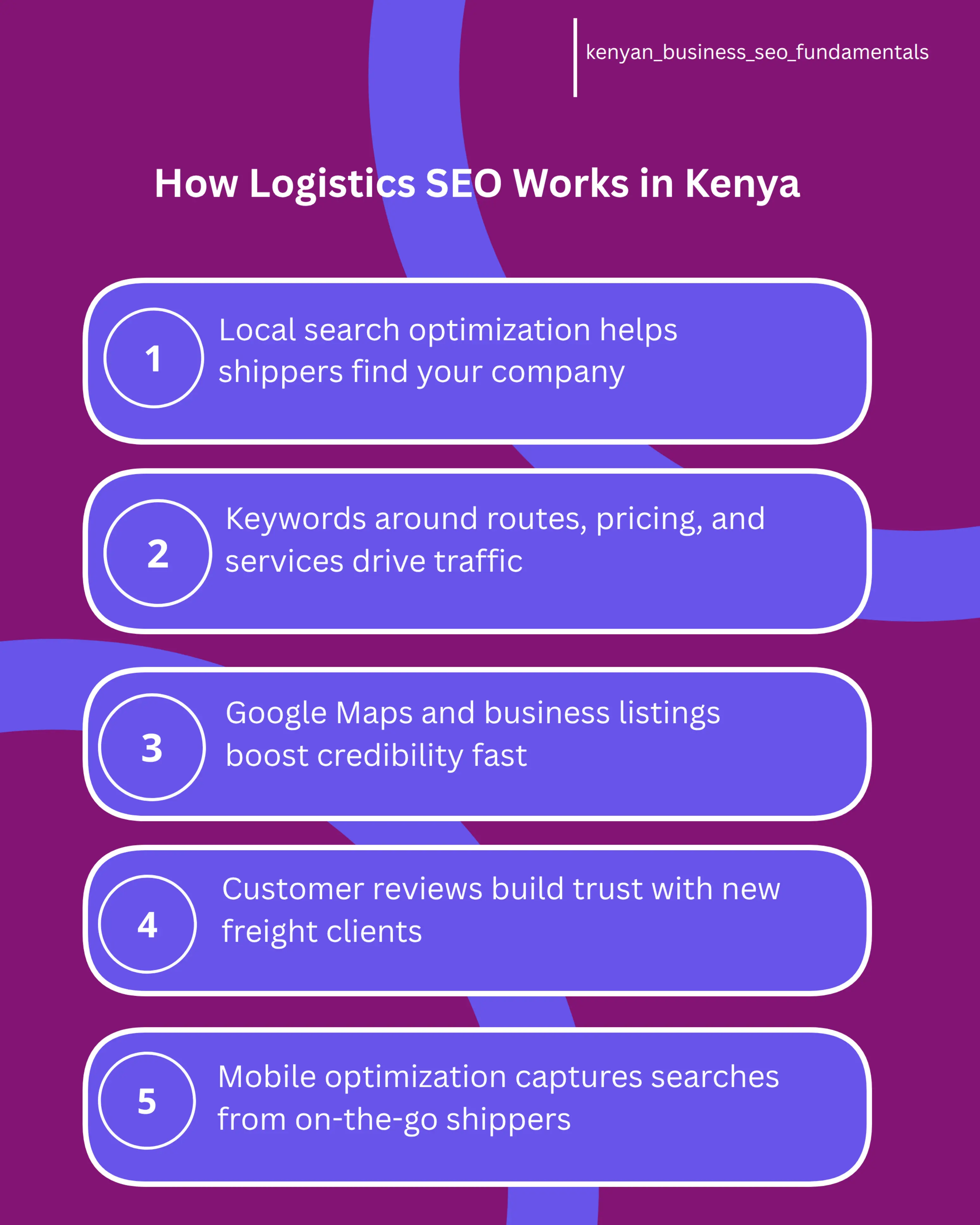
Logistics SEO rests on four pillars: keyword research, on-page optimization, local search optimization, and reputation management. Each one plays a role in getting your company found by shippers searching online.
Keyword Research and Strategy
Keyword research means identifying the exact words and phrases shippers use when they search for your services. It’s not guessing. It’s data.
A shipper in Nairobi searching for logistics doesn’t search for “transportation solutions provider.” They search for “cargo services Nairobi,” “transport company with tracking,” “same-day delivery Nairobi,” or “bulk freight rates.”
These are the keywords you need to target. Logistics keywords typically fall into four categories: location-based (“logistics Mombasa”), service-based (“refrigerated transport”), price-based (“affordable cargo services”), and problem-based (“urgent freight delivery”).
Your SEO strategy needs to address all four.
On-Page Optimization
On-page optimization makes sure your website content, structure, and technical setup tell Google and shippers exactly what you offer and where you operate. It includes your page titles, descriptions, headings, and body content on every page.
For a logistics company, this means clearly stating your service areas, cargo types, capacity, and rates on every relevant page. If you offer “same-day delivery in Nairobi,” that phrase needs to appear in your headings and descriptions, not just buried in one paragraph.
Local Search Optimization
Local search optimization gets your company found in Google Maps and local search results. When someone searches “logistics near me” on their phone, Google shows a map with the three closest companies.
To rank in that map, you need a complete Google Business Profile with your address, phone number, service areas, hours, and regular posts. You also need citations, meaning mentions of your business on industry directories, local listings, and review platforms.
Reputation Management
Reputation management means actively getting reviews from satisfied customers and responding to feedback on Google, Trustpilot, and other platforms. Shippers trust companies with high ratings and real reviews from other shippers.
This is an ongoing process. After every successful shipment, ask the customer to leave a review.
When you get negative feedback, respond professionally and show that you care about fixing problems. This builds trust with prospects who are evaluating your company through logistics seo services kenya providers before making contact.
Logistics SEO Examples in Kenya
To understand how logistics SEO works in practice, let’s look at real examples from Kenya’s logistics market.
Example 1: A Nairobi-Based Refrigerated Transport Company
A refrigerated transport company in Nairobi moves perishable goods—fruits, vegetables, dairy—to markets and retailers across Kenya. Their main competitors are three other refrigerated transport companies in the same city.
Without SEO, they might get two or three calls a week from shippers who knew them already or got their number from a friend. With SEO, they optimize their website for keywords like “refrigerated transport Nairobi,” “cold chain logistics Kenya,” and “perishable goods transport.” They get their Google Business Profile verified and updated with their service areas and vehicle capacity.
Within three months, they start appearing in Google search results when shippers search for refrigerated transport. They get five to ten new inquiries a week from shippers they’ve never met. Their revenue increases by 30 percent because they’re now the first company shippers find when they need cold chain logistics.
Example 2: A Mombasa-Based Port Logistics Company
A logistics company at the Port of Mombasa handles cargo clearance, storage, and distribution for importers and exporters. Their customers are spread across Kenya, but most are in Mombasa and the coastal region.
They optimize their website for keywords like “port cargo clearance Mombasa,” “import logistics Kenya,” and “customs clearance Mombasa.” They create detailed pages explaining their services, timelines, and rates. They get reviews from importers and exporters who have used their services.
When an importer in Dar es Salaam or a business in Nairobi needs to clear cargo through Mombasa, they search online and find this company’s website with detailed information about their services and positive reviews from other importers. The company gets more inquiries from new customers who found them through search, and they’re able to expand their business beyond their existing network.
Example 3: A Long-Distance Haulage Company
A haulage company moves goods across Kenya’s highways—Nairobi to Mombasa, Nairobi to Kisumu, Nairobi to Kericho. They compete with dozens of other haulage companies, and most shippers don’t know the difference between them.
They optimize their website for route-specific keywords: “transport Nairobi to Mombasa,” “haulage Nairobi to Kisumu,” “cargo services Nairobi to Kericho.” They add pages for each major route with details about delivery times, rates, and capacity. They get reviews from shippers who have used their services.
When a shipper needs to move goods from Nairobi to Mombasa, they search that exact phrase and find this company’s website with a dedicated page about that route, customer testimonials, and transparent pricing. They call the company directly instead of calling five other haulage companies at random.
Common Mistakes to Avoid
Most Kenyan logistics companies make the same mistakes with their online presence. Understanding these mistakes now will save you time and money.
Mistake 1: No Website or an Outdated Website
Some logistics companies still don’t have a website, or they have a website that hasn’t been updated in five years. Shippers assume these companies are not serious about their business or that they’re not reliable.
Your website needs to exist, and it needs to look professional and current. It doesn’t have to be fancy—it just needs to clearly answer the questions shippers have: What services do you offer? What areas do you serve? What are your rates? How do I contact you? How long does delivery take?
Mistake 2: Ignoring Google Business Profile
Google Business Profile is free, and it’s one of the most powerful tools for local logistics SEO. Yet many logistics companies don’t claim or optimize their profile.
If you don’t have a Google Business Profile, shippers can’t find you on Google Maps. If your profile is incomplete or outdated, shippers see incorrect information about your hours, location, or services. Claiming and optimizing your profile takes two hours and has a massive impact on your visibility.
Mistake 3: No Customer Reviews
Shippers make decisions based on reviews from other shippers. If your company has no reviews, you lose credibility compared to competitors who have dozens of five-star reviews.
The solution is simple: after every successful shipment, ask the customer to leave a review on Google. Make it easy for them—send them a direct link. Most satisfied customers will leave a review if you ask them to.
Mistake 4: Generic Content That Doesn’t Answer Specific Questions
Many logistics company websites have generic pages about “our services” or “why choose us,” but they don’t answer the specific questions shippers have. A shipper doesn’t care about your company story—they care about whether you can deliver their cargo on time and at a reasonable rate.
Your website content needs to be specific and detailed. Instead of a generic “services” page, create separate pages for each service: “Same-Day Delivery Nairobi,” “Refrigerated Transport,” “Bulk Freight,” “Port Clearance.” Each page should explain what the service includes, how much it costs, and how long it takes.
Mistake 5: Not Optimizing for Mobile
Most shippers search for logistics services on their phones while managing shipments or waiting for cargo. If your website isn’t mobile-friendly, shippers can’t read it, they can’t find your contact information, and they’ll leave and call your competitor instead.
Your website needs to look good and load fast on a phone. This is non-negotiable. Test your website on your own phone right now. If it’s hard to read or slow to load, fix it immediately.
Logistics SEO vs. Other Marketing Channels: A Quick Comparison
| Channel | Cost Per Lead | Time to Results | Long-Term ROI | Best For |
|---|---|---|---|---|
| Logistics SEO | Low (after initial setup) | 2-4 months | Very High | Sustainable growth |
| Google Ads | High (200-800 KES per click) | Immediate | Medium | Quick leads |
| Facebook Ads | Medium (50-300 KES per click) | 1-2 weeks | Low-Medium | Brand awareness |
| Word of Mouth | Low | Ongoing | High | Loyal customers |
| Industry Directories | Low-Medium | 1-2 months | Medium | Local visibility |
✅ Quick Action Checklist
- ☐ Claim or verify your Google Business Profile today and add your complete business information, service areas, and phone number.
- ☐ Audit your website on your phone. If it’s not mobile-friendly, contact a developer to fix it this week.
- ☐ Identify five to ten keywords shippers actually use to search for your services. Write them down and use them on your website.
- ☐ Create a process for asking satisfied customers to leave reviews on Google. Set a goal to get five new reviews this month.
- ☐ Update your website with specific, detailed information about each service you offer, including pricing, timelines, and service areas.
- ☐ Research your top three competitors’ websites. Note what they’re doing well and identify gaps you can fill.
- ☐ Set up Google Search Console and Google Analytics on your website to track where your traffic is coming from.
- ☐ Schedule a monthly check-in to review your search rankings, website traffic, and customer inquiries from search.
Ready to Improve Your Logistics SEO in Kenya?
Logistics SEO is not complicated, but it does require focus and consistency. The good news is that most of your competitors aren’t doing it well, which means there’s a huge opportunity for you to capture leads they’re leaving on the table.
Start with the quick action checklist above. Claim your Google Business Profile, optimize your website for mobile, and ask your customers for reviews. These three steps alone will improve your visibility significantly.
If you want a detailed, step-by-step plan tailored to your specific logistics business, reach out to AM Digital KE. We work exclusively with Kenyan businesses, and we’ll show you exactly how to optimize your online presence to capture more leads from shippers searching online.
See What Is Working, Any Day You Ask
Contracts are won on specific searches, not general visibility.
Every campaign move is logged in your SEO Brain, so you can ask which pages are bringing enquiries and get a straight answer in plain language. Our pricing is published, so you can evaluate us the same way you would evaluate any supplier.
See what that looks like in practice on our logistics and supply chain SEO services page, or start with a free SEO audit.
Frequently Asked Questions
How long does it take to see results from logistics SEO?
Most logistics companies start seeing improvements in their search rankings within two to four months. Google Business Profile changes can show results within weeks. However, the full impact of SEO—more calls, more inquiries, more revenue—typically takes three to six months to become obvious.
Can I do logistics SEO myself, or do I need to hire an agency?
You can do basic SEO yourself: claim your Google Business Profile, optimize your website for mobile, add customer reviews, and create detailed pages for each service. For more advanced work like technical SEO, link building, and competitive analysis, most logistics companies benefit from working with an agency that understands their market.
How much does logistics SEO cost?
Basic SEO (Google Business Profile optimization, website updates, review management) can cost between 10,000 and 30,000 KES per month. More comprehensive SEO that includes content creation, technical optimization, and competitive analysis typically costs 30,000 to 100,000 KES per month. The investment pays for itself when you get even one or two new customers per month from search.
What’s the difference between SEO and Google Ads for logistics companies?
Google Ads shows your company at the top of search results, but you pay for every click. SEO earns you organic search results, and you don’t pay per click. Ads are faster but more expensive long-term. SEO takes longer to work but costs much less per lead once it’s working.
How do I know if logistics SEO is working for my company?
Track these metrics: your search rankings for key logistics keywords, the number of website visitors from search, the number of phone calls or inquiries from search traffic, and your conversion rate (what percentage of inquiries become customers). Use Google Search Console and Google Analytics to measure these. If all four are improving, your SEO is working.
Take the Next Step
Logistics SEO is the most cost-effective way to capture leads from shippers searching online. The companies that act now will dominate their local markets while their competitors wonder why they’re losing business to someone shippers found on Google.
Start with the checklist above, or get a free SEO audit for your logistics company to see exactly where you stand today and what opportunities you’re missing.