Table of Contents
- What This Article Covers
- 📋 Key Takeaways
- What You Need Before You Start
- Step 1: Research the Keywords Your Travelers Actually Search
- Step 2: Optimize Your Google Business Profile for Local Visibility
- Step 3: Create Content That Showcases Your Unique Experience
- Step 4: Build Technical SEO So Google Can Find and Index Your Site
- Step 5: Build Backlinks From Travel and Tourism Authorities
- Common Mistakes to Avoid 🚫
- Quick Comparison Table: Tourism SEO Fundamentals
- ✅ Quick Action Checklist
- Ready to Improve Your Tourism SEO?
- Frequently Asked Questions
- Take the Next Step
- Additional Resources
TL;DR: Tourism SEO in Kenya means ranking your safari lodge or tour operator website higher on Google by targeting the keywords travelers actually search for. Start with local keyword research, optimize your Google Business Profile, create content that showcases your unique experiences, and build backlinks from travel authorities.
Most Kenyan tourism businesses fail because they use generic keywords, ignore mobile optimization, and don’t claim their Google Business Profile.
What This Article Covers
If you run a safari lodge in the Masai Mara, a tour operator in Nairobi, or any tourism business in Kenya, you already know competition is fierce. Travelers search Google before they book anything, and if your website doesn’t show up, they book someone else instead.
This guide teaches you exactly how to rank higher on Google for the searches that matter to your business. It builds on the fundamentals of seo in kenya, applied specifically to safari and tourism searches.
We’re not talking about theory or guesswork. We’re talking about the specific steps that work for Kenyan tourism businesses right now.
📋 Key Takeaways
- Local keyword research is your foundation. Target searches like “Masai Mara safari guides Nairobi” not just “safari Kenya”.
- Your Google Business Profile is not optional. It’s often the first thing travelers see and directly affects bookings.
- Mobile optimization is non-negotiable. Most travelers research on phones while planning trips.
- Content must showcase your unique experience. Generic lodge descriptions don’t rank or convert.
- Backlinks from travel and tourism authorities signal trust to Google and boost your rankings significantly.
What You Need Before You Start
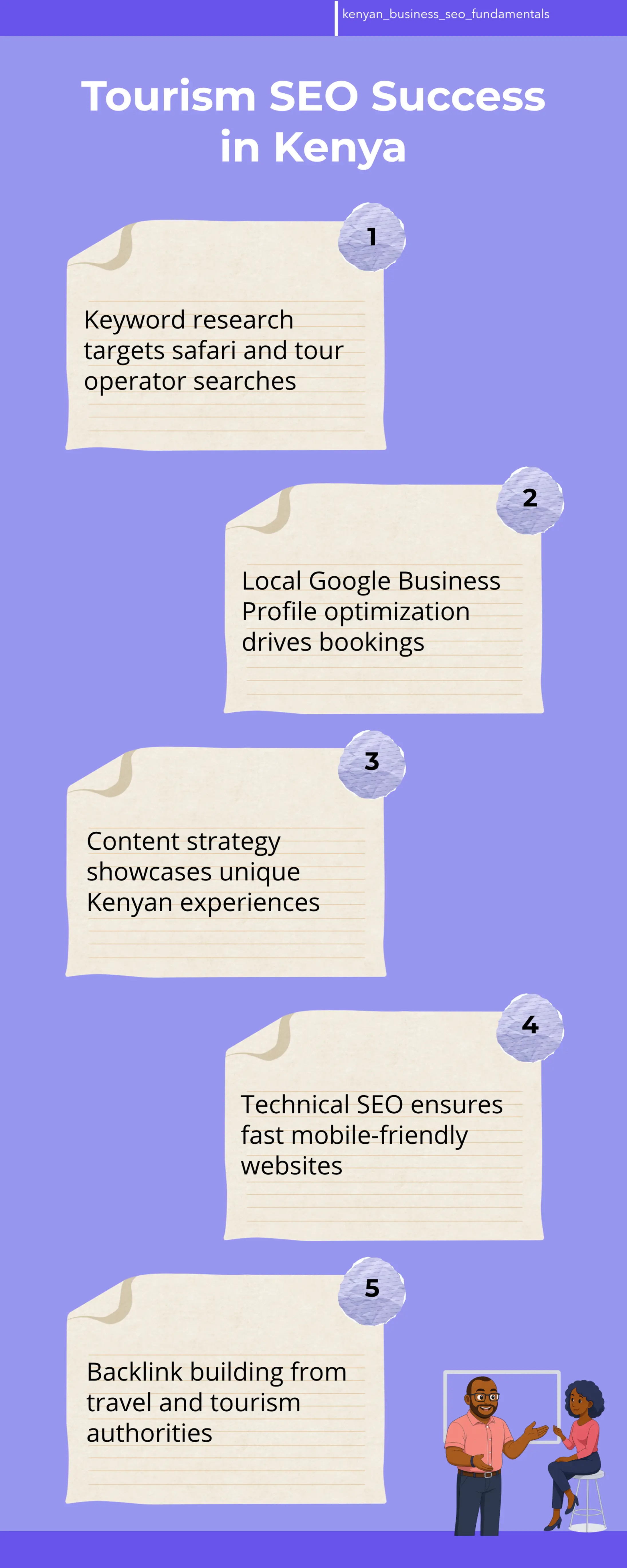
Before you optimize anything, you need three things in place. Without them, your SEO efforts will waste time and money.
A Website That Actually Works
Your website must load fast on mobile phones. If it takes more than three seconds to load, travelers bounce to your competitor’s site.
Test your website speed using Google’s free tools. Most Kenyan tourism websites we audit load in 6-8 seconds on mobile.
That’s too slow.
Google Business Profile Claimed and Verified
Your Google Business Profile is your direct connection to travelers searching for lodges or tours in your area. This is one of the fastest wins in hospitality tourism seo kenya.
If you haven’t claimed it, do that first today. Go to Google Business Profile, search your business name, and verify your location.
This takes 15 minutes and directly increases bookings.
Basic Analytics Installed
You need to track what happens after someone lands on your website. Install Google Analytics and Google Search Console.
These tools show which keywords bring visitors and whether they book.
Without data, you’re making decisions based on guesses. With data, you make decisions that increase revenue.
Step 1: Research the Keywords Your Travelers Actually Search
Most Kenyan tourism businesses target the wrong keywords. They bid on or optimize for “safari Kenya” or “tours Kenya” because those sound big and important.
The problem is those keywords are too broad and too competitive. This is the exact tension covered in national seo vs local seo which does your kenyan business need.
A traveler searching “safari Kenya” might be looking for information, prices, or a completely different experience than what you offer.
Find Keywords That Match Your Exact Offering
If you run a budget lodge near Amboseli, you should target “affordable Amboseli lodge” or “budget safari Amboseli Nairobi” not just “safari Kenya.” The first keywords have less competition and attract travelers ready to book.
Use free tools like Google Keyword Planner or Ubersuggest to find search terms with real volume. Look for keywords with 100-500 monthly searches and low competition.
Think Like Your Traveler
Your customer isn’t searching “safari lodge.” They’re searching “where to stay in Masai Mara with family” or “best safari guides near Nairobi” or “all-inclusive safari packages Kenya.”
Write down 20 questions a traveler would actually ask. Then optimize your content to answer those exact questions.
Traveler intent drives search behavior and determines which keywords convert to bookings.
Include Location Keywords in Every Strategy
Location keywords are your competitive advantage. Target specific regions, towns, and landmarks that travelers know.
Instead of “Kenya safari,” target “Tsavo East safari from Mombasa” or “Mount Kenya lodge Nanyuki” or “Lake Nakuru tour operators.” These keywords have less competition and attract travelers who know exactly where they want to go.
Step 2: Optimize Your Google Business Profile for Local Visibility
Your Google Business Profile appears in Google Maps and local search results. For tourism businesses, this is often the first place travelers look.
A complete, optimized profile directly increases phone calls, website visits, and bookings. Based on AM Digital KE client data across Kenyan accounts, tourism businesses with complete Google Business Profiles receive 3x more inquiry calls than those with incomplete profiles.
Complete Every Section With Accurate Information
Fill in your business name, address, phone number, website, and business category exactly as they appear everywhere else online. Inconsistencies confuse Google and hurt your rankings.
Add your business hours, including seasonal variations if you close during certain months. Add payment methods you accept, including M-Pesa if applicable.
Upload High-Quality Photos and Videos
Travelers want to see where they’ll stay and what they’ll experience. Upload 10-15 professional photos showing your lodge, rooms, dining area, and the surrounding landscape.
Videos perform even better. A 30-second video of sunrise at your lodge converts more travelers than photos alone, and works well across social platforms that matter for kenyan businesses.
Collect and Respond to Reviews
Ask recent guests to leave reviews on your Google Business Profile. Reviews directly influence click-through rates and conversion rates for tourism businesses.
Respond to every review, positive or negative. Thank guests for positive reviews and address concerns in negative reviews professionally.
Step 3: Create Content That Showcases Your Unique Experience
Generic lodge descriptions don’t rank on Google and they don’t convert travelers. You need content that tells your story and answers the specific questions travelers have.
Write Detailed Guides About Your Location
If you operate in the Masai Mara, write a comprehensive guide about “What to Expect on a Masai Mara Safari” or “Best Time to Visit Masai Mara for Wildlife Photography.” These guides work like experience and activity pages ranking for safari and tour searches, and they establish your authority.
Include practical details travelers actually need: what animals they’ll see, what to pack, how long the drive is from Nairobi, what the weather is like. Answer the questions in your Google Search Console that show what travelers are searching for.
Create Comparison Content That Positions Your Offering
Write content like “Amboseli vs. Tsavo East: Which Safari Should You Choose?” or “Luxury Lodge vs. Budget Camp in Kenya: Pros and Cons.” This content attracts travelers comparing options and positions your lodge as the expert choice.
Link these comparison articles to your lodge pages so travelers see you as the obvious choice after reading the comparison.
Develop Seasonal Content That Drives Off-Season Bookings
Most tourism businesses see seasonal demand swings. Create content that drives bookings during slow seasons.
In the dry season, write about “Best Time for Safari Photography” or “When to See Big Five in Kenya.” In the rainy season, write about “Why Green Season is Best for Birdwatching” or “Quiet Safari Experience in Low Season.”
This positions every season as attractive.
Step 4: Build Technical SEO So Google Can Find and Index Your Site
Technical SEO is the behind-the-scenes work that ensures Google can crawl, index, and rank your website. Most Kenyan tourism websites have technical problems that prevent them from ranking.
Ensure Your Website Loads Fast on Mobile
Travelers research on phones. If your site takes 5+ seconds to load on mobile, Google ranks it lower and travelers bounce to competitors.
Compress images, use a content delivery network, and minimize code. Test your speed in Google PageSpeed Insights and aim for a score above 80 on mobile.
Fix Crawl Errors and Broken Links
Use Google Search Console to find pages Google can’t crawl or broken links on your site. Fix these errors so Google can properly index all your content.
Broken links also hurt user experience. If a traveler clicks a link to a room description and gets a 404 error, they leave your site and book elsewhere.
Implement Structured Data for Rich Results
Use schema markup to tell Google what type of business you are, your location, your reviews, and your availability. This helps Google display rich results, including featured snippets, showing your rating and booking options directly in search.
Tourism businesses with proper schema markup see higher click-through rates because Google displays more information about your lodge in search results.
Step 5: Build Backlinks From Travel and Tourism Authorities
A backlink is when another website links to yours. Google sees backlinks as votes of confidence.
The more reputable websites link to you, the higher you rank. This is the foundation of national link building authority across kenyan regions.
Get Featured in Travel Guides and Tourism Blogs
Reach out to travel bloggers, tourism websites, and travel magazines in Kenya, especially those focused on tourism seo kenya how to attract international visitors. Offer them exclusive stories about your lodge or unique experiences you offer.
When they feature you and link to your website, Google sees this as a signal that your site is trustworthy and relevant. One backlink from a major travel site is worth more than 100 links from low-quality sites.
Partner With Tourism Boards and Associations
Join the Kenya Tourism Board, local chamber of commerce, or industry associations. These organizations often link to member websites, much like seo for saccos kenya benefits from association backlinks.
More importantly, these partnerships build credibility with travelers and create opportunities for co-marketing and referrals.
Create Content Worth Linking To
The best way to get backlinks is to create content so valuable that other websites want to link to it. Write original research about safari trends, create beautiful photography galleries, or develop comprehensive guides about your region.
Then reach out to travel websites and bloggers and let them know about your content. Many will link to it naturally if it’s genuinely useful.
Common Mistakes to Avoid 🚫
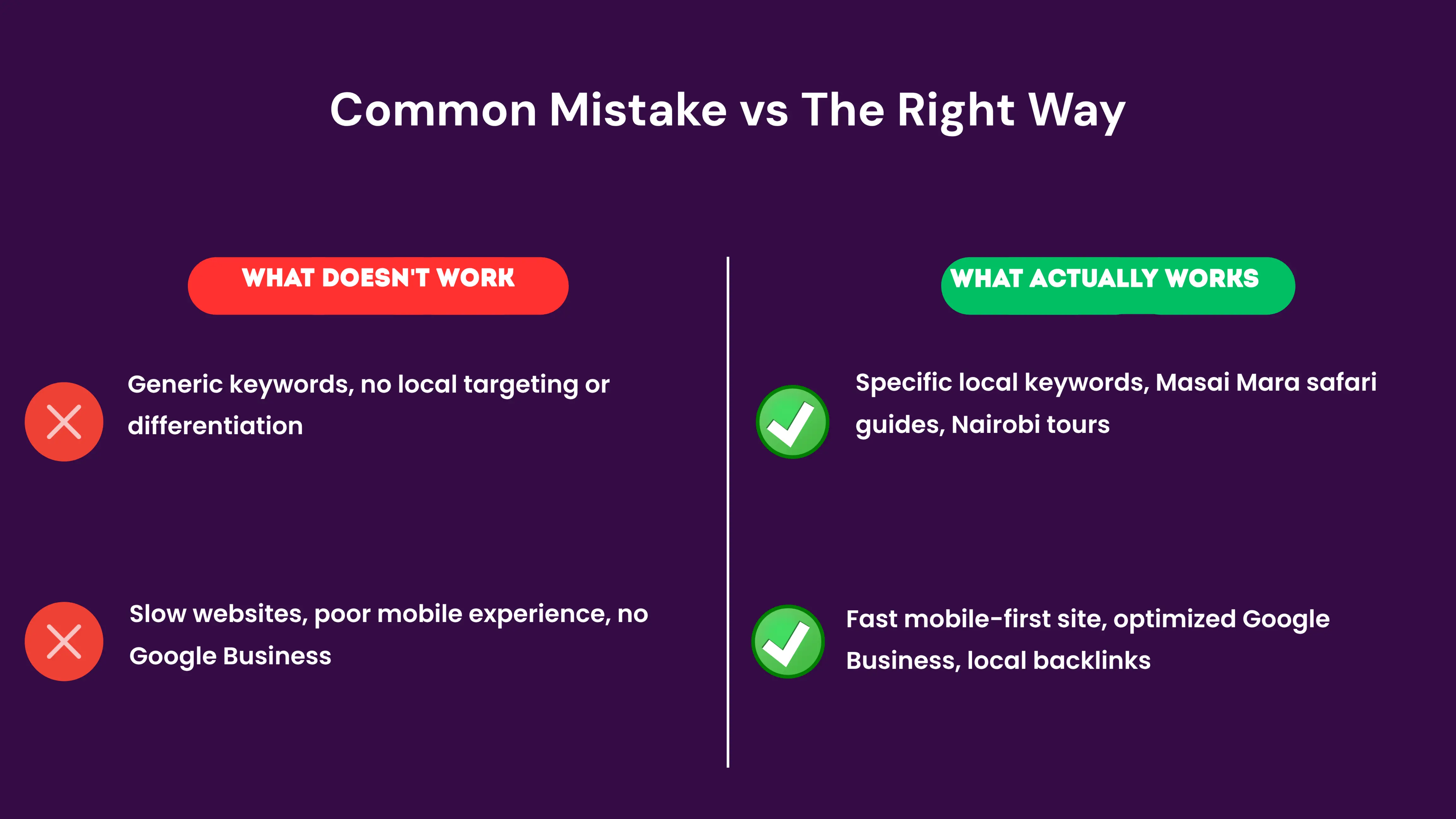
Most Kenyan tourism businesses make the same SEO mistakes repeatedly. Knowing what not to do saves you time and money.
Targeting National Keywords Instead of Local Keywords
A traveler searching “safari Kenya” could be from anywhere in Kenya or the world. They might not be ready to book.
But a traveler searching “Masai Mara lodge with pool near Nairobi” knows exactly what they want and is ready to book.
Focus 80% of your effort on local, specific keywords. You’ll rank faster and get more bookings from less traffic.
Ignoring Mobile Optimization
If your website doesn’t work well on phones, you’ve already lost most travelers. They’re researching on mobile while planning trips, comparing options, and making booking decisions.
Test your website on a mobile phone right now. If it’s hard to navigate, text is too small, or buttons don’t work, fix it before doing anything else.
Neglecting Your Google Business Profile
Your Google Business Profile is free and directly drives bookings. Yet most Kenyan tourism businesses leave it incomplete or outdated.
Incomplete profiles rank lower and give travelers less information. Complete profiles with photos, videos, and reviews convert 3-5x more travelers into customers, especially when paired with fast replies from an ai chatbot for kenya.
Writing Generic Content
Content like “Welcome to our lodge, we offer great service” doesn’t rank and doesn’t convert. Travelers see this on every lodge website.
Write specific, detailed content that showcases your unique experiences. Tell stories about your guides, your wildlife encounters, your local community involvement.
Buying Low-Quality Backlinks
Some agencies sell “backlinks” from low-quality websites. These backlinks don’t help you rank and can actually hurt your site in Google’s eyes.
Focus on earning backlinks from legitimate travel websites, tourism boards, and reputable blogs. Quality always beats quantity.
Quick Comparison Table: Tourism SEO Fundamentals
| SEO Element | Why It Matters for Tourism | How to Execute |
|---|---|---|
| Local Keywords | Attracts travelers searching for your specific region | Research keywords like “Masai Mara lodge Nairobi” not “safari” |
| Google Business Profile | Direct visibility in Maps and local results | Complete profile with photos, videos, reviews |
| Mobile Speed | Travelers research on phones during planning | Load time under 3 seconds on mobile |
| Content Strategy | Answers traveler questions and builds authority | Write guides, comparisons, seasonal content |
| Backlinks | Signals trust and authority to Google | Get featured in travel blogs and tourism sites |
✅ Quick Action Checklist
- ☐ Test your website speed on mobile using Google PageSpeed Insights
- ☐ Claim and verify your Google Business Profile with complete information
- ☐ Upload 10+ professional photos and at least one video to your Google Business Profile
- ☐ Research 20 local keywords your travelers actually search for
- ☐ Write one detailed guide about your location or experience
- ☐ Install Google Analytics and Google Search Console if not already done
- ☐ Ask 10 recent guests to leave reviews on your Google Business Profile
- ☐ Reach out to 5 travel bloggers or tourism websites about featuring your lodge
Ready to Improve Your Tourism SEO?
Tourism SEO isn’t complicated, but it requires focus and consistency. Start with local keyword research and Google Business Profile optimization this week.
These two actions alone will increase your visibility and bookings within 30 days.
Then move to content and technical SEO. Build this foundation and you’ll rank higher than 90% of your competitors who are still making basic mistakes.
Frequently Asked Questions
How long does it take to see results from tourism SEO in Kenya?
Most tourism businesses see improved visibility within 4-8 weeks if they focus on local keywords and optimize their Google Business Profile. Ranking for competitive national keywords takes 3-6 months.
Consistency matters more than speed.
Should I use Google Ads or SEO for my safari lodge?
Use both. Google Ads brings immediate traffic while you build SEO rankings.
But SEO brings long-term, cheaper traffic. A tourist searching “Masai Mara lodge” sees both ads and organic results, and you want to appear in both.
Do I need a blog for tourism SEO?
Yes. A blog gives you space to create content that answers traveler questions and targets local keywords.
One blog post per month about your location or experiences will significantly improve your rankings over time.
What’s the most important SEO factor for tourism businesses?
Local keyword targeting combined with a complete Google Business Profile. These two factors alone account for 60% of visibility improvements for Kenyan tourism businesses.
Everything else builds on this foundation.
Can I do tourism SEO myself or should I hire an agency?
You can do basic SEO yourself using free tools and this guide. But technical SEO, content strategy, and backlink building require expertise.
Most tourism businesses see better results hiring an agency that understands the Kenyan market.
Take the Next Step
You now understand the exact steps to rank higher on Google for tourism searches in Kenya. The next step is implementation.
Download our complete SEO checklist designed specifically for Kenyan tourism and hospitality businesses so you don’t miss any critical steps.
If you’re evaluating agencies to help execute this, see savage digital vs am digital ke for a side by side comparison.
You can also read artly vs am digital ke before making a decision.
Download the Complete SEO Checklist for Kenyan Businesses
Additional Resources
- From Nairobi to Mombasa- Scaling Your SEO Nationally – If your lodge chain or tour brand operates in more than one region, this shows you how to rank in each location without diluting your main site’s authority.
- Content Strategy for National Reach – Targeting All of Kenya – Pairs well with the seasonal and comparison content ideas above if you want your tourism content to pull travelers from every county, not just Nairobi.
- Competing Nationally in Kenya – Ranking Beyond Your City – Useful once your local keywords are ranking and you’re ready to compete for travelers researching Kenya trips from outside your immediate region.
- What is Search Volume (as seen from a Kenya SEO) – Explains the search volume numbers mentioned in the keyword research step, so you can judge whether a term like “Amboseli lodge” is worth targeting.
- What is Keyword Research (For the Kenya Market) – A deeper look at the keyword process used in Step 1, helpful if you want to go beyond Google Keyword Planner and Ubersuggest.
- What is CTR (As Seen From a Kenya SEO) – Breaks down the click-through rate metric referenced in the reviews and schema markup sections, so you can track whether your listing is actually getting clicked.