Table of Contents
- Introduction
- 📋 Key Takeaways
- What is School SEO in Kenya?
- Why Does School SEO Matter for Kenyan Businesses?
- How School SEO Works 🎯
- School SEO Examples in Kenya 📚
- Common Mistakes to Avoid ⚠️
- School SEO in Practice: A Comparison Table
- ✅ Quick Action Checklist
- Ready to Improve Your School SEO in Kenya?
- See What Is Working, Any Day You Ask
- Frequently Asked Questions
- Additional Resources
- Take the Next Step
TL;DR: School SEO in Kenya is the process of optimizing a school’s website and online presence so that parents and students find you when they search Google for schools in your area. It works by using the right keywords, creating quality content, building your Google My Business profile, and collecting student reviews. Schools that invest in SEO attract more student inquiries, build credibility, and grow enrollment without spending money on expensive ads.
Introduction
If you run a school in Kenya, you already know that enrollment is everything. Without students, you have no business.
But here’s what has changed in the last five years: most parents don’t walk to your gate anymore to ask about admission. They search Google first.
They type “best secondary schools in Nairobi” or “primary schools near Westlands” or “schools with STEM programs in Mombasa.” And when they do, if your school doesn’t appear on the first page of Google, they never find you.
That’s where school SEO comes in. It’s the set of techniques you use to make sure your school shows up when parents search for you online.
This isn’t about paying for ads. It’s about earning your place on Google organically, so parents find you naturally when they’re actively looking for a school like yours. SEO in Kenya has become essential for schools competing for enrollment.
📋 Key Takeaways
- School SEO targets parents searching for schools in your specific area, not a national audience.
- Most Kenyan parents now research schools online before visiting, making SEO critical for enrollment growth.
- Ranking on Google’s first page for local school keywords brings qualified leads who are already interested in enrollment.
- Google My Business, student reviews, and a mobile-friendly website are the three pillars of school SEO in Kenya.
- School SEO is a long-term strategy that builds trust and credibility, unlike paid ads that stop working when you stop paying.
What is School SEO in Kenya?
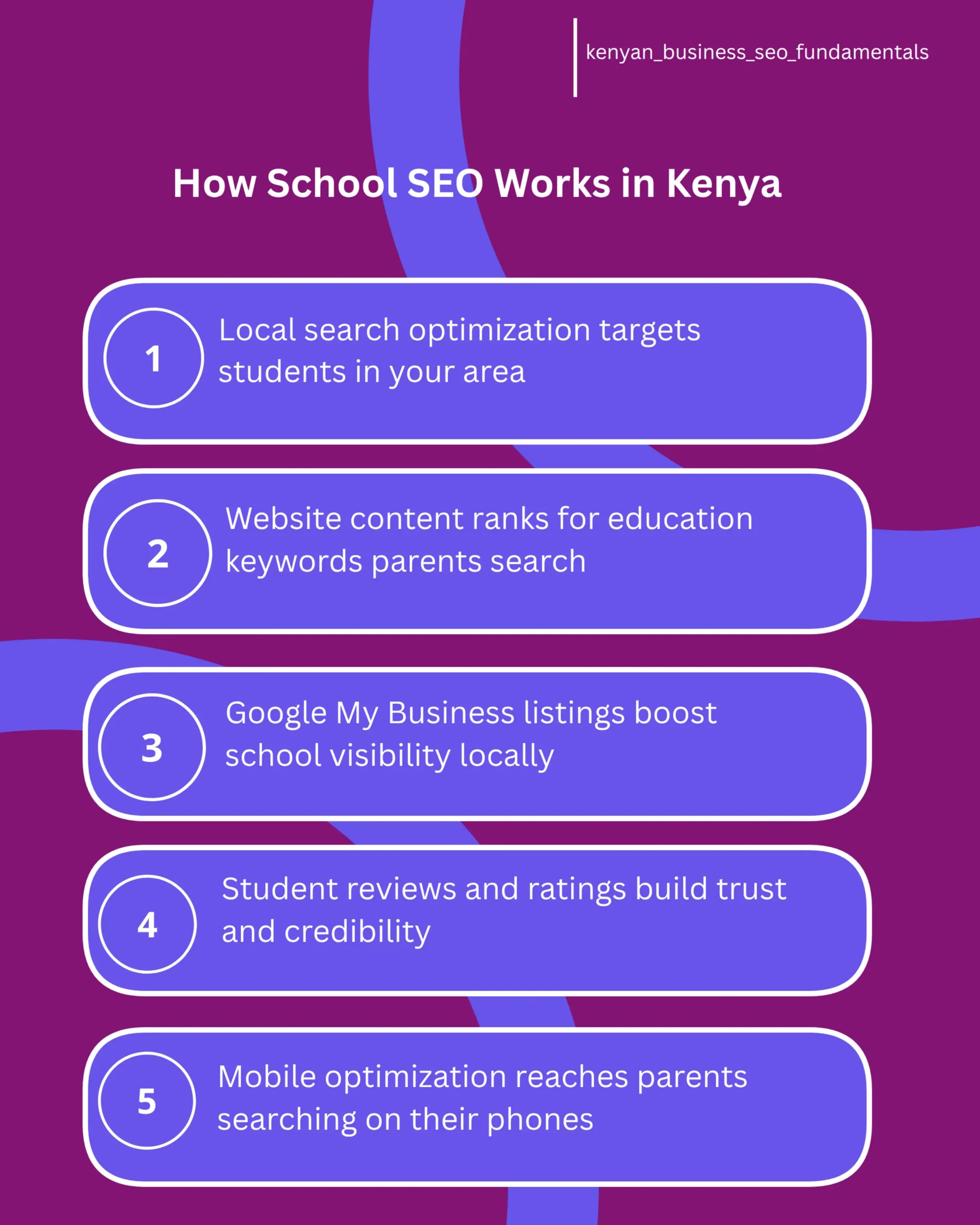
School SEO is the practice of optimizing your school’s website, Google My Business profile, and online reputation so that parents and students find you when they search for schools in your area on Google.
It’s not about tricking Google or using shortcuts. It’s about making your school visible to the exact people who are looking for you right now.
How It’s Different from Regular Marketing
Traditional school marketing in Kenya has always been word-of-mouth, local newspaper ads, or posters on the gate. These methods still work, but they’re limited to people who already know your school exists.
SEO reaches parents who don’t know your school yet but are actively searching for one. They’ve typed a keyword into Google, and your job is to be there when they do.
The Three Layers of School SEO
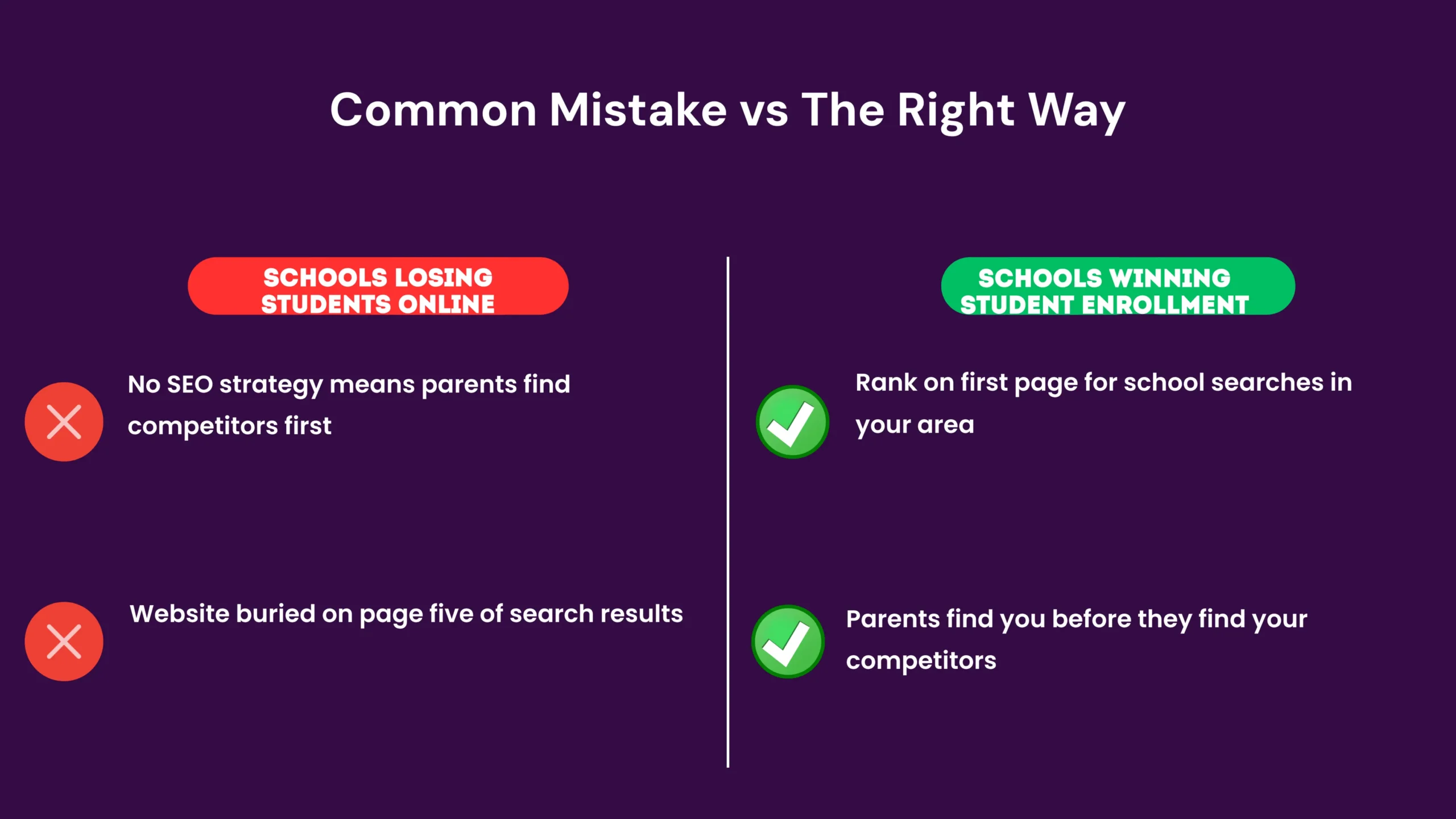
School SEO has three main components working together. First, your website must rank for keywords that parents actually search for. Second, your Google My Business profile must show up in local search results and Google Maps.
Third, your online reputation through reviews and student testimonials must convince parents that your school is worth visiting. All three layers matter.
If you only have a good website but no Google My Business profile, parents won’t find you on Maps. If you rank well but have no reviews, parents won’t trust you enough to apply.
Why Does School SEO Matter for Kenyan Businesses?
School SEO isn’t optional anymore in Kenya. Over 60% of Kenyan parents now research schools online before making enrollment decisions.
If your school isn’t visible in those searches, you’re losing students to schools that are. Here’s the reality: enrollment is down across Kenya.
Parents are more selective. They compare schools. They read reviews. They check websites. And if your school doesn’t show up in their search results, they move on to the next option.
You’re Competing with Schools That Have SEO
In Nairobi, Mombasa, and Kisumu, there are schools that have already invested in SEO. When a parent searches “best international schools in Karen” or “affordable secondary schools in Mombasa,” those schools appear first.
Your school appears on page three or four, if at all. That’s not because their school is better. It’s because they’ve optimized their online presence and you haven’t.
Enrollment Decisions Happen Online Now
Parents don’t just search for your school name anymore. They search for school type, location, fees, curriculum, and reviews.
They visit your website. They check your Google My Business profile. They read what other parents say about you.
If your website is outdated, your Google profile is incomplete, or you have no reviews, parents will assume your school is not serious about excellence. They’ll enroll their children somewhere else.
SEO Brings Qualified Leads, Not Just Traffic
When a parent searches for “primary schools in Lavington with swimming pool,” they’re already interested. They’re not just browsing. They’re ready to inquire about admission.
That’s a qualified lead. Paid ads might bring more traffic, but SEO brings the right traffic. It brings parents who are actively looking for exactly what your school offers.
Long-Term Growth Without Ongoing Ad Spend
Paid Google ads work as long as you pay for them. The moment you stop, your visibility stops.
But SEO builds organic visibility that compounds over time. Six months from now, your school will still rank for those keywords without paying anything extra. For schools with tight budgets, this is transformative.
You invest in SEO once, and it keeps working for you. This approach works whether you’re targeting national or local audiences.
How School SEO Works 🎯
School SEO works by aligning three things: what parents are searching for, what your website says, and what Google thinks about your school’s authority and relevance.
Let’s break down how each part works.
Keyword Research: Understanding Parent Search Behavior
Everything starts with keywords. A keyword is the exact phrase a parent types into Google when looking for a school.
“Secondary schools in Nairobi,” “best primary schools with sports,” “affordable boarding schools in Kenya” are all keywords. Your job is to find the keywords that parents in your area actually search for, then create content around those keywords.
If you run a school in Westlands, you need to rank for “schools in Westlands,” not “schools in Kenya.”
On-Page Optimization: Making Your Website Speak Google’s Language
Once you know what parents are searching for, you optimize your website pages to match those searches. This means putting keywords in your page titles, headings, and content.
It means writing clear, helpful information about your school’s programs, fees, and admissions process. Google reads your website to understand what it’s about.
If your website talks about your school’s excellence but never mentions “primary school in Nairobi,” Google won’t know to show you when someone searches for that phrase. Optimized content can even appear in featured snippets at the top of search results.
Google My Business: Your School’s Local Profile
Google My Business is a free tool where you claim your school’s profile on Google. When you set it up correctly, your school appears in Google Maps and in the local search results that show up when parents search for schools near them.
Your Google My Business profile includes your school’s address, phone number, website, hours, and photos. Parents can see your location on a map, read your reviews, and contact you directly from Google.
Reviews and Reputation: Building Trust
When a parent finds your school on Google, one of the first things they look at is your reviews. If you have five-star reviews from other parents, they’ll trust you more.
If you have no reviews or bad reviews, they’ll be skeptical. School SEO includes actively asking parents and students to leave reviews on Google.
This builds your credibility and signals to Google that your school is legitimate and well-regarded.
Mobile Optimization: Meeting Parents Where They Are
Most parents search for schools on their phones, not on computers. If your website isn’t mobile-friendly, it will load slowly, look bad, and frustrate visitors.
Google ranks mobile-friendly websites higher, so this is critical. Your school’s website must work perfectly on phones: fast loading, easy navigation, clear information, and simple contact buttons.
School SEO Examples in Kenya 📚
Let’s look at how school SEO works in real Kenyan scenarios. These examples will show you exactly what success looks like and how it translates to enrollment growth.
Example 1: A Primary School in Nairobi Westlands
A primary school in Westlands had a website, but it was rarely updated and didn’t rank for any local keywords. Parents searching for “primary schools in Westlands” found three competitors before finding this school.
After SEO optimization, the school’s website now ranks on the first page for “primary schools in Westlands,” “best primary schools in Nairobi,” and “schools with strong academics in Westlands.” Their Google My Business profile shows up in Maps results.
They’ve collected 47 five-star reviews from current parents. Result: Enrollment inquiries increased by 35% within six months. Parents were finding them online before they found competitors.
Example 2: A Secondary School in Mombasa
A secondary school in Mombasa was competing with larger schools that had bigger marketing budgets. They couldn’t afford expensive ads, so they invested in SEO instead.
Their SEO strategy focused on ranking for specific keywords like “best STEM secondary schools in Mombasa,” “secondary schools with strong university placement,” and “affordable boarding schools on the Coast.” They created blog posts about their university placement record, their science facilities, and their student life.
They optimized their Google My Business profile with photos of their campus and facilities. Result: Within eight months, they were ranking on the first page for all their target keywords.
They attracted 28 new students in the next intake, with most saying they found the school through Google search. This demonstrates how scaling SEO across regions can work for educational institutions.
Example 3: An International School in Nairobi Karen
An international school in Karen had a good reputation but limited visibility in online searches. Parents searching for “international schools in Karen” or “best international schools in Nairobi” weren’t finding them on the first page.
They implemented a comprehensive SEO strategy: they optimized their website for keywords like “IB schools in Karen,” “international schools with boarding,” and “schools with strong sports programs.” They set up their Google My Business profile with detailed information about their curriculum, facilities, and admissions process.
They encouraged parents and alumni to leave reviews. Result: They now rank first for “international schools in Karen” and appear in the top three for “best international schools in Nairobi.”
Their inquiry rate increased by 50%, and they had to open a waiting list for the next academic year.
Common Mistakes to Avoid ⚠️
Many schools in Kenya start their SEO journey with good intentions but make mistakes that slow down their progress or waste their effort. Here are the most common ones.
Mistake 1: Ignoring Google My Business
Some schools set up a Google My Business profile and then forget about it. They don’t update their information, don’t add photos, and don’t respond to reviews.
This is a huge missed opportunity. Your Google My Business profile is often the first thing parents see when they search for your school. If it’s incomplete or outdated, you lose credibility before they even visit your website.
Mistake 2: Writing for Other Schools, Not for Parents
Some school websites read like they’re written for other educators, not for parents. They use jargon, they focus on internal details, and they don’t answer the questions parents actually have: How much do you charge?
What’s your admissions process? What’s your university placement rate? Your website content must speak directly to parents’ concerns and questions. Answer them clearly and honestly.
Mistake 3: Targeting National Keywords Instead of Local Keywords
A school in Kisumu doesn’t need to rank for “best schools in Kenya.” That’s too broad and too competitive.
They need to rank for “schools in Kisumu,” “primary schools in Kisumu,” and “secondary schools near Kisumu town.” Local keywords have less competition and bring more qualified leads.
Parents searching for schools in Kisumu are much more likely to enroll than parents searching for schools anywhere in Kenya. Schools with multiple campuses need location-specific strategies.
Mistake 4: Not Collecting Reviews
Schools often assume that reviews will come naturally. They don’t.
You need to actively ask parents and students to leave reviews on Google after they’ve had a positive experience. Without reviews, your school looks less trustworthy. With reviews, you build credibility and improve your SEO ranking.
Mistake 5: Neglecting Mobile Optimization
If your website looks great on a computer but is slow and hard to navigate on a phone, you’re losing half your potential leads. Most parents search for schools on their phones.
Your website must be mobile-first. It must load fast, display clearly, and make it easy to find contact information and submit an inquiry.
School SEO in Practice: A Comparison Table
| SEO Element | Without School SEO | With School SEO |
|---|---|---|
| Google Search Ranking | Page 3-5 for local keywords | Page 1 for target keywords |
| Google My Business Profile | Incomplete or not optimized | Complete, updated, with photos and reviews |
| Student Reviews | 0-5 reviews, mostly old | 20+ recent reviews with 4.5+ stars |
| Website Mobile Experience | Slow, hard to navigate on phone | Fast, mobile-friendly, easy to contact |
| Parent Inquiries Per Month | 5-10 inquiries | 25-40 inquiries |
| Enrollment Growth | Flat or declining | 20-40% increase year-on-year |
✅ Quick Action Checklist
- ☐ Claim and complete your school’s Google My Business profile with accurate address, phone, website, and hours
- ☐ Add 10-15 high-quality photos of your school’s campus, classrooms, facilities, and student activities to your Google My Business profile
- ☐ Research the keywords parents in your area search for (use Google Search Console and Google Keyword Planner)
- ☐ Test your school’s website on a mobile phone to ensure it loads fast and is easy to navigate
- ☐ Create a system for asking parents and students to leave reviews on Google after positive interactions
- ☐ Update your website’s homepage to include local keywords and answer common parent questions about admissions, fees, and programs
- ☐ Write or update at least three blog posts answering questions parents ask about your school (university placement, curriculum, sports programs, etc.)
- ☐ Set up Google Analytics on your website to track how many parents are visiting and where they’re coming from
Ready to Improve Your School SEO in Kenya?
School SEO isn’t complicated, but it does require focus and consistency. Start with the basics: claim your Google My Business profile, optimize your website for mobile, and ask parents to leave reviews.
These three actions alone will improve your visibility and bring more qualified parent inquiries. From there, you can expand your strategy with keyword research, content creation, and ongoing reputation management.
If you’re ready to grow your school’s enrollment through search, reach out to our team at AM Digital KE. We specialize in SEO for Kenyan schools and have helped dozens of institutions attract more students online. We also help other sectors like SACCOs grow their digital presence.
See What Is Working, Any Day You Ask
Enrolment enquiries are the metric that matters, so that is what we report.
Every campaign move is logged in your SEO Brain, so you can ask which pages are bringing enquiries and get a straight answer in plain language. Our pricing is published, so you can evaluate us the same way you would evaluate any supplier.
See what that looks like in practice on our education and eLearning SEO services page, or start with a free SEO audit.
Frequently Asked Questions
How long does it take for school SEO to work?
Most schools see initial results within 3-4 months, but significant ranking improvements typically take 6-12 months. SEO is a long-term strategy, not a quick fix.
The timeline depends on your competition, keyword difficulty, and how consistently you implement best practices. Building authority across regions takes time but delivers lasting results.
Can my school do SEO without hiring an agency?
Yes, you can start with the basics yourself: claim your Google My Business profile, optimize your website for mobile, and ask parents to leave reviews. However, keyword research, technical optimization, and content strategy require expertise.
Many schools benefit from hiring an agency to handle the technical work while they focus on enrollment. Compare options like Savage Digital vs AM Digital KE or Artly vs AM Digital KE to find the right fit.
Does SEO work for schools in small towns like Kisii or Nakuru?
Absolutely. In fact, SEO often works better in smaller towns because there’s less competition.
A school in Kisii can easily rank first for “primary schools in Kisii” or “best secondary schools in Kisii town” with proper optimization.
What’s the difference between school SEO and paid Google ads?
Paid ads appear at the top of search results but stop working the moment you stop paying. SEO builds organic rankings that keep working and improve over time.
Paid ads are useful for immediate results; SEO is better for long-term, sustainable growth. You can also enhance parent engagement with tools like an AI chatbot.
How do reviews affect my school’s SEO ranking?
Reviews are a major ranking factor. Schools with more reviews and higher ratings rank higher on Google.
Reviews also build trust with parents. A school with 50 five-star reviews will convert more parent inquiries into enrollments than a school with no reviews. Combine this with insights from tracking essential metrics to optimize your strategy.
Additional Resources
- Content Strategy for National Reach – Targeting All of Kenya – Learn how to create content that attracts parents from multiple regions if your school has campuses in different cities or targets boarding students nationwide.
- Competing Nationally in Kenya – Ranking Beyond Your City – Discover strategies for schools that want to rank beyond their immediate location, especially useful for boarding schools or institutions with national reputations.
- What is Search Volume (as seen from a Kenya SEO) – Understand how many parents are actually searching for your target keywords so you can prioritize the terms that bring the most enrollment inquiries.
- What is Keyword Research (For the Kenya Market) – Master the process of finding the exact phrases Kenyan parents type into Google when searching for schools like yours.
- What is CTR (As Seen From a Kenya SEO) – Learn how to write page titles and meta descriptions that make more parents click through to your school’s website from Google search results.
- What is Alt Text (by Kenya’s SEO Authority) – Optimize your school’s campus and facility photos so they appear in Google Image Search and help parents visualize your school before visiting.
Take the Next Step
School SEO is the fastest way to attract more qualified parent inquiries and grow your enrollment through search. If you’re ready to implement a complete SEO strategy for your school, download our School SEO Strategy Guide for Kenyan Institutions to learn exactly how to rank first for your target keywords and attract more students online.
Promote your school effectively by understanding which social platforms matter for reaching Kenyan parents.