
Table of Contents
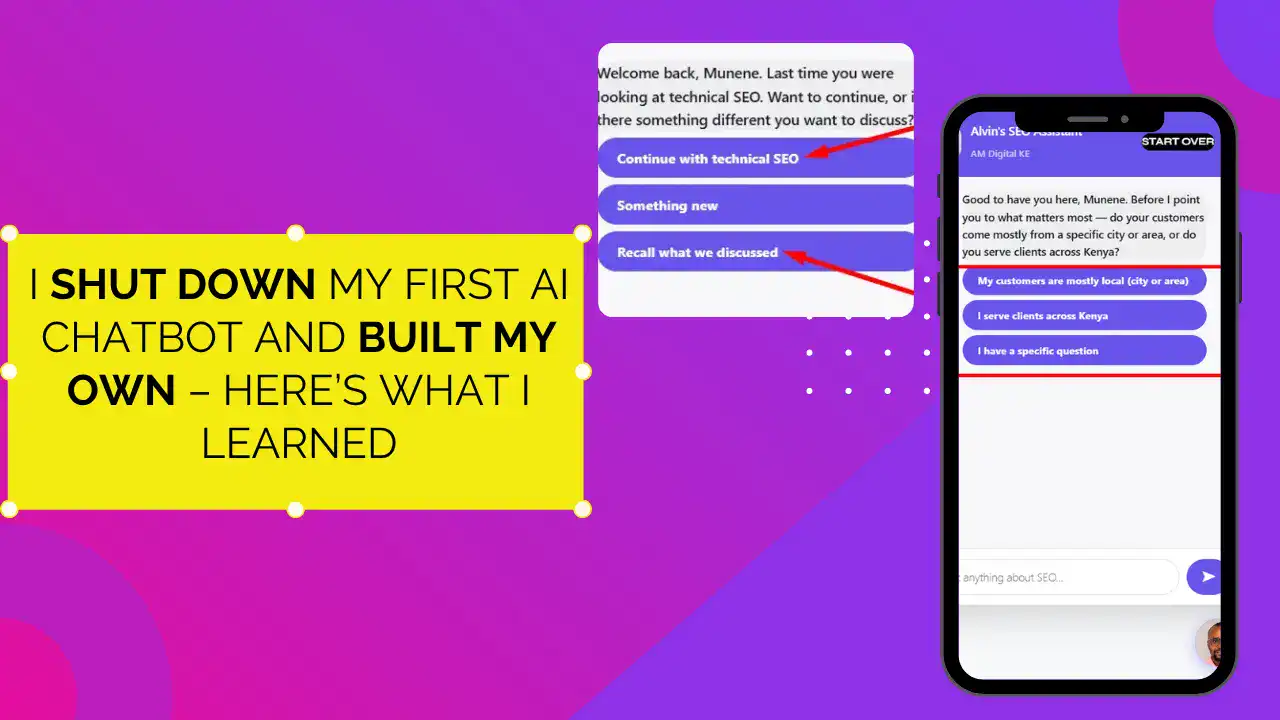
TL;DR: I had 200+ SEO articles, but visitors still could not find what they needed. I installed a chatbot. It slowed my site, locked users into predefined questions, and remembered nothing between visits. So I built my own AI chatbot using n8n and Google Sheets, a lesson that ties directly into how AI SEO differs from traditional SEO in Kenya.
The result is a learning tool that remembers every user, segments leads by industry automatically, and surfaces a CTA at the exact moment intent is highest. Here is what I learned and how the same thinking applies to five Kenyan industries.
I have over 200 SEO articles on this site. Plus an SEO resource page with guides, checklists, how-tos and more. Everything a Kenyan business owner needs to understand search.
The problem? Most visitors did not know where to start.
SEO feels technical. A clinic owner in Westlands or a restaurant manager in Karen does not arrive knowing the difference between on-page SEO and local SEO.
They arrive with a question. Usually something like: “Why is my business not showing on Google?”
A chatbot felt like the obvious answer. Instead of pointing people to a list of articles, I could let them ask in plain language and get a direct answer immediately.
So I installed one.
The First Attempt: WPChat
I chose WPChat. It is part of the Awesome Motive suite.
The same company I work with as a content and SEO expert.
I had seen how it was built from the inside. I had worked with the team behind it. It is a genuinely well-built product.
But it did not solve my specific problem. Three reasons.
Problem 1: It slowed my site
Page speed is one of the first things I tell clients to fix. Having a tool that undermined that on my own site was not something I could accept.
I shut it down within weeks and left an honest update on the original launch post.
Problem 2: Users could only pick from predefined questions
WPChat is built around a question tree. You set the questions, and users choose from them.
That works well for support bots and booking flows.
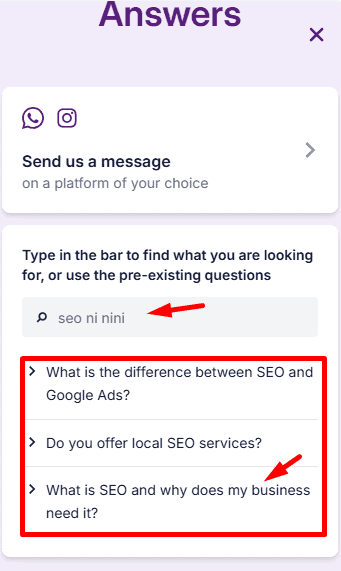
But I was not building a support bot. I was trying to answer real SEO questions that I could not predict in advance.
A Nairobi retailer asking about Google Shopping. A clinic asking how patients search for doctors. Those questions do not fit into a tidy preset list.
Problem 3: No memory
Every visit started from zero. A user who came back a week later got the same opening screen as a first-time visitor.
Nothing carried over. For a learning tool, that is a fundamental problem.
The value of a learning resource is supposed to compound. The bot should remember what you discussed and build on it. This one forgot everything.
WPChat is great at what it is designed to do. It just was not designed for what I needed.
Why I Decided to Build My Own
I am not a developer. But I understand marketing problems.
My problem was specific: I had the content, but my audience could not self-navigate it.
I needed something that could teach SEO concepts in plain language, link to the right articles, and remember each user so the experience got better over time.
No off-the-shelf tool did all three. So I built one using tools I already had: n8n for the backend automation, Google Sheets for conversation storage, and an AI model for the responses.
The key decision was not which tool to use. It was understanding what problem I was actually solving.
Most businesses that install a chatbot are solving “we need a chatbot.” I was solving “my readers do not know where to start, and I am losing them before they find the content that would help them.”
That distinction changes everything about how you build.
How the Bot Evolved: The UX Insight
The first version was open-ended. A text input field. Ask me anything.
It did not work.
My audience, business owners and marketing managers in Kenya, found a blank input box intimidating.
They did not know what was worth asking. They would type “SEO” or “help” and get generic responses. Or they would close the widget entirely.
So I changed my approach.
Instead of a blank input, I added chips and clickable topic buttons.
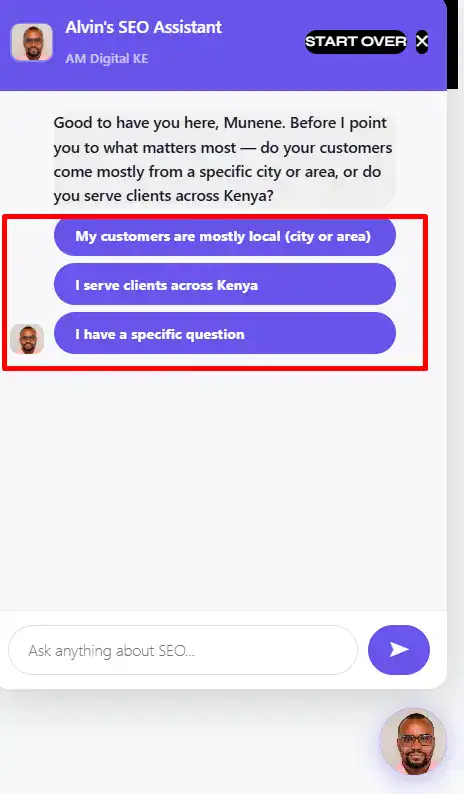
When you complete the gate (name, email, industry), you see three options tailored to your industry.

A real estate agent sees different options from a restaurant owner. You click a topic, the bot teaches you something specific, and new chips appear for the next step.
This changed the experience completely.
The lesson: your tool has to match your audience’s knowledge level, not yours.
I know SEO. My visitors do not. An open text field assumes they know what to ask.
Guided chips teach them what is worth asking.
That is a small design decision with a significant impact on whether the tool actually gets used.
This is also why there is no single template for building something like this.
It only works if you design around your specific audience’s starting point, not a generic version of your audience, but the actual people landing on your site.
What the Chatbot Actually Captures
Here is where it becomes genuinely useful from a marketing perspective.
User Information
When a user opens the bot, they enter their name, email, and industry before the first message.
Industry and Topics
From that moment, they are already segmented.
I know they are in real estate, healthcare, or e-commerce before they have asked a single question.
As the conversation continues, the bot automatically extracts topic tags. Local SEO. Google Business Profile. Site speed. Content strategy.
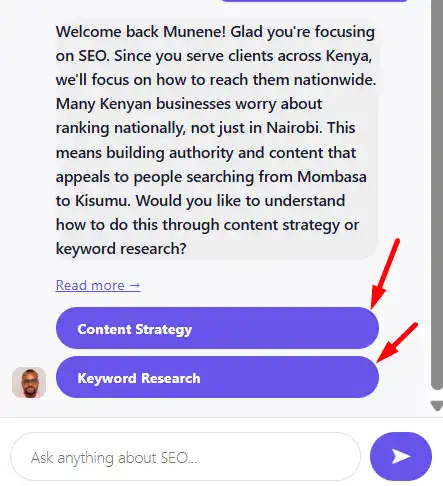
Not from a form they fill in, but from what they actually ask about. That is a far more accurate signal than any dropdown.
Interested Leads
By the time someone reaches their fourth message, they have asked three genuine questions in a row. That is not a casual visitor; that is someone engaged, interested, and self-qualified.
Now, that is when the CTA appears. A prompt to book a free SEO analysis or message me on WhatsApp, with a pre-filled message already referencing what they were learning about.
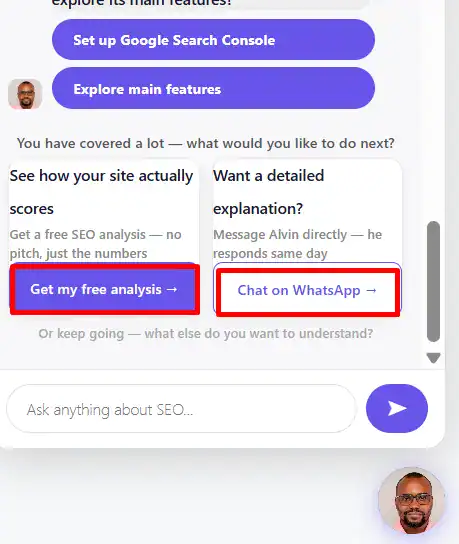
Analysis of Content Gap
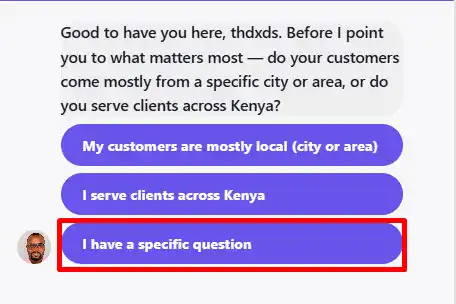
Once you know what your users are looking for, it is much easier to create content or solutions around what you found out.
For example, in the AMDigitalKE chatbot, once you enter your details, the first question will ask you if “you have a specific question.”
I collect these answers and create content around the topics.
Continuous Learning
Education should not be a one-time thing. So every time someone comes back, the chatbot “remembers” them.
They don’t need to enter their details again.
After this, they can continue what they previously started, recall it, or start on a new topic.

The Result
Every lead arrives in my system already categorised by industry and already tagged by interest.
When it is time to follow up, I am not guessing what they care about. The data tells me.
And the follow-up is genuinely specific because it is based on their actual intent and behaviour, not my assumptions.
This is the argument: not just collecting emails, but collecting context.
You know which industries are coming to you, which SEO topics matter most to each of them, and which leads have already demonstrated enough interest to be worth a conversation.
That is a different kind of lead list.
What This Could Look Like for Your Business
The chatbot works for AM Digital KE because it solved a specific problem. Here is how that same thinking applies across five industries.
Real Estate
Real estate agents and developers in Nairobi are sitting on valuable knowledge about neighbourhoods, property types, and what buyers actually ask before they commit.
A chatbot that answers “what should I look for in a Kilimani property” or “how do I know if a listing is genuine” captures buyer intent early and routes the right leads to the right person.
Every conversation tags itself: first-time buyer, investor, rental seeker. Your follow-up is already segmented before you pick up the phone.
Restaurants and Hospitality
“Best restaurant in Westlands” is searched hundreds of times a month. Most restaurants in Nairobi have no content that captures that traffic.
A chatbot that answers reservation questions, explains your menu, or walks someone through your events builds a data point every time it is used.
You learn which dishes generate interest before the booking. You learn whether people are coming for the atmosphere or the food. That data informs your marketing and your menu.
Healthcare and Clinics
Patients search before they book. They want to know if a clinic handles their specific condition, what the wait times are, and whether their insurer is accepted.
A chatbot that answers those questions around the clock reduces front desk load and captures intent.
A clinic that uses this well can segment enquiries by speciality before a human ever picks up the phone and follow up accordingly.
E-commerce and Retail
Competing with Jumia or Kilimall on price is a losing position. Competing on expertise is not.
A chatbot that helps a customer understand which product actually fits their needs and why builds trust that a marketplace listing cannot replicate.
Every product question is data. That data tells you what your E-commerce buyers care about, which shapes everything from your content to your stock decisions.
Professional Services: Law and Accounting
Trust is the entire value proposition for a law firm or accounting practice.
A chatbot that explains basic processes like how to register a company, what documents you need for a tax query, and what PAYE compliance actually involves.
This demonstrates expertise before any money changes hands. Plus, it also pre-qualifies: someone who has just asked three detailed questions about company registration in Kenya is not a tyre-kicker.
They are ready to have a serious conversation.
Check out the list of industries I help optimise for SEO.
How to Think About Building One
The question is not “should I build a chatbot for my Nairobi business?”
The question is: what specific marketing or nurturing problem do I have?
- What does my audience not understand that I do?
- How and what information would let me serve them better from the first interaction?
- What does a warm, self-qualified lead look like for my business?
Once you are clear on those answers, the technology becomes much easier to choose.
Sometimes a chatbot for your Kenyan business is the right fit. Sometimes it is a quiz, a calculator, a checklist, or a different format entirely.
Check out my resource page to see examples of different lead magnets that can work for you.
The tool follows the problem, not the other way around.
If you are asking those questions and want a second perspective, that is exactly what the free SEO analysis conversation is for.
You bring your situation. I bring mine. Together, we work out what makes sense for your specific business, your audience, and your current marketing gaps.
Not a template. Your solution.
Try It Yourself
The chatbot is live on this site right now. Open it in the corner of this page.
Ask it a question about SEO. See how it responds. Notice whether it triggers any ideas about how something similar could work for your business or your clients.
If it does, book a free SEO analysis. Come with your ideas, and I will come with mine. We look at your audience, your content, and your current flow, and we figure out the right next move together.
FAQS: AI ChatBot for Kenyan Businesses
What is the difference between a chatbot and an AI chatbot?
A regular chatbot follows a script. It shows predefined questions and routes you through a decision tree.
An AI chatbot understands plain language and generates responses in real time. It can handle questions you did not anticipate and give answers that feel like a conversation, not a menu.
Can a small business in Kenya afford a custom AI chatbot?
Yes. The tools required are a workflow system like n8n, Google Sheets, or a backend stack like Supabase, and an AI model.
The real investment is time spent designing the experience around your specific audience. Off-the-shelf tools often cost more monthly and solve less.
How does a chatbot collect leads without feeling like a form?
The gate feels like the start of a conversation, not a signup. Users enter their name, email, and industry to unlock the chat.
Because they immediately receive something valuable in return, real answers, the exchange feels fair. By the time a CTA appears, they have already self-qualified. This is the same approach I use to build clients their lead magnets.
How do chatbots help with lead nurturing in Kenya?
Chatbots capture more than an email; they capture context. Industry, conversation topics, and engagement depth are all logged automatically.
That means when you follow up, you already know what the lead cares about. For Kenyan businesses where trust is built slowly, that specificity makes a significant difference.
Do I need a developer to build a custom chatbot?
Not necessarily. Tools like n8n handle the backend automation without code.
The harder part is designing the experience. Understanding your audience’s knowledge level, what questions they will ask, and what information you need to collect. The thinking matters more than the technical execution.