TL;DR: Anchor text is the blue, clickable words in a link that tell Google what the linked page is about. Using the right anchor text helps Google rank your pages for the keywords you care about. Get it wrong, and you waste backlinks, internal links, and SEO opportunities.
What Does Anchor Text Mean?
Anchor text is the visible, clickable text inside a hyperlink. When you see blue underlined words on a website, that is anchor text.
The anchor text is what users click on to go to another page, but it is also what Google reads to understand what that linked page contains.
Think of anchor text as a label. If a link says “best accounting software for Kenyan SMEs,” Google understands that the linked page talks about accounting software for Kenyan small businesses. If a link just says “click here,” Google learns nothing about what the linked page actually covers.
Anchor text appears in three main places on your website: inside the body of your content (when you link to other pages), in navigation menus, and in footer links.
It also appears on other websites when they link to you. Each type sends a signal to Google about your page’s topic and relevance.
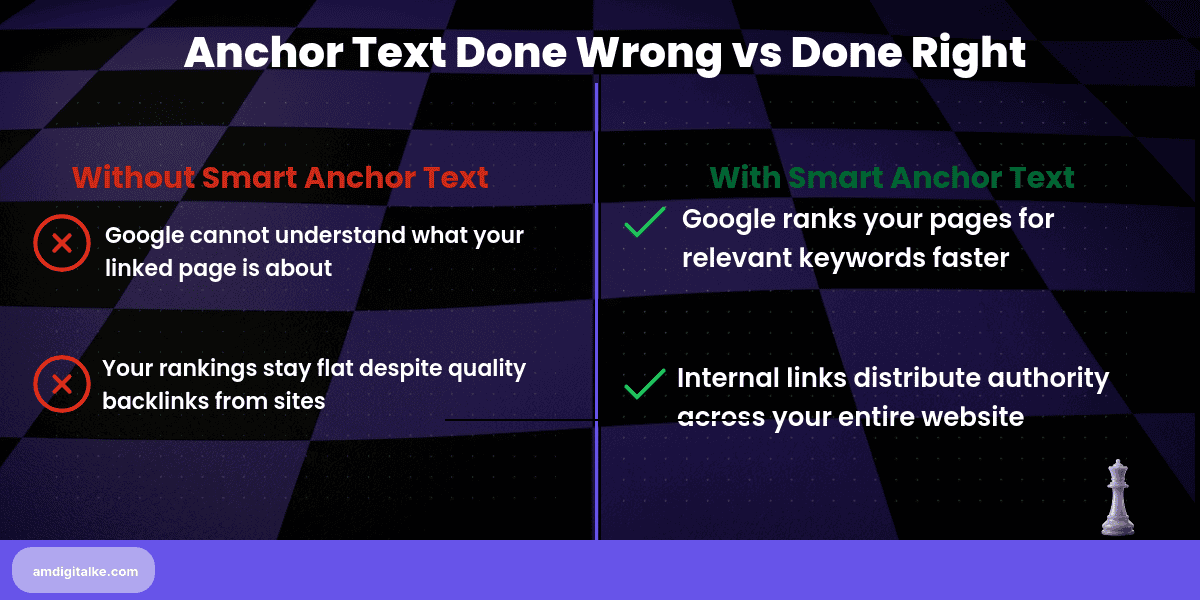
The power of anchor text is that it bridges the gap between what Google sees and what your page actually means. Google cannot read your page the way a human does. It reads anchor text as a strong clue about page content.
📋 Key Takeaways
- Anchor text is the clickable text in a link that tells Google what the linked page is about
- Overusing exact match anchor text triggers Google’s spam filters and hurts your rankings
- Internal links with strategic anchor text pass authority to your most important pages
- Backlinks with relevant anchor text rank you faster for competitive keywords
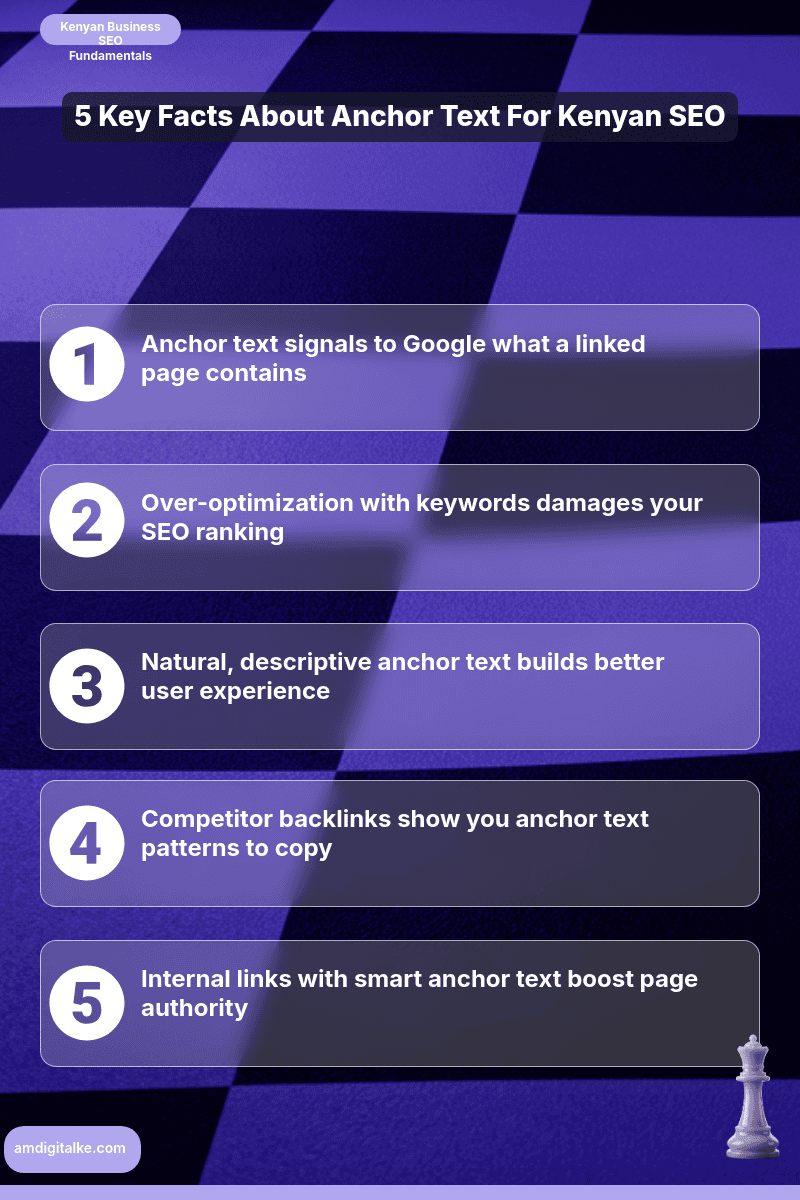
- Natural, descriptive anchor text improves both SEO and user experience
Why Anchor Text Matters More Than You Think
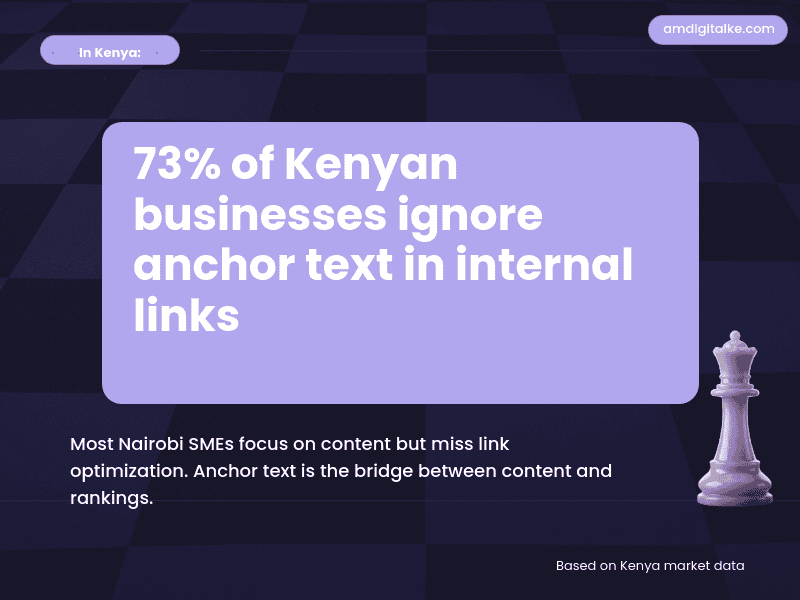
Most Kenyan business owners focus on writing good content. They spend weeks perfecting blog posts about their services. Then they publish the post and wonder why it does not rank.
The missing piece is usually anchor text. Without strategic anchor text, your links are weak. Your internal links do not pass authority where you need it. Your backlinks do not reinforce the keywords you want to rank for.
The Three Types of Anchor Text
Exact match anchor text uses the exact keyword you want to rank for. An example is linking the words “digital marketing agency Nairobi” to your homepage. This is powerful but can look unnatural if overused.
Partial match anchor text includes your keyword but adds other words. An example is “top digital marketing agency in Nairobi.” This looks more natural and is safer for SEO.
Branded anchor text uses your company name or generic words like “click here” or “read more.” This is natural and safe but carries less keyword power. Most of your anchor text should be branded or partial match.
Why Does Anchor Text Matter for Kenyan Businesses?
Google uses anchor text as one of its top ranking signals. When multiple websites link to you with the same anchor text, Google assumes your page is an authority on that topic. This is why a Nairobi plumbing business that gets backlinks with the anchor “emergency plumber Nairobi” will rank higher than a competitor with generic backlinks.
For Kenyan SMEs, anchor text is a free ranking lever you already have access to. You do not need to buy ads or spend money on tools. You just need to understand how to use the links you already have.
Anchor Text Signals Authority to Google
Google sees anchor text as a vote of confidence. When another website links to you with relevant anchor text, it is like that website is saying “this page is about this topic.” The more sites that do this with consistent anchor text, the stronger your authority signal.
A Westlands accounting firm that gets 5 backlinks with “tax consultant Westlands” will rank better than one with 10 random backlinks using different anchor text. Quality of anchor text beats quantity of links.
Internal Links with Smart Anchor Text Distribute Authority
Your internal links are links from one page on your website to another page on your website. These links pass authority and help Google understand your site structure. But they only work if you use smart anchor text.
If you write a blog post about “how to register a business with KRA,” you should link to your services page using anchor text like “business registration services” not “click here.” This tells Google that your services page is relevant to business registration.
Anchor Text Helps You Rank for Long-Tail Keywords
Long-tail keywords are longer, more specific search phrases. A Mombasa hotel might target “budget hotel near Mombasa Old Town” instead of just “hotel Mombasa.” These keywords have less competition and often convert better.
When you use long-tail anchor text in internal links, you help Google understand that specific page covers that specific topic. This makes it easier to rank for those exact phrases.
How Anchor Text Works 🔗
Anchor text works by creating a connection between the link source and the link destination. Google crawls the link, reads the anchor text, and updates its understanding of what the destination page is about. This process happens automatically whenever a link exists.
The power comes from repetition and consistency. If 10 different websites link to your page using “best SEO agency Kenya,” Google gets a strong signal that your page is about SEO agencies in Kenya. If those same 10 sites use 10 different anchor texts, the signal is weaker.
How Google Reads and Weighs Anchor Text
Google does not read anchor text the same way it reads page content. Anchor text gets extra weight because it is a third-party endorsement. When someone else writes anchor text pointing to your page, it carries more credibility than words on your own page.
Google also looks at the context around the link. If a link appears in an article about plumbing with anchor text “emergency plumber,” that is more powerful than the same anchor text appearing in an article about fashion. Context matters.
Internal vs External Anchor Text Signals
Internal anchor text (links within your own site) helps Google understand your site structure and distributes authority between your pages. External anchor text (links from other sites) serves as a ranking signal and builds your overall domain authority.
Both matter, but external anchor text carries more weight. A backlink with good anchor text is worth more than an internal link with the same anchor text. However, internal links are under your control, so you should optimize them first.
Anchor Text Examples in Kenya 📍
Let us look at real examples of how anchor text works for Kenyan businesses. Understanding these examples will help you apply the concept to your own business.
Example 1: A Nairobi Digital Marketing Agency
A digital marketing agency in Nairobi wants to rank for “digital marketing services Nairobi.” They should look at their backlinks and see what anchor text competitors are getting. If competitors have backlinks with “digital marketing Nairobi,” “SEO services Nairobi,” and “social media marketing Nairobi,” the agency should aim for similar anchor text.
Internally, the agency should link to their services page using these anchor texts from relevant blog posts. A post about “why your Nairobi startup needs social media marketing” should link to the services page with anchor text “social media marketing services.” This reinforces the connection between the blog post topic and the services page.
Example 2: A Mombasa Real Estate Business
A Mombasa real estate agent wants to rank for “property for sale Mombasa.” They have a blog and post regularly about neighborhoods, market trends, and buying tips. Each blog post is an opportunity to use smart anchor text.
A post about “best neighborhoods in Mombasa for families” should link to their properties listing page using anchor text like “properties for sale in family-friendly Mombasa neighborhoods.” This is natural language that also reinforces the keyword. Over time, these internal links help Google understand that the properties page is about selling property in Mombasa.
Example 3: A Nairobi Restaurant Using Local Backlinks
A restaurant in Westlands wants to rank for “best restaurant Westlands.” They can reach out to local Nairobi food bloggers and ask them to feature the restaurant. When these bloggers link to the restaurant, they should use anchor text like “best restaurant Westlands” or “top dining in Westlands.”
This is more effective than asking bloggers to link with generic anchor text like “visit our website.” The specific anchor text tells Google that the restaurant is relevant to “best restaurant Westlands” searches. Over time, multiple links with this anchor text push the restaurant higher in rankings.
| Business Type | Target Keyword | Best Anchor Text | Why It Works |
|---|---|---|---|
| Nairobi Accountant | tax consultant Nairobi | tax consultant Nairobi | Exact match signals relevance to Google |
| Mombasa Hotel | beachfront hotel Mombasa | beachfront accommodation Mombasa | Partial match looks natural and ranks well |
| Nairobi Plumber | emergency plumber Nairobi | 24-hour plumbing services Nairobi | Partial match with keyword variation |
| Kisumu Salon | best salon Kisumu | top hair salon in Kisumu | Partial match with local modifier |
Common Mistakes to Avoid ⚠️
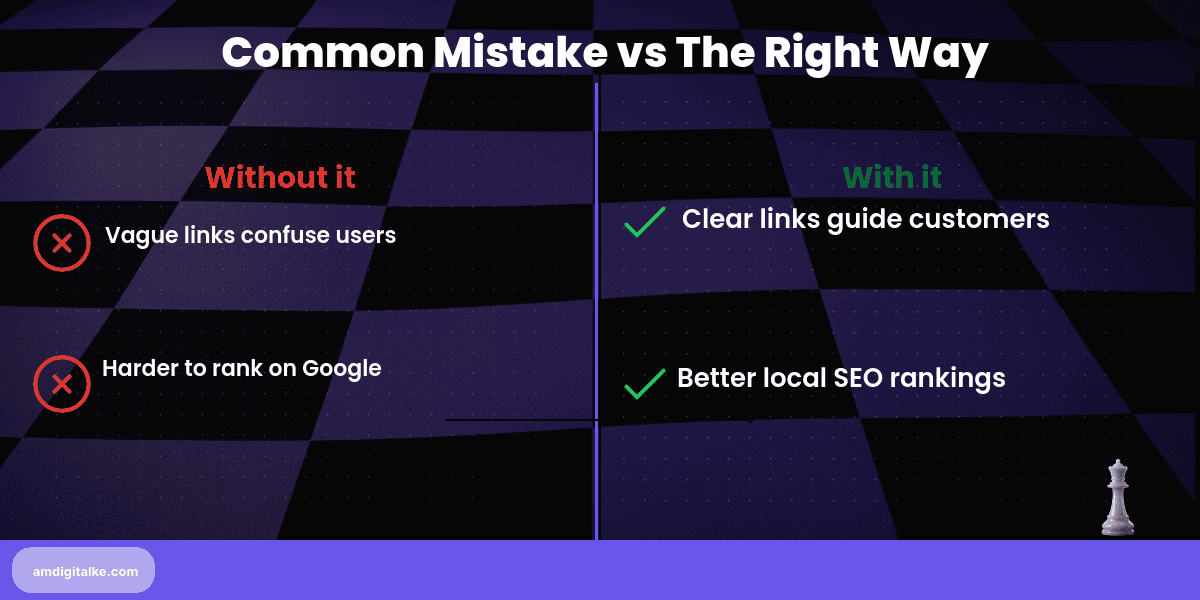
Most Kenyan businesses make anchor text mistakes without realizing it. These mistakes waste your backlinks and internal links. Understanding what to avoid is just as important as knowing what to do.
Mistake 1: Over-Optimizing with Exact Match Anchor Text
Using exact match anchor text for every single link is a red flag to Google. If 90% of your backlinks use “digital marketing Nairobi,” Google suspects you are trying to manipulate rankings. Google may penalize you by lowering your rankings.
The safe rule is this: aim for 10-20% exact match anchor text, 30-40% partial match, and 40-50% branded or generic. This mix looks natural and keeps you safe from penalties. A Nairobi business with 100 backlinks should have roughly 10-20 with exact match anchor text.
Mistake 2: Using Generic Anchor Text Like “Click Here”
Many business owners use “click here,” “read more,” or “learn more” as anchor text. This is safe but wastes the ranking power of the link. Google learns nothing about what the linked page is about.
Generic anchor text is fine for some links, especially in navigation. But when you have the opportunity to use descriptive anchor text, use it. A link that says “read more about our SEO services” is better than “read more.”
Mistake 3: Ignoring Internal Link Anchor Text
Most business owners focus on backlinks and ignore internal links. But internal links are under your control and should be optimized first. A blog with 50 posts should have strategic internal links with good anchor text connecting related posts and pointing to important service pages.
A Nairobi marketing agency with a blog should link from blog posts to service pages using descriptive anchor text. This is free SEO that most competitors ignore. You can gain an advantage just by doing this one thing well.
✅ Quick Action Checklist
- ☐ Audit your top 10 backlinks and note the anchor text used for each one
- ☐ Identify 5 internal links on your website that use generic anchor text like “click here” and rewrite them
- ☐ Create a list of 10 target keywords for your business and the anchor text you want to rank for
- ☐ Review your blog posts and add 2-3 internal links per post using strategic anchor text
- ☐ When reaching out to other websites for backlinks, suggest specific anchor text in your outreach email
- ☐ Check what anchor text your top 3 competitors are getting for their backlinks
- ☐ Update your website footer links to use descriptive anchor text instead of generic text
Ready to Master Anchor Text for Your SEO?
Anchor text is one of the simplest and most overlooked SEO tactics. A Kenyan business owner who understands anchor text has an advantage over 90% of competitors. You do not need to hire an agency or spend money to get this right.
Start by auditing your current links, then optimize your internal links, then reach out for backlinks with strategic anchor text. These three steps will improve your rankings faster than
Need a complete walk-through? Download this complete SEO Checklist for everything you need to do.
Ready to optimise your anchor text strategy for better Kenya search rankings? Let’s analyse your website’s current link structure with a free SEO audit.
And create a comprehensive anchor text plan that drives more local customers to your business.
Curious to learn how to use anchor text as an SEO tactic? Check out the posts below.
- How to Get Backlinks for Your Kenyan Business
- What is On-Page SEO?
- How to Index Your Website
- How to Leverage E-E-A-T for Rankings for Your Kenyan Business
These articles will walk you through the best strategies to use anchor texts in SEO
Have more SEO questions? Our SEO FAQs Kenya page answers the most common ones.
Frequently Asked Questions
What is the best anchor text for SEO?
The best anchor text is descriptive, relevant to both the link source and destination, and includes your target keyword without looking forced. Partial match anchor text that includes your keyword plus other words is usually safer than exact match. For example, “best plumber in Nairobi” is better than just “plumber” because it includes location and quality modifier.
Can anchor text hurt my SEO ranking?
Yes, anchor text can hurt your rankings if overused. Using exact match anchor text for 80% of your backlinks signals spam to Google. Using irrelevant anchor text that does not match your page content can also confuse Google about what your page is about. Balance is key.
How many backlinks do I need with specific anchor text to rank?
There is no magic number, but consistency matters more than quantity. Ten backlinks with the same relevant anchor text from quality websites will outrank 50 random backlinks with different anchor texts. For most Kenyan businesses, 5-10 quality backlinks with targeted anchor text is enough to see ranking improvements.
Should I use anchor text in my navigation menu?
Yes, but keep it simple and branded. Your main navigation should use your brand name or simple descriptive text like “Services,” “About,” or “Contact.” You do not need to optimize navigation for keywords. Save keyword-rich anchor text for internal links within your content.
What is the difference between anchor text and link text?
Anchor text and link text mean the same thing. They both refer to the visible, clickable words in a hyperlink. Some people use these terms interchangeably. The HTML code that creates a link is called an anchor tag, which is why the clickable text inside it is called anchor text.