Table of Contents
In short: SEO is getting your own website found when Kenyans search Google for what you sell. Start by fixing your site's basics and your Google Business Profile; you may see movement early, but proper results start from around month 3.
Key takeaways
- Social media posts reach your followers, while SEO reaches strangers who are already searching for what you sell.
- Fix broken links, redirects and missing titles before you write new pages.
- Choose searches by what buyers want, not by how many people type them.
- At month 1, judge whether the work is done; look for proper results from around month 3.
- Doing SEO yourself costs hours each week; Managed SEO from AM Digital KE starts from KES 80,000 a month.
You post on Facebook, Instagram or TikTok most days, yet when someone searches Google for what you sell, another business comes up. SEO is the work that puts your own website in front of those searchers, the people who already want what you offer.
It builds over a few months: you may see movement early, and proper results start from around month 3. The upside is that the pages you build keep bringing people in long after you’ve written them, and you can start on the first steps this week.
By the end, you’ll be able to judge whether SEO fits your business, what to do first, and whether to do it yourself or bring in help.
What SEO for a small business in Kenya really is
SEO, short for search engine optimisation, means getting your own website found when Kenyans search Google for what you sell. You shape your pages so Google understands what you offer, where you offer it and why a customer can trust you.
Say you run a small office cleaning company in Westlands. When a facilities manager types “office cleaning Westlands” into Google, Google shows a handful of businesses, and SEO is the work that makes yours one of them.
Why SEO is different from posting on social media
Many of the owners I speak to think SEO means posting on social media. It’s an easy mix-up, because both happen online and both are about getting seen.
The difference is who starts the conversation. On social media, you post and hope the right person scrolls past; on Google, the customer has a need, types it in and picks from what appears.
A post also has a short life. It reaches people who already follow you, gets its likes in a day or two, then sinks under newer posts.
A page on your website works the other way round. Once Google shows it for a search, it can keep bringing visitors for months without you posting again.
| Social media post | SEO page on your website | |
|---|---|---|
| Who sees it | Mostly people who already follow you | People searching for what you sell |
| How long it’s seen | A day or two, then it sinks in the feed | It can keep showing for months |
| Where it lives | On a platform you don’t own | On your own website |
| Customer’s mood | Scrolling | Looking for an answer now |
Your posts still help people remember you, so keep them going. What they can’t do is put you in front of the stranger who searches for a cleaner tomorrow morning.
I’ve written a fuller guide on what SEO is in Kenya for owners who want the idea at more length.
How Google decides which businesses to show
Google reads pages across the web, stores what it finds, then matches pages to what each person types. It weighs the words on your page, how well the page answers the search, whether your site loads and works, and whether other sites and listings mention you.
For a small business, that comes down to four things: a website Google can read, pages that match real searches, a complete Google listing, and signs that others trust you. Every step in the checklist serves one of these four.
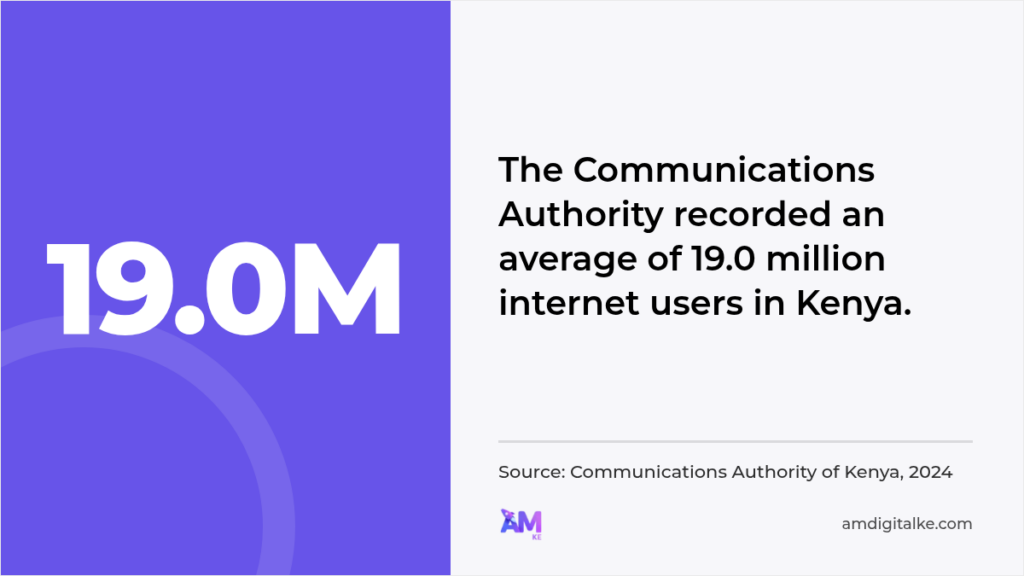
The audience is there. The Communications Authority of Kenya recorded an average of 19.0 million internet users in Kenya in 2024, and each of them could type your service into a search box.
Is SEO worth it for a small business?
SEO is worth it when people search for what you sell, and for most local trades they do. Someone looking for a plumber, a caterer or an accountant often starts by typing it into Google.
Check this for your own business before you spend a shilling. Type your service and your town into Google the way a customer would, and look at what comes up.
Ads, a map with local businesses and other firms’ pages all tell you people are searching. If the results look unrelated, try the words your customers use when they call you.
Can SEO actually bring me sales and leads?
It can, because of who arrives. A person searching “office cleaning Westlands prices” isn’t scrolling for fun; they need a cleaner and they’re deciding who to call.
When your page answers that search clearly, with your services, the areas you cover, a price range and a WhatsApp number, that person can contact you the same day.
I’ve seen route pages, one page for each route a transport business runs, lift bookings by 60%. That was one business and one tactic, so treat it as what’s possible, not a figure for yours.
The worth of SEO sits in the sums of your own business. Say one new office contract leaves you KES 12,000 profit a month after wages and supplies, and the client stays a year.
That one client is worth KES 144,000 in profit. A page that brings in two such clients over a year has earned you KES 288,000 for work you did once.
Why don’t more Kenyan businesses use SEO?
The reason I hear most is the mix-up with social media. Owners post every day, feel they’re doing their online marketing, and never get to their website.
The second is timing. A post gets likes within the hour, while SEO shows little in the first weeks, so many owners stop before it starts to pay.
The third is a worry that it’s technical. Some of it is, but most of the work is writing clear pages about things you already know from serving customers.
That gap works in your favour. In many Kenyan towns and trades, few businesses are working on the searches that matter, so steady effort has room to stand out.
How long does SEO take to work?
You may see movement early, such as a page starting to show for a few searches. Proper results start from around month 3.
The wait comes from how Google works. It needs time to find your pages, read them, compare them with other sites and decide where they belong.
I understand that three months feels long when you need customers now. But the pages keep working after you’ve built them, while an advert stops the day you stop paying.
Be careful with anyone who promises rankings or leads within a month. Nobody controls how fast Google moves.
Is SEO replaced by AI?
AI tools such as ChatGPT, and the AI answers Google shows above some results, get their information from websites. They need clear pages to read and to quote.
So the work stays the same: pages that answer real questions plainly, on a site that works. A page written well for a customer is the kind of page these tools draw on.
How to do SEO for your business: the checklist
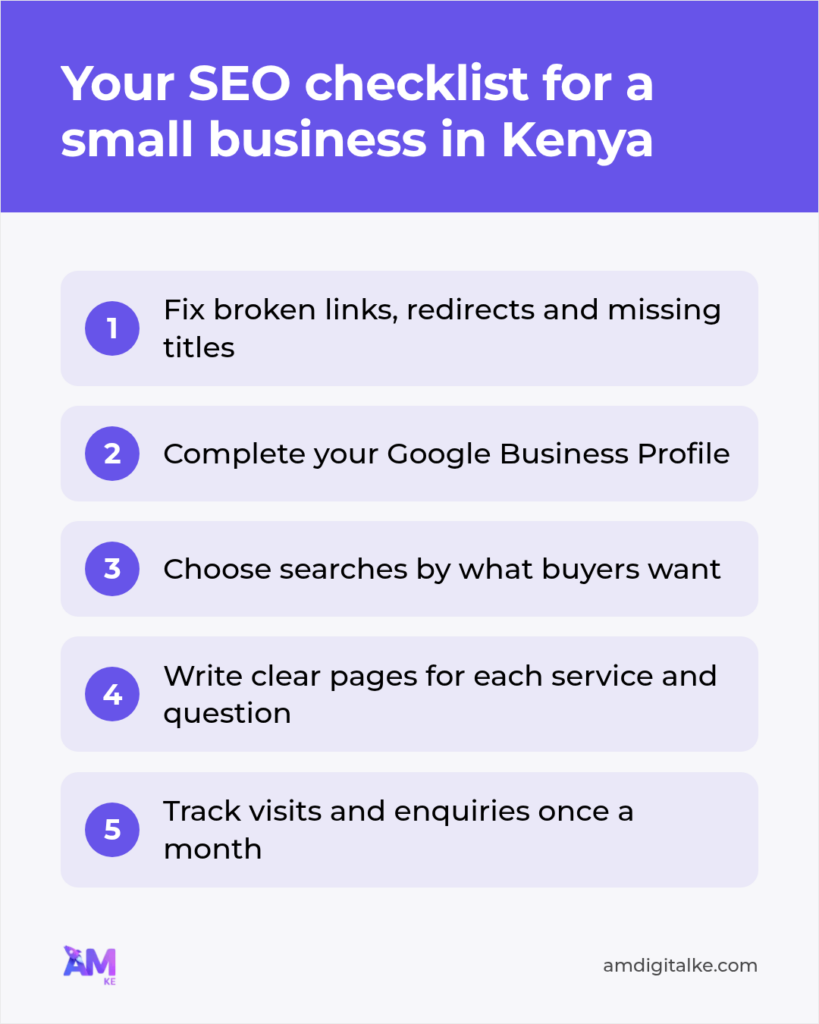
These are the steps in the order I’d take them on any small business site. Keep the list beside you and tick each one off as you go.
- Fix your site’s basic problems: broken links, wrong redirects and missing page titles.
- Set up your Google Business Profile with your address, hours, phone, photos and areas served.
- Choose searches by what buyers want, not by how many people type them.
- Write helpful pages and articles that answer the questions customers ask you.
- Improve the pages you already have, starting with your home and service pages.
- Link your own pages together each time you publish.
- Track what happens once a month, in visits and in enquiries.
I keep a longer version, with every check spelt out, in the complete SEO checklist for Kenyan businesses.
Step 1: Fix your site’s basic problems
A broken link sends visitors and Google to a page that no longer exists. A wrong redirect sends them somewhere they didn’t ask to go, and a missing page title leaves Google without a label for the page.
Many owners want to start by writing, and that makes sense, because writing feels like progress. But new pages on a faulty site lose part of their value, so fix the basics first.
Google Search Console, a free tool from Google, shows which of your pages it can’t reach or read. My guide on how to do technical SEO walks through the repairs one by one.
Step 2: Set up your Google Business Profile
This is the free listing that shows on Google Maps and beside local searches, with your address, hours, phone number, photos and reviews. For a business people visit or call, it’s often the first thing a customer sees.
Fill in every field and use the same name, address and phone number as on your website. For the Westlands cleaner, that means listing the areas served, such as Parklands, Kilimani and Upper Hill, and adding photos of real jobs.
Ask happy clients for a review after each job, while the work is fresh in their mind. You’ll find every field explained in what a Google Business Profile is.
Step 3: Choose searches by what buyers want
Write down the words a customer types when they’re ready to act. “Office cleaning Westlands prices” tells you far more about a buyer than “cleaning”, even though fewer people type it.
This is called search intent: what the person wants when they search. A small search from someone ready to hire can bring more business than a big search from someone who’s only curious.
Start with the questions clients ask you on the phone and on WhatsApp, since they’re the words real buyers use. How to do keyword research shows how to check that list and add to it.
Step 4: Write helpful pages and articles
Give each main service its own page, and each common question its own article. One page does one job, so Google knows exactly which search it answers.
Write plainly, say where you work, give the details a buyer needs, and end with how to reach you. A page that helps someone choose does more for you than a page that praises your company.
The cleaner might write “How much does office cleaning cost in Nairobi?” and “Daily or weekly office cleaning: which does your office need?”. To plan what to write and in which order, see how to build a content strategy.
Step 5: Improve the pages you already have
Your home page and service pages already exist, and Google already knows them, so they’re often the quickest gain. Make each title say what the page offers and where, for example “Office Cleaning in Westlands, Nairobi”.
Then add what’s missing. Price ranges, areas covered, how to book and answers to the questions people ask before they buy all help a page match the search and win the call.
Step 6: Link your own pages together
When one page mentions something you’ve covered elsewhere, link to it with words that name that page. Readers find more of what they need, and Google sees which pages belong together.
Do it each time you publish. The new page links to related ones, and one or two older pages link back to it.
Step 7: Track what happens
Once a month, check in Search Console how often your pages appeared, how many people clicked and which searches brought them. Count the calls, WhatsApp messages and enquiries too, and ask new clients how they found you.
Look at the trend across months, not a single week. It tells you which pages to build on and which to rework.
What is the 80/20 rule for SEO?
The 80/20 rule says a few actions bring most of the result. For a small business, those few are usually a complete Google Business Profile, a site with its basic problems fixed, and clear pages for the searches buyers make.
Get those three right before anything else. Links from other sites, extra articles and fine-tuning all add value, but they add much less while the base is weak.
Which SEO tasks to do first
When time and money are tight, the order matters more than the amount. Start with what stops Google reading your site, then what puts you on the map, then what builds over time.
What to do this week
- Fix broken links and missing page titles.
- Claim and complete your Google Business Profile.
- Write down five searches a buyer would type to find you.
- Ask three recent clients for a Google review.
None of these needs a budget. On a small site, you can often finish them in a few afternoons.
What to do next, and what can wait
Next, write one page for each of your five searches and improve your main service pages. Link them together as you go.
Getting other sites to link to yours can wait. Those links, called backlinks, do help, but they work best once your own pages are worth linking to.
A new website design can wait too. A plain site that loads fast on a phone and answers the search often does better than a beautiful one that’s slow.
What a sensible result looks like at month 1 and month 3
At month 1, judge the work, not the sales. Check that the fixes are done, the profile is live and complete, and the new pages are published and showing in Search Console.
From around month 3, look for proper results: your pages appearing for the searches you chose, more visits from Google, and more calls and messages from people who found you there.
For the Westlands cleaner, a good sign might be the prices page showing for “office cleaning Westlands prices” and new enquiries that mention Google. If nothing has moved by then, look again at the searches you chose and whether each page answers them, before you change everything.

SEO services in Kenya: doing it yourself or hiring a company
Both routes can work. The choice turns on what you have more of: time or money.
What doing SEO yourself takes
Doing it yourself costs no fees, but it costs hours. You learn the basics, fix the site, write pages, keep your profile fresh and check the numbers every month, for months on end.
Say the work takes you six hours a week, and an hour of your time in the business is worth KES 1,500 to you. That’s KES 9,000 a week, about KES 36,000 a month, before any tools you choose to buy.
The upside is that you learn your own market closely, and that knowledge stays with you. Many owners start alone, get the basics in place, then hire help once they see what the weekly work involves.
How much does SEO cost for a small business in Kenya?
Agencies in Kenya price their work differently, so compare what’s done each month, not only the number on the invoice.
I sell one plan, Managed SEO, from KES 80,000 a month. Doing it yourself costs your time instead, and those hours have a price even when no invoice arrives.
What to ask any SEO company or agency in Kenya
- What exactly do I get each month, and who does the work?
- Does a person read and edit every article before I see it?
- Do I approve changes before they go live on my site?
- Is there a lock-in contract, and what happens if I stop?
- When should I expect proper results?
- Will I get a report in plain language, and who explains it to me?
A firm that answers the timing question with “one month” is promising something nobody controls. Around month 3 for proper results is the answer to look for.
I tested 15 Kenyan SEO agencies and spoke to their past clients, and I’ve published head-to-head comparisons from that work. Ask any agency, mine included, to put its answers in writing before you sign.
What Managed SEO from AM Digital KE includes
Managed SEO is for owners who would rather not do the work themselves. It’s the one plan I sell, so there’s no menu of packages to compare.
- A strategy built for your business, run through our systems, carried out with you.
- Up to 30 articles a month, each read and edited by a person before you see it.
- 4 of your existing pages improved every month.
- Fixes to current pages: broken links, redirects, missing titles and the like.
- Links between your own pages, added every week.
- Social posts made from your articles.
- The SEO Brain, which you can ask anything, any day of the month.
- A plain-language report every month and a monthly call with you.
Nothing goes live on your site until you approve it, and there’s no lock-in contract.
It doesn’t include social media management. The social posts are made from your articles, so your feeds keep moving while the real work happens on your website.
Every part of the plan is set out on our services page.
Where to start: a free SEO analysis
The quickest next step is to see where your own site stands today. My free SEO analysis is instant, covers your site and your city, and needs no call.
You get a clear starting picture to work through the checklist with. A call is optional afterwards, and you won’t be put into a chain of sales messages.
You’ve been posting for people who scroll past; this is how you start reaching the ones already searching. Get your free SEO analysis.
Frequently asked questions
Do I need a website for SEO?
Yes. SEO gets your own website found, so the site is where the work happens.
A Google Business Profile can bring calls on its own, but a website gives Google far more to match against what people search.
Should I stop posting on social media?
No. Social posts keep you in front of people who already know you.
Count them as keeping in touch, not as your search work, and give your website its own time each week.
Does SEO work outside Nairobi?
It does. People in Kisumu, Nakuru, Eldoret and Mombasa search for local services the same way, often adding their town to the search.
Name your town and the areas you serve on your pages and your profile, so Google can match you to those searches.
Additional resources
- SEO FAQs: Your Complete Guide to Search Engine Optimization in Kenya: Are you curious about SEO in Kenya, how it can help your business, and don’t know where to start?
- Why Search Intent Beats Search Volume: The Strategic SEO Move: I go into detail about why Kenyan businesses need to focus more on the intent of the keywords rather than just volume.
- What is Content Marketing: I define all the common SEO terms for the Kenyan business community.
- Local SEO Services: Local SEO services for Kenyan businesses: Google Business Profile, citations, reviews, and local content.
- What is Technical SEO: I explain what technical SEO is in a simple but detailed way.
- What is On-Page SEO: Are you looking to improve your digital marketing?