Table of Contents
- Key Takeaways
- Why Mobile-First Copywriting Matters in Kenya
- Mobile-First Copywriting Rules for Kenyan Websites
- Your Mobile-First Copywriting Checklist
- Related Content
- Frequently Asked Questions
- Why is mobile-first copywriting important in Kenya?
- How can I make my content mobile-friendly?
- What happens if my website isn’t mobile-friendly?
- Are there tools to test mobile-friendliness?
- Can mobile-first copywriting improve sales?
TL;DR: Mobile-first copywriting means creating website content optimized for Kenya’s phone users, ensuring fast loading and easy reading.
Last Updated: March 2026
Key Takeaways
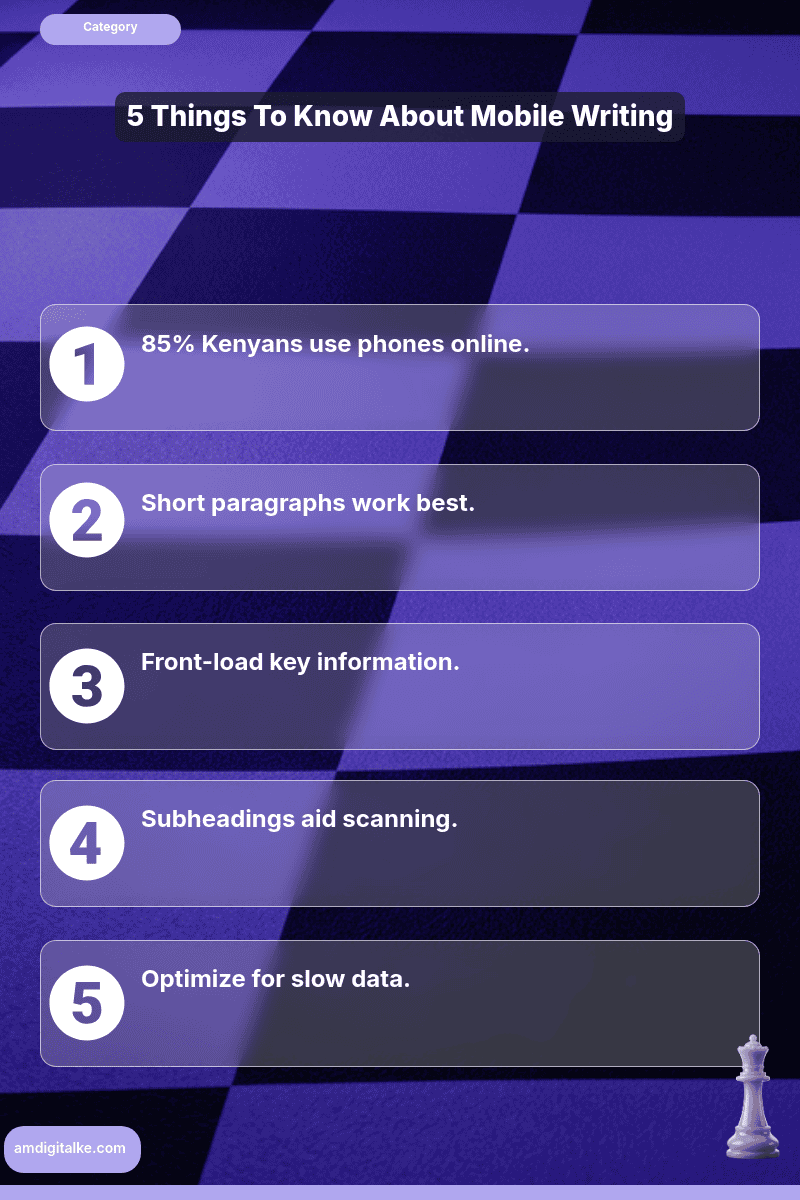
- Based on AM Digital KE client data across Kenyan accounts, most internet users access the web via mobile.
- Short paragraphs improve readability.
- Front-load key information.
- Use subheadings for scanning.
- Optimize for slow connections.
Your website looks amazing on your laptop.
Clean design, beautiful images, detailed paragraphs explaining every service.
Then a potential customer in Eastlands opens it on their phone.
Slow loading, tiny text, endless scrolling.
They hit the back button within 5 seconds.
You just lost a customer because you wrote for a desktop, not for the phone in their hand.
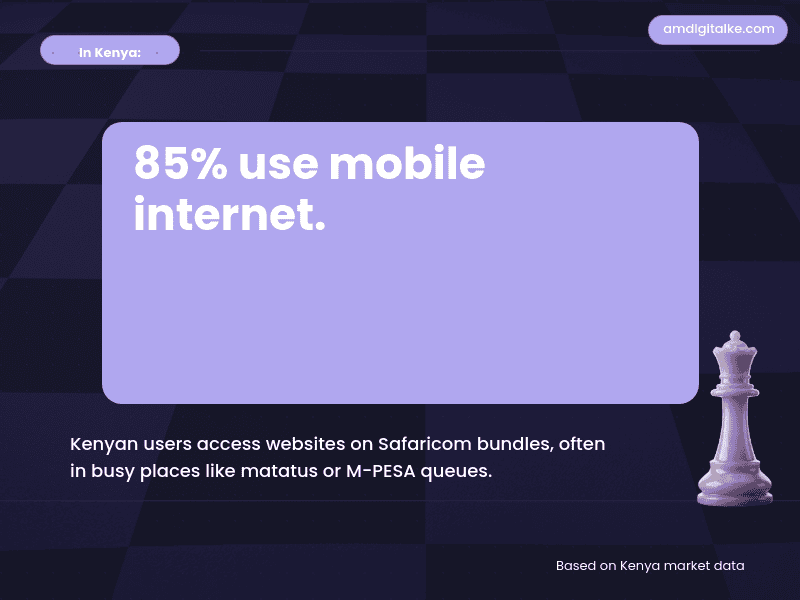
Here’s what most Kenyan business owners miss: most Kenyan internet users access the web primarily through mobile devices.
Your customers are reading your website on matatus, during lunch breaks, while waiting at the M-PESA agent.
They’re on Safaricom data bundles, dealing with slower connections, and they have zero patience for websites that waste their time or data.
Why Mobile-First Copywriting Matters in Kenya
Mobile-first isn’t just about responsive design.
It’s about writing copy that works on small screens with distracted readers.
A paragraph that looks perfect on a desktop becomes an intimidating wall of text on a phone.
Kenyan users will bounce before they finish your first sentence if you don’t make it easy to read.
The cost of getting it wrong?
High bounce rates signal to Google that your content isn’t valuable, which tanks your rankings.
You might be targeting implementing proper keyword research, but if users leave immediately, Google assumes your page doesn’t answer their query.
Mobile-First Copywriting Rules for Kenyan Websites
1. Write in Short Bursts
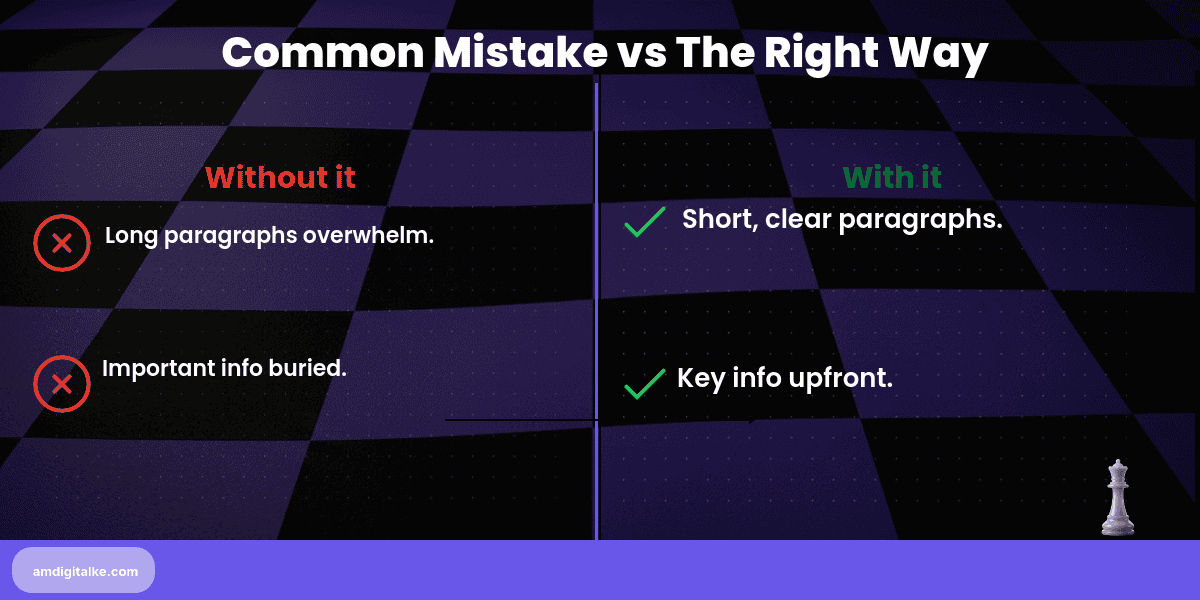
Desktop writing: 5-6 sentence paragraphs.
Mobile writing: 2-3 sentence paragraphs maximum
Each paragraph should convey ONE idea.
On a phone screen, even three sentences look substantial.
Your Karen restaurant’s “About Us” section shouldn’t be a 10-sentence essay.
Break it into digestible chunks.
2. Front-Load Your Value
Kenyan mobile users decide within 3 seconds whether to stay or leave.
Put your most important information first:
❌ “At our Westlands-based law firm, established in 2005, we have a team of experienced attorneys who specialise in various legal matters including…”
✅ “Westlands law firm specialising in land disputes, employment law, and business contracts. Free initial consultation.”
See the difference?
The second version tells mobile users exactly what you offer and gives them a reason to keep reading.
This principle is crucial for understanding what SEO copywriting means.
3. Use Subheadings as Signposts
Mobile users scan, they don’t read word-for-word.
Subheadings let them jump to what matters most to them.
A Kilimani dental clinic’s service page should have clear H2 subheadings:
Teeth Whitening – From KES 8,000
Root Canal Treatment – Pain-Free Process
Dental Implants – Permanent Solution
Users can quickly scan and find their specific needs without reading everything.
For more context, check out my SEO FAQs page, where I explain how proper heading structure affects mobile rankings.
4. Make Your CTAs Thumb-Friendly
“Call Now” buttons should be large enough to tap easily.
Phone numbers should be clickable.
WhatsApp links should open the app directly.
And most importantly, place CTAs where thumbs naturally rest on the screen (middle-right for right-handed users).
5. Cut Unnecessary Words Ruthlessly
Mobile screens have limited real estate.
Every word must earn its place.
Desktop version: “We are pleased to offer our valued customers a wide range of comprehensive financial services”
Mobile version: “Personal loans, business accounts, and M-PESA integration”
The mobile version conveys the same information in 60% fewer words.
6. Use Formatting for Scannability
- Bold your key benefits so they pop on small screens
- Use bullet points instead of long lists in sentences
- Add emojis strategically for visual breaks (✅ ❌ )
- Keep sentences under 20 words when possible
7. Test on Actual Kenyan Devices
Don’t just resize your browser.
Test your copy on the phones your customers actually use.
Mid-range Android devices on Safaricom’s network.
Your copy might look perfect on your iPhone 15, but how does it load on a Samsung Galaxy A14 in Kasarani?
Understanding what Mobile-First Indexing means helps you grasp why Google now prioritises mobile-optimised content over desktop versions.
A Nairobi online fashion store rewrote their product descriptions using mobile-first principles.
Original descriptions averaged 150 words with long paragraphs.
New descriptions: 50-75 words maximum, broken into 2-sentence paragraphs with clear size/material/price highlights at the top.
Results after 2 months:
- Bounce rate dropped from 68% to 41%
- Average time on page increased from 22 seconds to 1:47 minutes
- Mobile conversions increased by 34%
The products didn’t change.
The copywriting did.
Your Mobile-First Copywriting Checklist
☐ Paragraph audit – Break any paragraph longer than 3 sentences into smaller chunks
☐ Front-load test – First sentence of each section answers “what’s in it for me?”
☐ Subheading scan – Can someone understand your page by reading only the H2s?
☐ CTA placement – All buttons/links are thumb-accessible and clearly visible
☐ Word count cut – Remove 30% of unnecessary words (especially adjectives)
☐ Mobile preview – Test on an actual Android device, not just browser resize
☐ Loading speed – Images compressed, text loads before images
Before implementing changes, download this complete SEO Checklist to ensure your mobile content meets all the best practices for understanding what On-Page SEO means best practices.
Mobile-first copywriting isn’t about dumbing down your content
It’s about respecting your Kenyan customers’ time, data, and attention.
At AM Digital KE, we optimise both understanding what Technical SEO means and the copy itself to ensure your website works perfectly on the devices your customers actually use.
Check out our Website Copywriting Services and learn how we rewrite content for Kenyan users browsing on phones with limited data and attention spans.
Request a free SEO audit where we’ll review your content on actual Kenyan devices, identify walls of text killing engagement, and rewrite for scannable, thumb-friendly mobile experiences.
Related Content
Curious to learn more about mobile optimisation and copywriting? Check out the posts below
- How to Do SEO Copywriting — This implementation guide shows you how to write SEO-friendly copy that works perfectly on mobile devices.
- What is Page Speed — Mobile-first copywriting must pair with fast loading speeds for Kenyan mobile networks.
- How to Optimise Page Speed — Learn specific tactics to make your mobile content load faster on Safaricom and Airtel connections.
- What is Content Marketing — Mobile-first principles apply to all your content marketing efforts, not just website copy.
These articles will help you master mobile-optimised content that converts.
Have more SEO questions? Our SEO FAQs Kenya page answers the most common ones.
Frequently Asked Questions
Why is mobile-first copywriting important in Kenya?
Most Kenyans access the internet via phones, often on slow connections, so mobile-optimized content improves user experience.
How can I make my content mobile-friendly?
Use short paragraphs, clear subheadings, and place important information at the top to keep Kenyan phone users engaged.
What happens if my website isn’t mobile-friendly?
Kenyan users will leave quickly, increasing bounce rates and harming your Google rankings.
Are there tools to test mobile-friendliness?
Yes, Google’s Mobile-Friendly Test helps Kenyan businesses check if their website works well on phones.
Can mobile-first copywriting improve sales?
Yes, mobile-friendly content keeps Kenyan customers engaged, leading to higher conversions.