
Table of Contents
- The Ksh 2.7 Million Lesson we Learned
- The Game Has Changed: Why This Problem Is Worse Now
- How This Actually Happens
- The 60% Problem: Most Customers Google After Your Ad
- Why Social Media Ads Alone Often Fail or Frustrate
- Why This Hits Harder in Kenya
- The Solution: Build Foundation First
- What To Do Next
- Get The Pre-Ad Checklist
A few years ago, I was working with one of the best SEO companies on something that seemed like a sure bet. We had a high-novelty product priced over Ksh 200,000 and low production costs.
The kind that makes people stop scrolling.
The market data looked promising: about 50 searches per month.
This means low competition and high margins. Perfect opportunity.
So we did what most businesses do when they see opportunity: we decided to dominate with paid ads.
We decided to spend KSh 30,000 per day. After all, the profit margins were amazing.
So we created beautiful and creative ads with precise targeting.
The Ksh 2.7 Million Lesson we Learned
Month one: Traffic tripled.
People were clicking. Engagement was high.
But sales? Barely moved.
Month two: Same pattern.
Great metrics. Terrible revenue.
Month three: Still nothing.
Total spend: Ksh 2.7 million.
Then we noticed something in Google Search Console as we tracked our traffic:
- Month 1: 50 searches for our product category
- Month 2: 100 searches
- Month 3: 200 searches
- Month 4: 500 searches
Our ads were working, and people wanted the product.
But when they googled it, they found our competitors.
The Game Has Changed: Why This Problem Is Worse Now
Ten years ago, Kenyan businesses could overlook search.
Kenya wasn’t a heavy search nation. Instead, most people used social media to discover products, ask friends, and browse Facebook groups.
Today, everything has changed.
Kenya is now one of the world’s biggest AI users.
ChatGPT, Perplexity, Claude, and more are now tools millions of Kenyans use daily, which is exactly why we wrote about what still works between AI SEO and old-school SEO in Kenya.
And what’s interesting is that only a small percentage use AI for business.
The rest? Personal research, product research, and shopping decisions.
Think about it: When someone sees your ad for office furniture, what do they do?
- Old behavior (2015): Ask in a WhatsApp group, maybe Google briefly
- New behavior (2025): Ask ChatGPT, “What’s the best office furniture in Nairobi?” or Google it directly
And here’s the problem:
AI tools don’t see your Facebook ads.
After conversations with many business owners, most believe that AI recommends products and services based on what it has recommended to others.
But AI does not work like that.
Instead, it goes to Google and first sees what is ranking well.
After all, if Google trusts it, it must be trustworthy, right? Then it looks at mentions, content created around it, and so on.
Let’s do this practically to show you what I mean.
I went to my ChatGPT and asked it, “Which are the best seafood restaurants in Nairobi?”
Hyper specific, like I would if I were actually looking for a place to eat seafood.
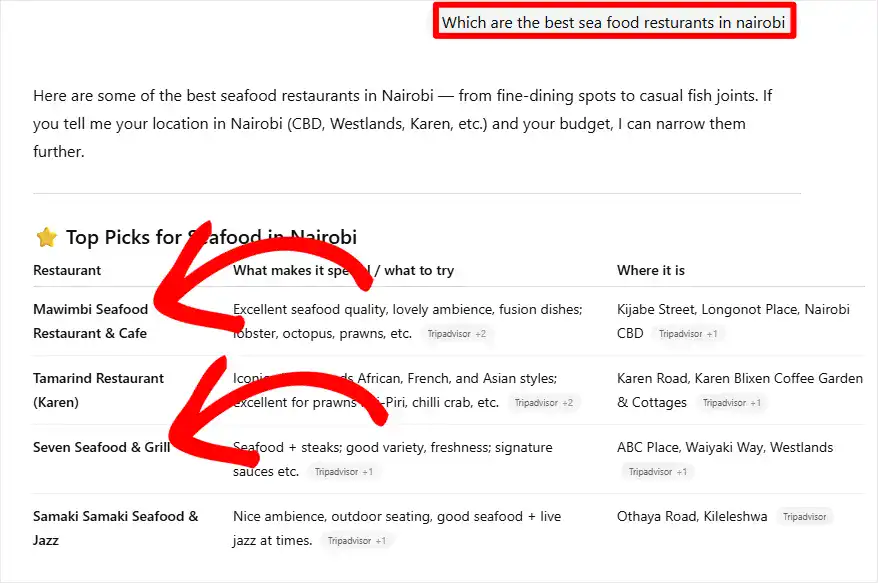
Now, take a close look at the restaurants I have highlighted with arrows, and refer to the next screenshot.
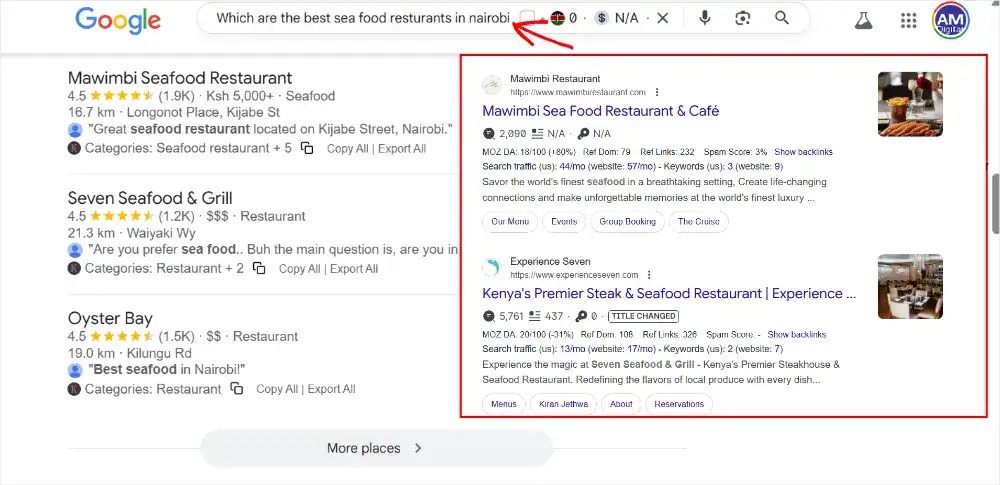
As you can see, the two top-ranking restaurants on Google are both recommended on ChatGPT.
In fact, they also appear in Google’s list of best local restaurants (list with restaurants on the left).
But I hear you asking, “Those are only two out of the five recommendations, where are the other 3 options?”
Well, they have a great social presence, numerous reviews, are mentioned in plenty of blogs and lists, and just miss out on the top three positions on Google.
See, AI’s research process is not so different from ours.
In a nutshell, AI recommends based on web presence.
Think blog posts, reviews, articles, and content across the internet.
So now you have two problems:
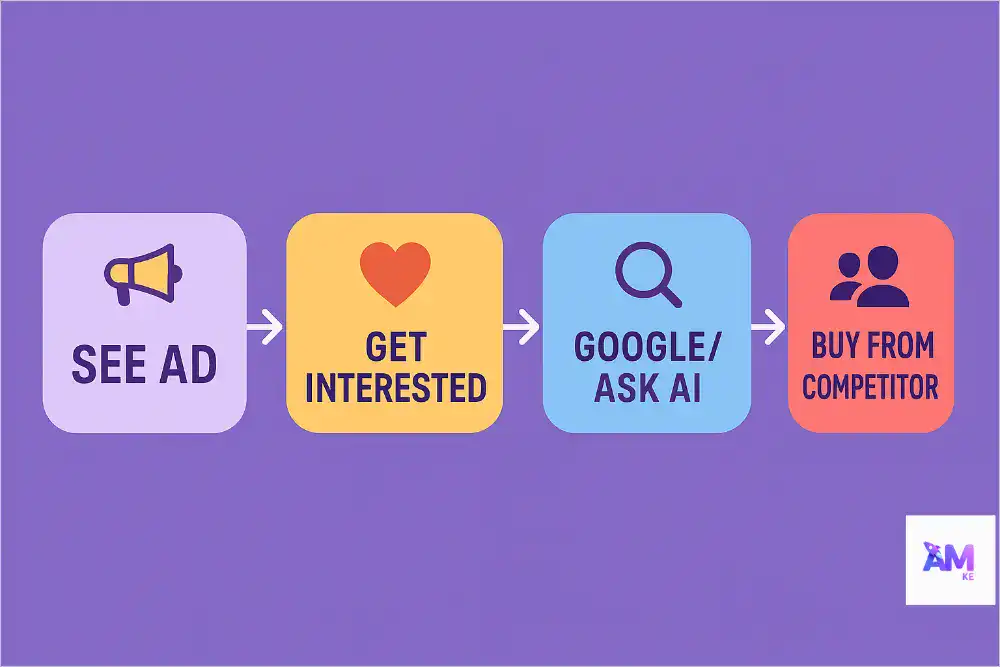
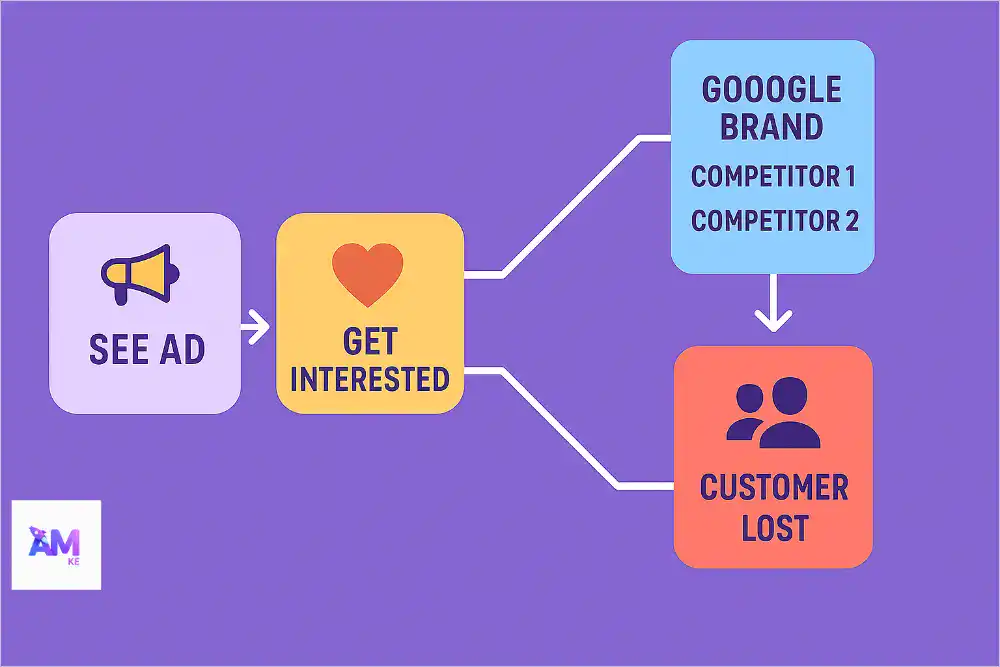
- People Google after seeing your ad → find competitors
- People ask AI for recommendations → AI suggests competitors… based on who ranks on Google
So, regardless of the research direction they take, they end up in the same place: your competitors.
Your ads create awareness.
Search and AI direct that awareness to whoever has the strongest online presence.
Free download (PDF)
The Pre-Ad Checklist: 21 checks before you pay for ads
- The 3 searches that show if customers will find you or a competitor
- Your Google profile, landing page and tracking, checked in plain language
- A simple score: run the ads now, or fix the gaps first
We will email you the checklist, plus occasional SEO tips. Unsubscribe any time.
How This Actually Happens
Here’s the typical customer journey:
- Monday morning: Sarah sees your ad for premium office furniture on Facebook. Looks interesting.
- Monday afternoon: Sarah opens her laptop and types into ChatGPT: “Best office furniture stores in Nairobi with good reviews.”
- What ChatGPT tells her: Your three competitors. All of them have blogs, reviews, and strong web presence.
What your Facebook Ads Manager shows:
- ✓ Impression delivered
- ✓ Click recorded
- ✗ No conversion
What actually happened: Your Instagram ad just generated a sale for your competitor.
The 60% Problem: Most Customers Google After Your Ad
Here’s the statistic that should change how you think about ads: 60% of people who see your ad will Google your brand or product before buying.
Not “might Google.” Will Google. Or at least ChatGPT it!
For mid-to-high-value products in Kenya, anything over Ksh 10,000, this number is even higher.
Nobody hands over serious money because they saw a pretty Facebook ad.
They research. They verify. They compare.
Your ad budget ends at the click. Their buying journey continues on Google and AI.
And if you’re not there when they search? Someone else is.
Why Social Media Ads Alone Often Fail or Frustrate
The fundamental problem is simple:
Social Media Ads = Interruption Marketing
People weren’t looking for you. You’re interrupting their scrolling. High awareness, low intent.
Google Search = Intent Marketing
People ARE actively looking for solutions. They’ve typed what they want. High intent, ready to buy.
AI Recommendations = Trust Marketing
People are asking for expert opinions. AI suggests based on web authority and mentions.
The brutal truth: Ads raise awareness. Search and AI close deals.
And sadly, most businesses measure ad success by clicks and impressions.
But the real question is: what happens after the click?
When that person Googles or asks AI, do they find you or your competitor?
Why This Hits Harder in Kenya
Three factors make this problem worse for Kenyan businesses:
1. Mobile-First Behavior
Based on AM Digital KE client data across Kenyan accounts, over 80% of traffic comes from mobile devices.
Mobile users click the first 1-2 results and rarely scroll. If you’re not in the top 3, you’re invisible.
2. Data Cost Consciousness
Expensive data means people are deliberate.
They won’t click multiple sites to compare. They trust the first good result.
One shot, that’s all you get.
3. Trust Verification Culture
Kenyans research before big purchases.
Google presence = legitimacy.
No Google presence = not real.
Your competitor showing up first = they get the trust by default.
The Solution: Build Foundation First
The fix isn’t complicated.
It’s just backwards from what most businesses do.
WRONG ORDER:
- Run ads to create awareness
- Hope people buy
- Wonder why conversions are low
RIGHT ORDER:
- Build your Google and web presence FIRST
- Make sure people find YOU when they search
- THEN run ads to accelerate what’s already working
Before You Run Any Ads, Verify:
✓ Brand Search: Google your exact business name. Are you #1? Do you have reviews? Does it look professional?
✓ Product Search: Google “[your product] Kenya/Nairobi”. Do you appear in the top 10? Or just competitors?
✓ AI Presence: Ask ChatGPT about your industry. Does it mention you? Or only competitors?
If you’re not showing up in at least two of these three places, pause your ads. You’re not ready yet.
You’ll just spend money creating demand that your competitors will capture.
The Foundation-First Timeline:
First: Build organic presence
- Rank for your brand name
- Create helpful content about your product
- Build Google My Business with reviews
- Get listed in relevant directories
Second: Test small ad budgets
- Now people can find you when they search
- Start with Ksh 1,000-3,000/day
- Watch if brand searches increase
- Verify conversions are happening
Third: Scale ads confidently
- You own your space online
- Ads create demand YOU capture
- Search and AI direct people to YOU
- Everything works together
What To Do Next
You don’t need to become an SEO expert.
You just need to answer one question before spending on ads: When customers see your ad and Google your product, will they find YOU or your competitor?
Not ready for the checklist?
Start with our free SEO tools for Kenyan businesses to see where you currently rank. Plus, here is how to get started on your SEO yourself.
To learn more about SEO terms, check out my SEO FAQs page for a glossary.
Get The Pre-Ad Checklist
Look, I get it. SEO takes months.
You need leads now.
That’s exactly why I created this checklist: The SEO Expert’s Ad Optimization Checklist
So, you can run ads WITHOUT wasting money while your SEO builds.
Think of it as ‘ads with seatbelts.
You continue running ads, but with the mindset of an SEO expert!
It’s 21 simple checks that take 30 minutes and could save you thousands, if not millions.
Think of it as your pre-flight checklist before takeoff. But this time, you are verifying if you’re ready before you spend.
Not sure where you stand?
Start with my free SEO analysis that shows exactly where you rank when customers Google, what competitors are doing better, and whether you’re ready for ads or need to wait.
No pressure, no sales calls. Just honest data so you can make smart decisions.
Plus, you can always Get My Free Analysis → as always. This way, you know exactly where your business stands.