

Last updated: June 2026
TL;DR:
Kenya had 23.4 million internet users in 2026 at an internet penetration rate of 40.5% (DataReportal). Google holds 96.85% of Kenya’s search market, but desktop and mobile traffic are split almost exactly 50/50, not the mobile-only picture most marketers assume (StatCounter, May 2026). Google AI Mode launched in Kenya on 21 August 2025, and businesses without a GEO strategy are already losing clicks they cannot see in Search Console.
Methodology note: The data on this page is drawn from primary sources, including:
- DataReportal Digital 2026: Kenya, StatCounter Global Stats (Kenya)
- The Communications Authority of Kenya (CA Kenya) Sector Statistics Reports Q4 FY2024/25 and Q2 FY2025/26
- The CA Kenya Audience Measurement and Industry Trends Report 2026
- Google official announcements
- Cloudflare data reported by Business Daily Kenya
Where public Kenya data does not exist, figures are labelled “Based on AM Digital KE client data across Kenyan accounts.”
Global statistics are labelled [GLOBAL] and followed by a Kenya interpretation sentence.
This page is reviewed and updated quarterly. A new annual edition is published each January.
Key Statistics at a Glance
- Kenya had 23.4 million internet users in 2026 (DataReportal).
- Kenya’s internet penetration rate stood at 40.5% in 2026 (DataReportal).
- 77.5 million mobile connections were active in Kenya in late 2025, equal to 134% of the total population (DataReportal).
- 83.5% of Kenyans owned a smartphone as of June 2025 (CA Kenya Q4 FY2024/25).
- 4G network coverage reached 97.3% of Kenya’s population by June 2025 (CA Kenya Q4 FY2024/25).
- Total data subscriptions in Kenya reached 58.5 million by June 2025, a 27.3% increase year-on-year (CA Kenya Q4 FY2024/25).
- Google held 96.85% of Kenya’s search engine market share in March 2026 (StatCounter).
- Desktop traffic (49.91%) and mobile traffic (49.26%) were at near-parity in Kenya as of May 2026 (StatCounter).
- Google AI Mode launched in Kenya on 21 August 2025 (Google official via iAfrica).
- Total digital ad spend in Kenya reached KES 11.76 billion in Q1 FY2025/26 (CA Kenya Audience Measurement Report 2026).
- Facebook captured 43% of Kenya’s digital ad spend; YouTube 23%; Instagram 22%; TikTok 10% (CA Kenya 2026).
- Kenya had 18.4 million social media user identities in October 2025, equal to 31.8% of the population (DataReportal).
- Mobile money subscriptions reached 51.4 million in Kenya at 98% penetration by December 2025 (CA Kenya Q2 FY2025/26).
- Kenyan firms paid over KES 30 million in data protection compensation in 2025 (ODPC via TechTrendsKE).
- Kenya’s e-commerce market generated US$762 million in revenue in 2024, growing at 15 to 20% annually (ECDB).
Here is a table of contents to view everything at a glance.
Internet and Mobile in Kenya 2026
| Metric | Value | Source |
|---|---|---|
| Population | 57.8 million | DataReportal 2026 |
| Median age | 20 years | DataReportal 2026 |
| Internet users | 23.4 million | DataReportal 2026 |
| Internet penetration | 40.5% | DataReportal 2026 |
| Offline population | 59.5% | DataReportal 2026 |
| Mobile connections | 77.5 million | DataReportal 2026 |
| Mobile penetration | 134% of population | DataReportal 2026 |
| Smartphone penetration | 83.5% | CA Kenya Q4 FY2024/25 |
| 4G population coverage | 97.3% | CA Kenya Q4 FY2024/25 |
| 5G population coverage | 30% | CA Kenya Q4 FY2024/25 |
| Data subscriptions | 58.5 million (+27.3% YoY) | CA Kenya Q4 FY2024/25 |
| Mobile money subscriptions | 51.4 million (98% penetration) | CA Kenya Q2 FY2025/26 |
| Urban internet penetration | 56.5% | DataReportal 2026 |
| Rural internet penetration | 25% | DataReportal 2026 |
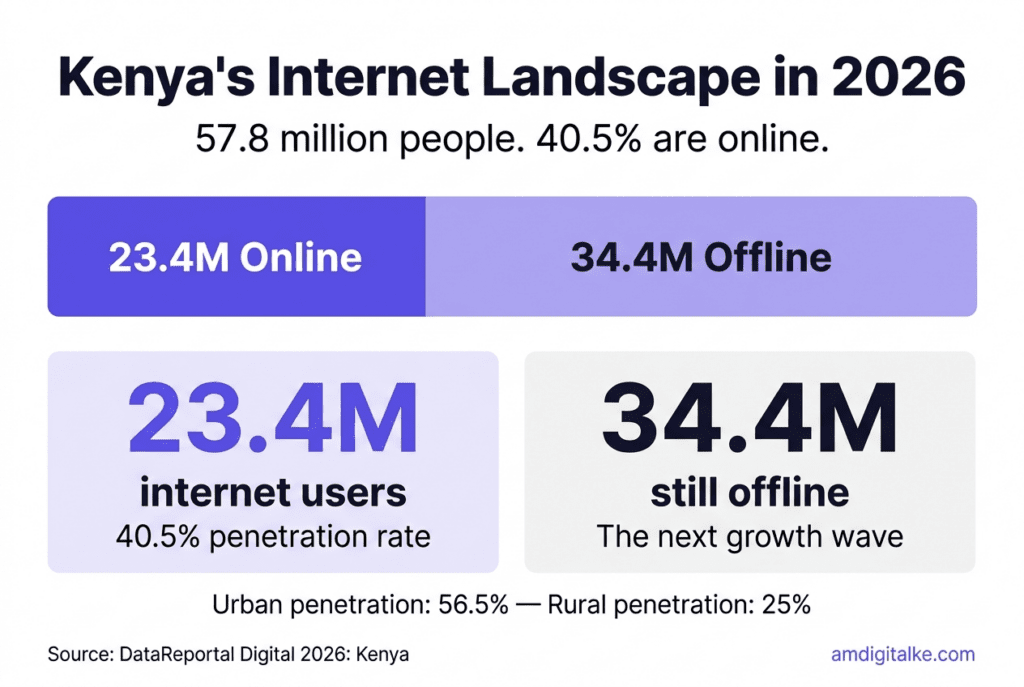
Kenya has 57.8 million people. The median age is 20 years. This is a young, digitally ambitious population, and the infrastructure is catching up fast.
The 77.5 million mobile connections figure is not a mistake. Kenya’s population is 57.8 million, but 77.5 million SIM connections are active.
Many Kenyans carry two lines, one for Safaricom, one for Airtel, sometimes one for work. Reach calculations that assume one person equals one connection will overestimate coverage.
M-Pesa processes KES 40.2 trillion annually. Mobile money is not a payment feature you can add later. It is the financial infrastructure of the Kenyan economy.
Any business operating online without M-Pesa integration is not offering digital commerce. It is offering a checkout form that most Kenyan buyers will abandon.
The urban/rural split sits at 56.5% penetration in cities versus 25% in rural areas. That gap is not a reason to wait. It is a window.
Businesses that build authority in Google now will be the default answer when rural connectivity closes. The cost of that authority is lower today than it will be in 2028.
59.5% of Kenya’s population is still offline. That is not a statistic about underperformance. It is the size of the next wave.
How Kenyans Search
| Metric | Value | Source |
|---|---|---|
| Google search market share | 96.85% | StatCounter, March 2026 |
| Bing search market share | 2.52% | StatCounter, March 2026 |
| Desktop traffic share | 49.91% | StatCounter, May 2026 |
| Mobile traffic share | 49.26% | StatCounter, May 2026 |
| Tablet traffic share | 0.83% | StatCounter, May 2026 |
| ChatGPT Kenya search traffic share | 0.5% | Cloudflare via Business Daily, 2025 |
Kenya is not a pure mobile-first search market. The data says otherwise.
Desktop accounts for 49.91% of web traffic in Kenya. Mobile accounts for 49.26%. Those figures are from StatCounter’s May 2026 dataset, based on over 3 billion monthly page views. The split is almost exactly equal.
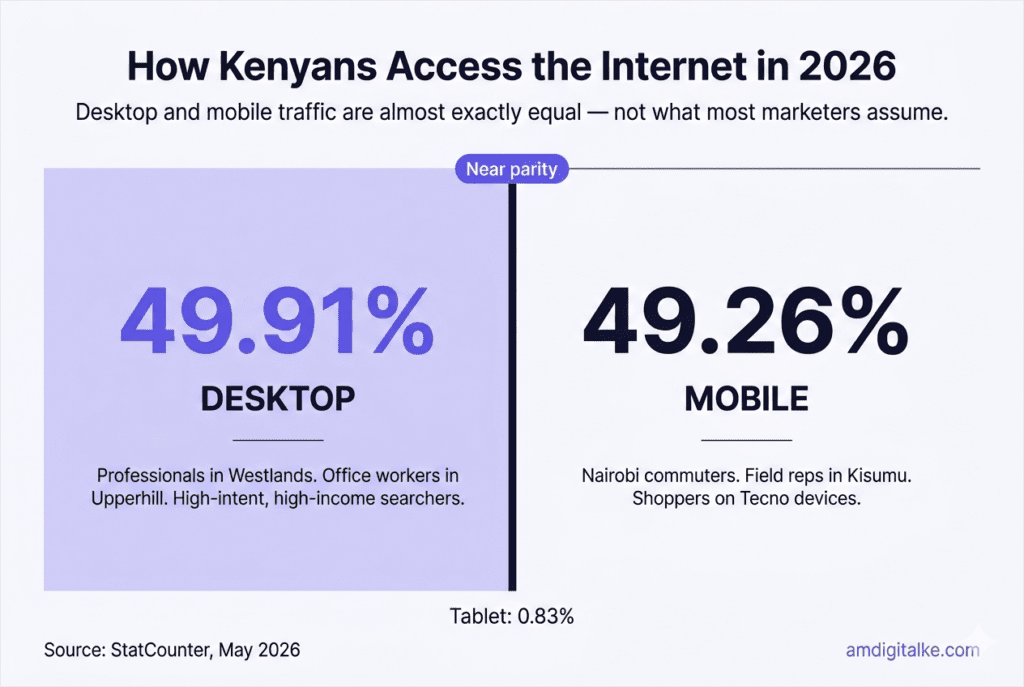
This matters for how you build. The narrative in Kenyan digital marketing has long been “mobile first, mobile everything.” That narrative is incomplete.
The office worker in Upperhill opens Google on a MacBook. The field sales rep in Kisumu opens it on a Tecno.
The Westlands consultant researching vendors opens it on both, depending on where they are. All of them are your customers.
A site that loads fast on mobile but crawls on desktop, or that collapses on a wider screen, is leaving half the market underserved.
Google holds 96.85% of Kenya’s search market. Bing holds 2.52%. Alternative search engines have no meaningful presence. One platform decides your digital visibility in Kenya.
That concentration creates both a risk and a clarity. The risk is dependence. The clarity is that you do not need to spread your SEO effort across multiple engines. You optimise for Google, and you rank in Kenya.
ChatGPT entered Kenya’s top five search engines for the first time in 2025 with a 0.5% share (Cloudflare via Business Daily). That is a small number.
It is also the first time an AI engine has cracked the Kenyan search market. The direction of travel is visible.
WhatsApp is active on over 90% of Kenyan internet users’ devices daily. Search starts on Google. The purchase conversation often starts on WhatsApp.
The funnel does not end at the click. A business that ranks well but has no WhatsApp contact point is capturing awareness and losing the conversion.
The Kenya SEO Industry
SEO Service Pricing in Kenya 2026
| Service Type | Price Range | Source |
|---|---|---|
| Basic monthly retainer | KES 15,000–50,000/month | Multiple Kenyan agency sources, 2026 |
| Mid-tier monthly retainer | KES 50,000–150,000/month | Multiple Kenyan agency sources, 2026 |
| Comprehensive digital packages | KES 80,000–300,000+/month | Nelium Systems, 2026 |
| One-time SEO audit | KES 50,000–200,000 | Axiom Web Solution, 2026 |
| Hourly consulting rate | KES 3,000–8,000/hour | Axiom Web Solution, 2026 |
| Google Ads management fee | KES 25,000–45,000/month | Nairobi Web Experts, 2026 |
Digital Ad Spend in Kenya by Platform
| Platform | Share of Kenya Digital Ad Spend | Source |
|---|---|---|
| 43% | CA Kenya Audience Measurement Report, 2026 | |
| YouTube | 23% | CA Kenya Audience Measurement Report, 2026 |
| 22% | CA Kenya Audience Measurement Report, 2026 | |
| TikTok | 10% | CA Kenya Audience Measurement Report, 2026 |
| Total spend (Q1 FY2025/26) | KES 11.76 billion | CA Kenya Audience Measurement Report, 2026 |
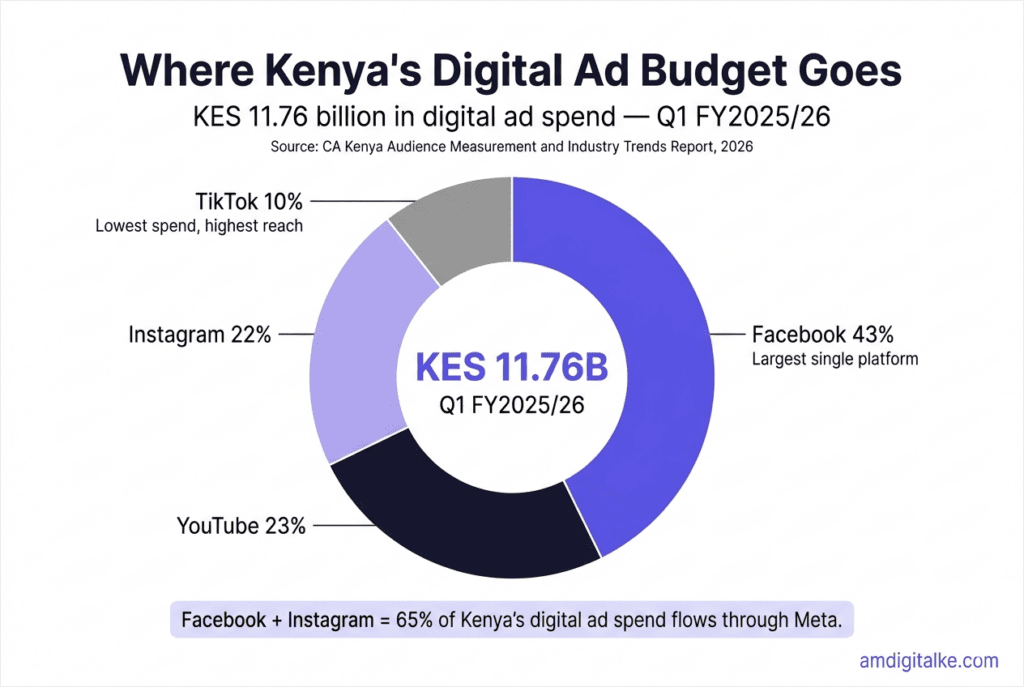
KES 11.76 billion in digital ad spend flowed through the Kenyan market in Q1 FY2025/26 alone.
That figure comes directly from the CA Kenya Audience Measurement and Industry Trends Report 2026, making it one of the most authoritative Kenya-specific digital spending datasets available.
Facebook and Instagram together captured 65% of that spend. Meta is not a social media platform in Kenya. It is the primary paid digital channel.
Every business running ads in Kenya is, in effect, renting visibility from one company.
That is the argument for organic search.
A KES 50,000 monthly Google Ads budget delivers traffic this month and nothing next month when the budget runs out.
A KES 50,000 SEO retainer builds authority that keeps delivering in month six, month twelve, and beyond. The compound effect of organic search is not a marketing metaphor.
It is how the economics actually work.
On pricing: a KES 5,000/month “full SEO” package is not SEO. At that price point, no real technical work is being done, no content is being produced, no links are being built.
What is being sold is a report, sometimes automated, sometimes fabricated. The risk is not just wasted money.
Cheap SEO that uses low-quality links or keyword stuffing can trigger a Google penalty that takes months to recover from.
At KES 15,000 to 50,000 per month, a business gets foundational work: an audit, basic on-page optimisation, and some content.
At KES 50,000 to 150,000, a business gets a real programme: technical SEO, content strategy, link building, and reporting.
Then, at KES 150,000 and above, a business gets a full managed programme with dedicated resources. The gap between these tiers reflects real differences in output, not just markup.
AI Search and AI Overviews in Kenya
| Metric | Value | Source |
|---|---|---|
| Google AI Mode launch in Kenya | 21 August 2025 | Google official via iAfrica |
| AI Overviews available globally | 200+ countries by May 2025 | Google official |
| Reduction in organic clicks on AI Overview queries [GLOBAL] | 34.5% | Ahrefs, 2026 |
| Zero-click rate, desktop search [GLOBAL] | 61.5% | SparkToro, 2026 |
| Zero-click rate, mobile search [GLOBAL] | 34.4% | SparkToro, 2026 |
| Uplift for sites cited inside AI Overviews [GLOBAL] | 35% more clicks vs non-cited | Seer Interactive via Search Engine Land, 2026 |
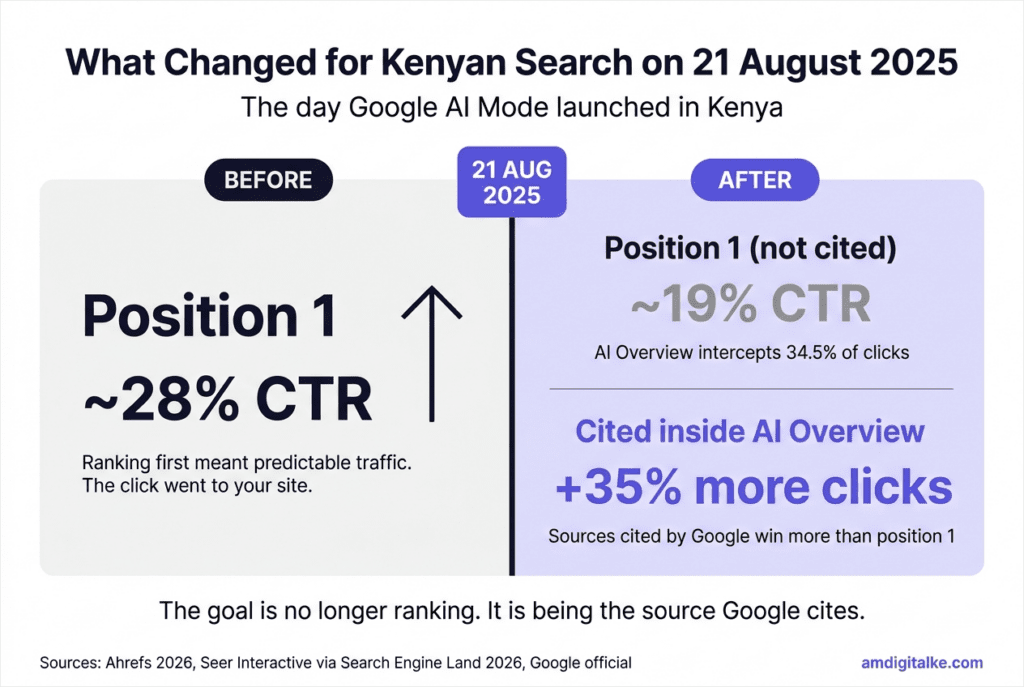
21 August 2025 is the date the rules changed for Kenyan search.
Before that date, ranking position 1 delivered a predictable volume of clicks. After that date, Google began answering questions directly on the results page. The user got the answer. They never visited a website.
Globally, 61.5% of desktop searches and 34.4% of mobile searches in 2026 end without a click [GLOBAL, SparkToro 2026].
In Kenya, where AI Mode has been live since August 2025, these patterns are now active. Position 1 still matters. But it matters differently than it did 12 months ago.
The zero-click story has a second half that most coverage misses.
Sites cited inside AI Overviews receive 35% more clicks than competitors on the same query who are not cited [GLOBAL, Seer Interactive via Search Engine Land 2026].
The goal is no longer just ranking. It is the source Google uses when it constructs its answer.
What gets cited is not a mystery. Content that answers a specific question with a specific answer. Structured data that tells Google exactly what a business is and who it serves.
Consistent business information across the web. Author credentials that are verifiable. Vague content does not get cited. Authoritative, structured, entity-clear content does.
This is what Generative Engine Optimisation (GEO) means in practice. And at the time of writing, no other SEO agency in Kenya is publishing a dedicated data source page for Kenya’s digital statistics.
AI engines default to wherever the best, most structured data lives. This page is AM Digital KE staking a claim on that ground.
SEO vs Paid Ads in Kenya
| Channel | Average CPC in Kenya | Notes | Source |
|---|---|---|---|
| Google Ads, Retail/Services | KES 15–130 | Lower competition than global markets | Nairobi Web Experts, 2026 |
| Google Ads, Real Estate | KES 130–260+ | High-intent, competitive keywords | Nairobi Web Experts, 2026 |
| Google Ads, E-commerce | KES 60–150 | Scale for peak seasons | Nairobi Web Experts, 2026 |
| Google Ads, Legal [GLOBAL] | USD 6.75–8.58 (~KES 870–1,100) | Kenya legal CPCs are lower, but high-intent | WordStream/Ryze AI, 2026 |
Kenya is still a light-competition paid search market compared to the US and UK. A legal services keyword that costs $6.75 to $8.58 per click in the US costs a fraction of that in Kenya.
That gap exists because fewer Kenyan businesses are running Google Ads. The gap is closing as more businesses discover the channel.
Kenya’s e-commerce market generated US$762 million in revenue in 2024 and is growing at 15 to 20% annually (ECDB). 70% or more of those transactions happen on mobile.
Businesses competing for that revenue are bidding against each other on Google. The CPC for “buy apartments Kilimani” or “logistics company Nairobi” reflects real commercial intent at real commercial stakes.
A high Quality Score can cut your CPC by up to 50% (Nairobi Web Experts, 2026). Fast pages, relevant ad copy, and strong alignment between the ad and the landing page are not just UX improvements.
They are direct cost reductions. Most Kenyan businesses running Google Ads are paying more per click than they need to because their landing pages are slow or generic.
The budget question comes down to time horizon. A KES 50,000 monthly SEO retainer takes three to six months to show meaningful traffic movement. It then compounds.
A KES 50,000 monthly Google Ads budget delivers leads now, and zero leads the month you pause it. Neither is wrong.
The right answer depends on how much time you have and what your cash flow can absorb.
What This Means for Kenyan Businesses
The Compliance Risk Most Digital Marketers Are Ignoring
| Case | Outcome | Source |
|---|---|---|
| Kenyan firms, total compensation payouts in 2025 | KES 30 million+ | ODPC via TechTrendsKE, 2026 |
| Unsolicited marketing messages case | KES 500,000 awarded to complainant | RecordingLaw, 2026 |
| Nairobi Hospital, patient image used in advertising without consent | KES 500,000 fine | DataGuidance |
| Brainstorm Insurance Brokers, personal data processed without consent | KES 1.01 million fine | DataGuidance |
| Maximum administrative fine under current DPA | KES 5 million or 1% of annual turnover | Kenya Data Protection Act, 2019 |
Kenya’s Data Protection Act (2019) is no longer in awareness mode. It is in enforcement mode.
The Office of the Data Protection Commissioner (ODPC) signalled in January 2026 that the period of foundational awareness is over (PwC Kenya, 2026).
The regulator is now issuing fines. Kenyan firms collectively paid over KES 30 million in data protection compensation in 2025 alone.
The cases are instructive. Nairobi Hospital was fined KES 500,000 for using a patient’s image in an advertisement without consent.
Brainstorm Insurance Brokers was fined KES 1.01 million for processing personal data without consent.
A former employee of a major service provider was awarded KES 500,000 after receiving unsolicited marketing messages despite having exercised the right to erasure.
These are not edge cases. These are standard digital marketing practices that thousands of Kenyan businesses run every week.
Unsolicited email campaigns. Cold SMS blasts. Retargeting without a proper consent mechanism. Using customer data collected for one purpose to market a different product.
Running third-party remarketing lists without a registered data processing agreement. Every one of these is an enforcement target.
The current maximum administrative fine is KES 5 million or 1% of annual turnover, whichever is lower.
The pending Data Protection (Amendment) Bill 2025 proposes changing “whichever is lower” to “whichever is higher.”
If that amendment passes, large organisations face a dramatically higher financial ceiling for violations.
The practical calculation is straightforward. A KES 300,000 digital marketing campaign that cuts corners on data consent could generate a KES 1 million fine and a reputational investigation.
Compliance is not a legal team problem. It is a marketing budget problem.
What this means operationally: get your privacy policy in order, add a compliant consent mechanism to your website, build your email list only from people who explicitly opted in, and understand what your data processing agreements with vendors like Meta and Google actually say.
Three Priorities That Come Out of This Data
Fix your GEO before your competitors figure out what it is.
Google AI Mode is live in Kenya. Structured, authoritative content with clear entity signals is what gets cited in AI Overviews.
The window to establish your business as the default source for your category is open right now. It will not stay open. Every month, more agencies understand GEO. The first movers will be hardest to displace.
Stop treating Kenya as a mobile-only market.
The 50/50 device split is real, sourced, and consistent across StatCounter’s Kenya dataset. Desktop users in Kenya skew professional, urban, and higher-income.
A website that performs beautifully on a Tecno phone but falls apart on a 1440px monitor is writing off a high-value segment of the market every day.
Build for the long game.
KES 11.76 billion flows through Kenya’s digital ad ecosystem each quarter. Most of it rents attention from Meta.
The businesses that invest in organic search now are the ones that will not need to renegotiate that rent every time Meta changes its algorithm, increases its CPMs, or makes a policy decision that impacts their account.
Frequently Asked Questions
How many internet users does Kenya have in 2026?
Kenya had 23.4 million internet users in 2026, representing an internet penetration rate of 40.5% of the total population of 57.8 million (DataReportal Digital 2026: Kenya). This marks continued growth from previous years, driven by expanding 4G infrastructure, falling smartphone prices, and the widespread adoption of mobile data subscriptions. The Communications Authority of Kenya reported 58.5 million total data subscriptions as of June 2025, a 27.3% increase year-on-year.
What is Google’s search market share in Kenya?
Google held 96.85% of Kenya’s search engine market share in March 2026 (StatCounter). Bing held 2.52%. All other search engines, including Yahoo, DuckDuckGo, and Yandex, held less than 0.5% combined. ChatGPT entered Kenya’s top five search engines for the first time in 2025 with a 0.5% share (Cloudflare via Business Daily), signalling the early emergence of AI-powered search in the Kenyan market.
When did Google AI Overviews launch in Kenya?
Google AI Mode launched in Kenya on 21 August 2025, as part of a broader rollout across South Africa, Nigeria, and other markets (Google official via iAfrica). AI Overviews had already been available in over 200 countries and territories by May 2025 (Google official). Since the August 2025 launch, Kenyan searches on qualifying queries now surface AI-generated answer summaries above traditional organic results, reducing click-through rates for some categories of search results.
How much does SEO cost in Kenya in 2026?
SEO monthly retainers in Kenya range from KES 15,000 to KES 300,000+ per month, depending on scope. Basic foundational packages sit between KES 15,000 and KES 50,000 per month. Mid-tier programmes covering technical SEO, content, and link building range from KES 50,000 to KES 150,000 per month. Comprehensive managed programmes, including strategy, content, and paid channel integration, start at KES 80,000 and can exceed KES 300,000 per month. One-time SEO audits range from KES 50,000 to KES 200,000 (Axiom Web Solution, 2026).
Is mobile search more popular than desktop in Kenya?
Not significantly. As of May 2026, desktops accounted for 49.91% of web traffic in Kenya, and mobiles accounted for 49.26%, with tablets making up the remaining 0.83% (StatCounter). This near-equal split challenges the assumption that Kenya is a pure mobile-first market. Both device types represent a roughly equal share of search and browsing traffic, meaning digital strategies and website experiences must perform well on both screen sizes, not just mobile.
Get a Free SEO Analysis
Need more data around SEO and marketing in Kenya? Check out this page on Kenya Digital Marketing Benchmarks.
Most Kenyan businesses rank on Google without a GEO strategy, a structured data layer, or an understanding of what the 50/50 device split means for their site.
We fix all three.
Book a free SEO analysis, and we will show you exactly where your business stands, what is holding back your rankings, and what to prioritise first.
AM Digital KE: Every Piece We Move is By Design amdigitalke.com